Kanekalon vs Toyokalon vs Heat-Resistant Fiber: Which Is Best for Wholesale Wigs?
Choosing the right synthetic wig fiber types is an important decision for wig wholesalers, beauty supply stores, salon owners, and private label wig brands. The fiber used in a synthetic wig influences its appearance, softness, styling flexibility, maintenance requirements, and wholesale cost.
However, comparing Kanekalon vs. Toyokalon vs. heat-resistant fiber is not always straightforward. Different suppliers may use similar marketing terms for products with very different specifications. A wig advertised as heat-friendly, for example, may not withstand the same styling temperature as another heat-resistant product.
For wholesale buyers, selecting the wrong fiber can result in customer complaints, inconsistent product quality, and unnecessary inventory costs.
In this guide, Dejun Hair explains the differences between major synthetic wig materials, how to evaluate their quality, and how to choose suitable fibers for different retail markets. You will also learn what to test before placing bulk orders and how to work with a reliable synthetic wig manufacturer.
1. What Are the Main Types of Synthetic Wig Fibers?
Synthetic wigs are manufactured from engineered fibers designed to imitate the appearance and movement of natural hair.
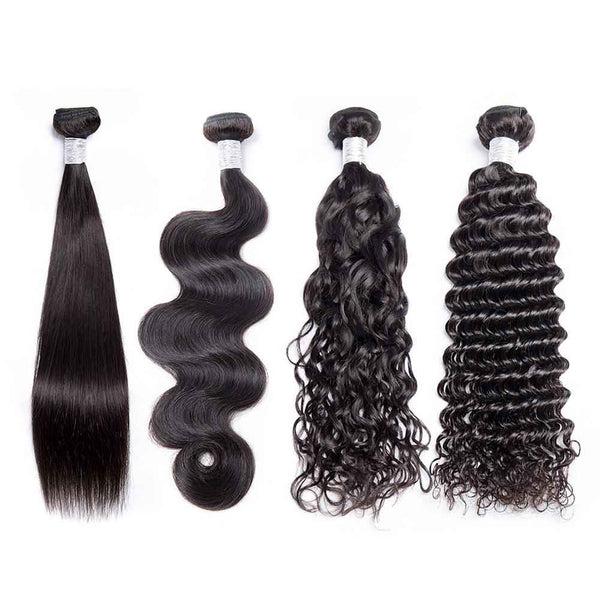
Unlike human hair, synthetic hair fibers can be produced with specific textures, colors, curl patterns, and styling characteristics.
The most commonly discussed synthetic wig fiber types include:
- Kanekalon fiber: A recognized brand associated with synthetic hair fibers, including certain modacrylic products used in hair applications.
- Toyokalon fiber: A branded synthetic hair fiber name used in the hair industry, with characteristics depending on the particular product specification.
- Heat-resistant synthetic fiber: A performance category covering fibers designed to tolerate specified styling temperatures.
- Regular synthetic fiber: A broad commercial category covering conventional fibers that may have limited heat-styling capabilities.
One important distinction is that Kanekalon and Toyokalon are fiber brand names, while heat resistance describes a material’s performance.
Therefore, these categories are not necessarily mutually exclusive. A branded fiber may also have heat-resistant properties, depending on its formulation.
For wholesale buyers, the most reliable approach is to compare actual fiber specifications rather than relying on product names alone.
2. What Is Kanekalon Fiber?
Kanekalon is a well-known synthetic fiber brand used in various hair applications, including wigs, braiding hair, and hairpieces.
Certain Kanekalon fibers are based on modacrylic technology, although individual products may have different characteristics.
Appearance and softness
Kanekalon-based hair products can provide a natural-looking appearance when the appropriate fiber grade and finishing process are used.
Depending on the product, buyers may notice:
- Soft, flexible fiber movement
- Controlled shine
- Consistent color appearance
- Good retention of manufactured hairstyles
However, softness and shine are not determined by the fiber brand alone. Fiber diameter, surface treatment, and manufacturing quality also affect the finished wig.
Styling and heat resistance
Not every Kanekalon product is designed for heated styling.
Some products are intended to maintain their original shape without regular heat treatment. Others may have specific heat-related performance characteristics.
Buyers should request the manufacturer’s permitted styling temperature and care instructions before using curling irons or straighteners.
Best wholesale applications
Kanekalon synthetic wigs may suit retailers seeking products with consistent textures and attractive presentation.
Potential applications include straight wigs, curly wigs, fashion wigs, and selected lace front styles.
For businesses targeting mid-range retail customers, the appropriate Kanekalon product can be worth evaluating alongside other high-quality synthetic wig fiber options.
3. What Is Toyokalon Fiber?
Toyokalon is another established name encountered in the synthetic hair industry.
Products sold under this name are commonly associated with synthetic hair applications, but buyers should confirm the actual fiber composition and performance of the specific material being offered.
Texture and visual appearance
Toyokalon hair products may be manufactured with different textures, finishes, and fiber dimensions.
Depending on the formulation and processing, they can offer:
- Smooth or textured surfaces
- Different levels of shine
- Flexible movement
- Consistent manufactured curl patterns
It would be misleading to claim that all Toyokalon fibers are softer, shinier, or less expensive than Kanekalon fibers. These characteristics must be evaluated at the product level.
Maintenance requirements
Toyokalon synthetic wigs generally require care appropriate to their specific fiber composition.
Excessive friction, unsuitable washing products, and unauthorized heat styling can affect their appearance.
Retailers should provide clear maintenance instructions to reduce avoidable customer complaints.
Best wholesale applications
Toyokalon synthetic wigs may be considered for fashion wigs, textured styles, everyday synthetic wigs, and other products where the manufacturer’s specifications meet the intended retail requirements.
When comparing Kanekalon vs Toyokalon hair, request equivalent wig samples with similar lengths, densities, cap constructions, and styling finishes.
This makes the comparison more meaningful.
4. What Is Heat-Resistant Synthetic Wig Fiber?
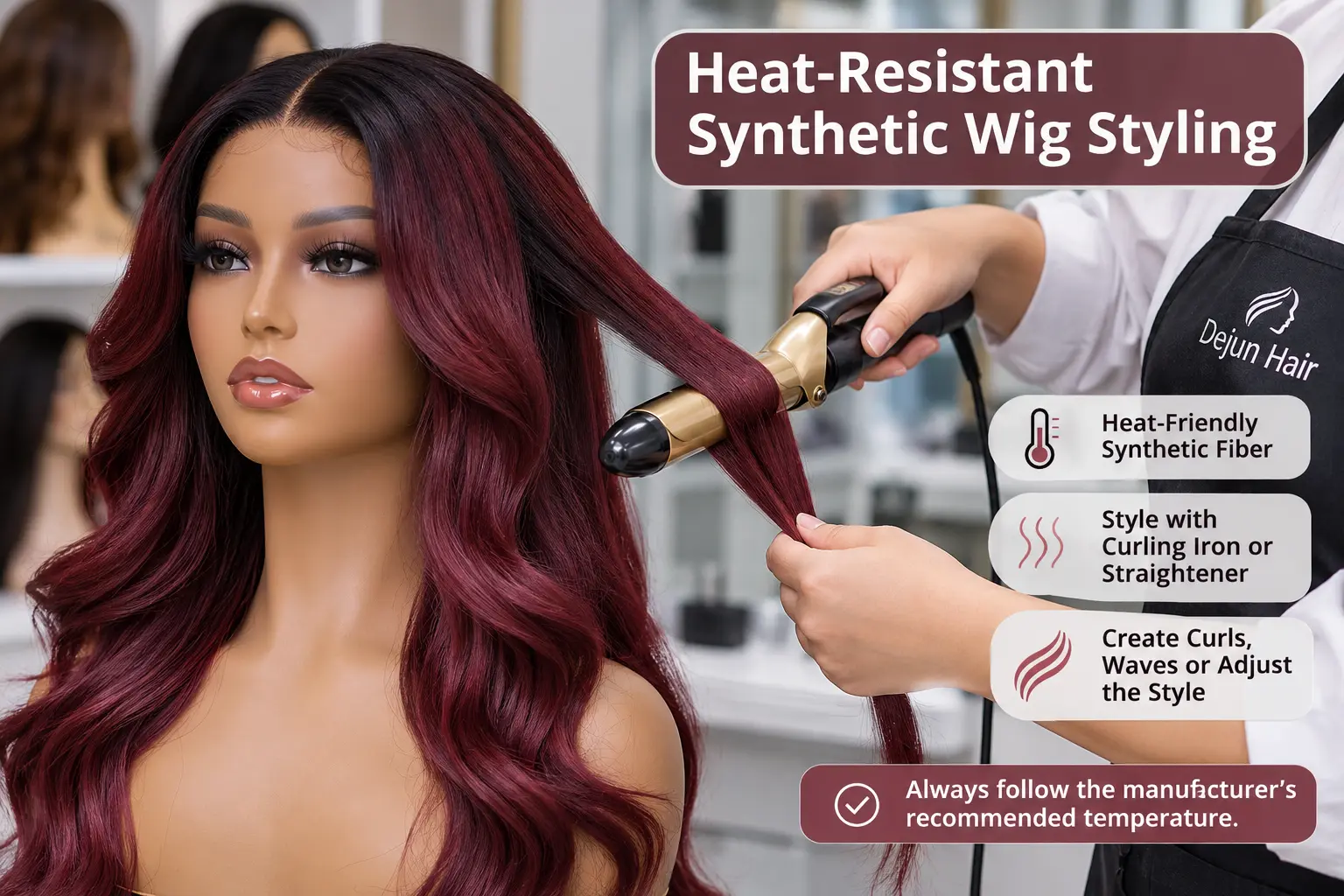
Heat-resistant synthetic wig fiber is designed to tolerate certain levels of heat exposure without unacceptable deformation.
These fibers are often marketed as heat-friendly or heat-stylable synthetic hair.
Depending on the material, they may be produced from heat-tolerant polyester-based polymers or other engineered synthetic formulations.
Why heat resistance matters
Traditional synthetic wigs are frequently designed to retain their original style.
Heat-friendly synthetic wigs provide additional styling possibilities when used within the manufacturer’s specified temperature limits.
Customers may be able to adjust straight styles, reshape curls, or modify their hairstyle without purchasing another wig.
This flexibility can be attractive to salon customers, content creators, and fashion-conscious consumers.
Understanding styling temperatures
There is no universal safe temperature for all heat-resistant synthetic wigs.
A styling temperature suitable for one fiber may permanently damage another.
Wholesale buyers should therefore confirm:
- The recommended styling temperature range
- The maximum permitted temperature
- Whether the fiber supports repeated heat styling
- Whether heat styling changes the original curl pattern
- The manufacturer’s recommended styling method
Always test a small, inconspicuous section before applying heat to the entire wig.
Best wholesale applications
Heat-resistant synthetic wigs may be especially suitable for online wig stores, beauty salons, and retailers serving customers who want more styling flexibility.
However, the additional styling capability should justify any increase in purchasing cost.
5. Kanekalon vs Toyokalon vs Heat-Resistant Fiber: Key Differences
The following synthetic wig fiber comparison summarizes the main considerations for wholesale buyers.
| Feature | Kanekalon | Toyokalon | Heat-Resistant Fiber |
|---|---|---|---|
| Classification | Fiber brand | Fiber brand | Performance category |
| Softness | Grade-dependent | Grade-dependent | Formulation-dependent |
| Shine | Depends on fiber and finish | Depends on fiber and finish | Depends on fiber and finish |
| Natural appearance | Possible with suitable grades | Possible with suitable grades | Possible with suitable grades |
| Heat styling | Product-specific | Product-specific | Supported within specified limits |
| Curl retention | Depends on processing | Depends on processing | Depends on formulation and styling |
| Tangling resistance | Construction-dependent | Construction-dependent | Construction-dependent |
| Maintenance | Follow product instructions | Follow product instructions | Follow product instructions |
| Wholesale price | Quote required | Quote required | Quote required |
| Best purchasing approach | Verify grade and authenticity | Verify grade and composition | Verify temperature performance |
Which fiber looks most natural?
No fiber name guarantees a more natural appearance.
Natural-looking synthetic wigs depend on fiber thickness, surface finish, density, color blending, and wig construction.
A well-manufactured conventional synthetic wig may look more realistic than a poorly constructed heat-resistant wig.
Which fiber tangles less?
Synthetic wig tangling is influenced by fiber surface properties, length, curl pattern, friction, and maintenance.
Long curly wigs often require more detangling than short straight wigs, regardless of the fiber brand.
For wholesale buyers, testing the finished wig is more useful than comparing raw fiber labels alone.
Which fiber offers better value?
The best synthetic fiber for wigs is the one that meets the customer’s expectations at a commercially sustainable landed cost.
Premium materials are not automatically the most profitable choice.
A moderately priced wig with consistent quality and strong local demand may generate better business results than a more expensive product with limited sales volume.
6. Which Synthetic Wig Fiber Is Best for Different Wig Styles?
Different hairstyles place different demands on synthetic hair fibers. Wholesale buyers should evaluate fiber selection together with the finished wig design.
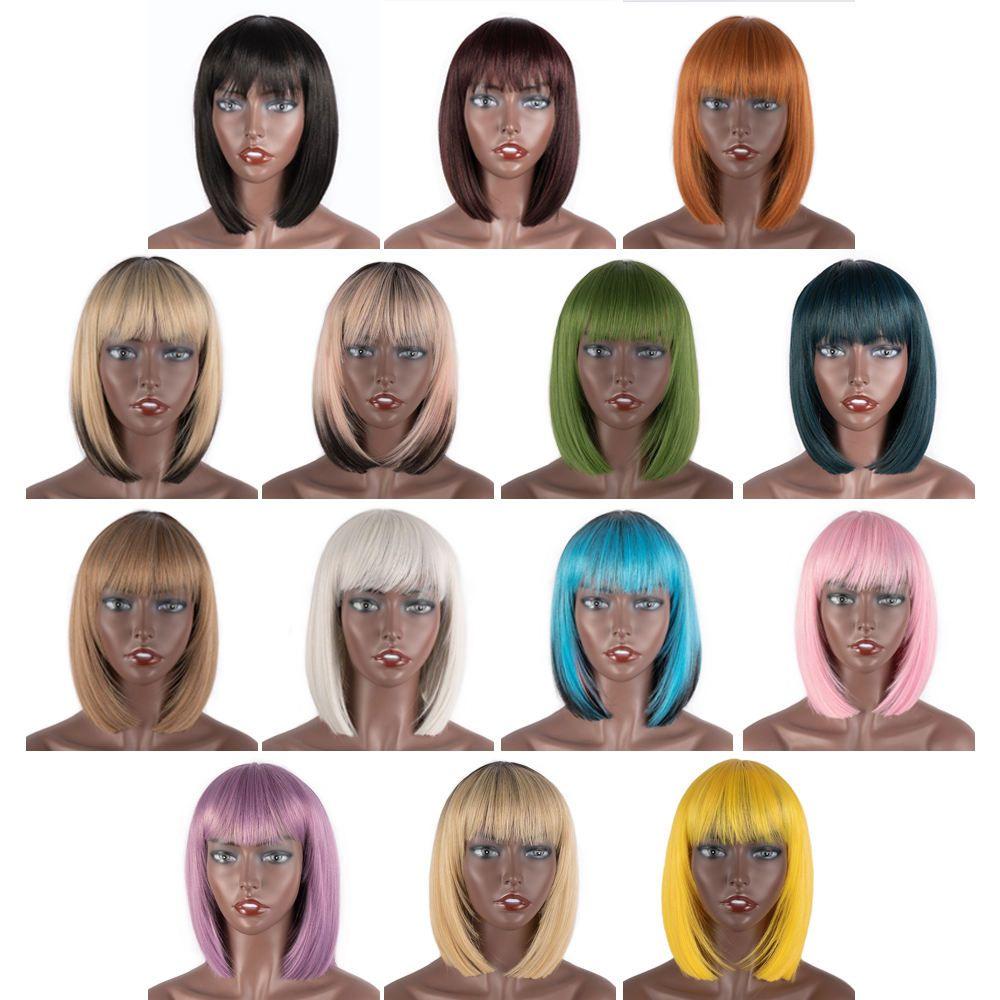
Synthetic bob wigs
Bob wigs are popular for their manageable length and versatile appearance.
For wholesale bob wigs, buyers should prioritize smooth movement, controlled shine, consistent ends, and reliable shape retention.
Heat-resistant fiber may be useful when customers want to adjust the bob’s shape. However, pre-styled conventional fibers can also be appropriate for affordable, low-maintenance collections.
Synthetic lace front wigs
Lace front wigs require attention to both fiber quality and hairline construction.
The best fiber should complement the lace design without creating excessive bulk or unnatural shine around the front.
When evaluating synthetic lace front wigs, inspect the lace material, knot appearance, hair density, and fiber movement together.
A premium fiber cannot compensate for poor hairline construction.
Curly synthetic wigs
Curly synthetic wigs should maintain their intended curl pattern while remaining reasonably manageable during normal use.
Buyers should test curl recovery after washing, friction-related tangling, and the ease of separating curls.
Long, tightly curled wigs may require more maintenance than shorter styles.
Straight synthetic wigs
Straight synthetic wigs place greater emphasis on surface smoothness and natural movement.
For longer straight wigs, friction around the shoulders and clothing can increase tangling.
Retailers should assess how the fiber behaves after repeated brushing and simulated daily wear.
For additional everyday retail options, buyers can explore wholesale short synthetic wigs in different textures and colors.
7. How to Choose Synthetic Wig Fibers for Your Wholesale Market
The best synthetic wig fiber for wholesale depends on the target customers, retail price range, and product positioning.
African beauty supply stores and distributors
African wig markets include diverse customer groups, from budget-conscious shoppers to premium fashion buyers.
Retailers may consider affordable pre-styled wigs for customers seeking convenient everyday hairstyles.
Natural black, brown, curly, straight, and bob styles can be useful starting points, but actual demand varies by country, city, and customer segment.
For wholesalers serving multiple retail outlets, mixed-style purchasing can help test demand without committing excessive inventory to one fiber type.
European and North American online retailers
Online wig buyers often evaluate products through photographs, videos, customer reviews, and styling demonstrations.
For these channels, fiber appearance under different lighting conditions is particularly important.
Heat-friendly wigs may offer an additional selling point when customers value controlled restyling.
However, retailers should avoid advertising a wig as heat-resistant without documented temperature guidance.
Private label wig brands
Private label synthetic wigs require consistent specifications across repeat orders.
Brands should define the approved fiber grade, texture, color, length, cap design, and packaging before production.
A consistent material specification helps protect brand reputation and reduces differences between product batches.
Retailers developing a broader collection can review Dejun Hair’s wholesale synthetic wigs to compare available product styles and customization possibilities. Dejun Hair
8. How to Test Synthetic Wig Fiber Quality Before Bulk Ordering
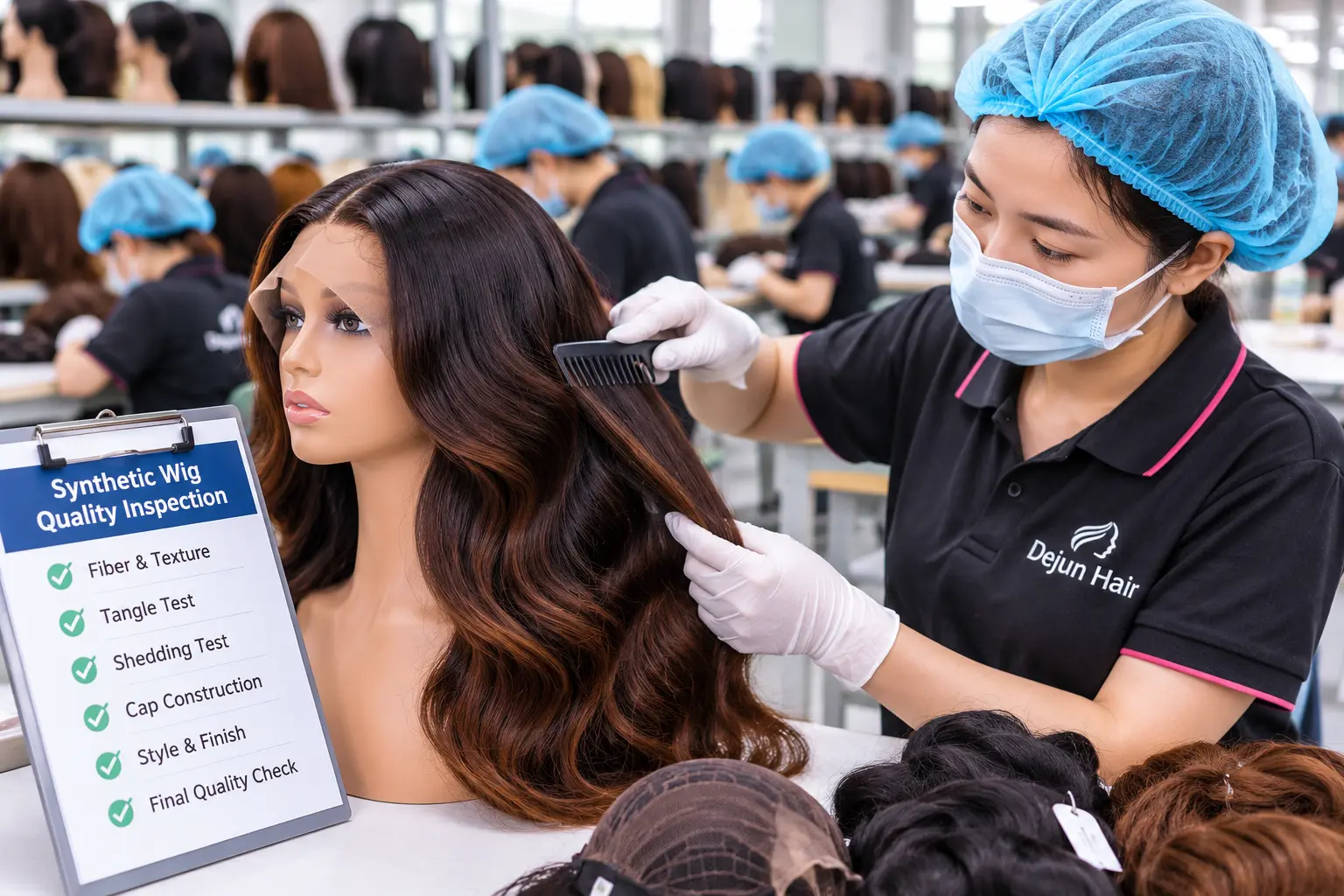
Sample testing is one of the most effective ways to reduce wholesale sourcing risks.
A reliable synthetic wig supplier should be able to explain the material specifications and provide samples for evaluation.
Step 1: Inspect fiber softness and appearance
Examine the wig under natural and indoor lighting.
Check whether the shine matches the intended retail positioning and whether the fibers feel reasonably smooth.
Compare samples with similar lengths and constructions to avoid misleading conclusions.
Step 2: Perform a controlled tangling test
Brush each sample using the same method and record resistance, visible frizz, and knot formation.
For long wigs, pay particular attention to the nape and ends.
Repeat the evaluation after controlled handling or wear simulation.
Step 3: Evaluate shedding and construction
Gently comb the wig and inspect loose fibers.
Also examine stitching, wefts, lace attachments, and cap construction.
Some loose fibers may result from manufacturing and finishing, but excessive or continuing shedding should be investigated.
Step 4: Verify heat resistance
For heat-friendly products, obtain the manufacturer’s styling instructions.
Test a small section using the approved temperature and technique.
Inspect for deformation, unwanted texture changes, melting, or loss of the original style.
Never assume that all heat-resistant synthetic hair fibers tolerate identical temperatures.
Step 5: Check washing and curl retention
Wash the sample according to the supplier’s instructions.
After drying, compare the original and final appearance.
Record changes in curl definition, smoothness, shine, and tangling.
Step 6: Confirm repeat-order consistency
Ask whether the supplier can maintain the approved material grade, color, texture, and construction for future orders.
Retain an approved reference sample and use it when inspecting production batches.
This is particularly important for OEM synthetic wigs and private label collections.
9. How Fiber Type Affects Wholesale Wig Pricing and MOQ
Synthetic wig pricing depends on more than the raw material.
Important cost factors include fiber grade, hair length, density, cap construction, manufacturing complexity, finishing, and packaging.
Material quality and processing
Specialized fibers may cost more because of their formulation, processing, or performance requirements.
However, buyers should not assume that every heat-resistant fiber is more expensive than every branded conventional fiber.
Actual supplier quotations are necessary for a fair comparison.
Wig length and density
Longer and denser wigs generally require more material and production work.
This can increase manufacturing costs even when the same fiber is used.
Cap construction
A basic machine-made cap may have a different cost structure from a lace front or other specialized construction.
Buyers should compare complete wig specifications rather than fiber prices alone.
Minimum order quantity
MOQ requirements vary according to stock availability, material sourcing, and customization.
Ready-stock products may support smaller orders or mixed styles, while custom colors, packaging, and exclusive designs may require higher quantities.
Dejun Hair supports low-MOQ and mixed-style wholesale purchasing, with customization requirements confirmed according to the order. Dejun Hair
For accurate quotations, buyers should provide the intended fiber specification, length, texture, color, cap design, packaging requirements, and estimated quantity.
Calculate the landed cost
The lowest factory price does not necessarily represent the lowest overall purchasing cost.
Wholesale buyers should consider:
Landed Cost per Wig = Product Cost + Allocated Freight + Import Duties and Taxes + Customs and Handling Costs
Testing samples and estimating landed costs before ordering helps businesses establish realistic retail margins.
10. Choosing a Reliable Synthetic Wig Manufacturer
Selecting the right manufacturer is just as important as choosing the fiber.
A reliable manufacturing partner should provide transparent specifications, consistent quality, flexible purchasing arrangements, and practical after-sales support.
Confirm manufacturing capabilities
Ask whether the supplier controls fiber processing, cap construction, styling, inspection, and packaging.
Understanding the production process helps buyers evaluate quality consistency and lead-time reliability.
Request material documentation
If a supplier claims to use a particular branded fiber, request supporting information about the fiber grade and origin.
For heat-friendly products, request temperature specifications and care instructions.
Discuss OEM and private label options
Custom manufacturing may include:
- Fiber grade and texture selection
- Wig length, density, and color
- Cap construction and sizing
- Custom logo labels and packaging
- Product sampling and specification approval
Evaluate the supplier’s communication
A dependable supplier should answer technical questions clearly and explain what can or cannot be customized.
Avoid relying exclusively on promotional claims such as “100% tangle-free” or “unlimited heat styling.”
Why work with Dejun Hair?
Dejun Hair is a wig manufacturer based in Shaoyang, Hunan, China, with more than 20 years of local manufacturing experience.
Our factory supports synthetic wigs, human hair wigs, wholesale supply, and OEM/ODM customization for overseas distributors, salons, and private label brands.
We understand that wholesale buyers need more than attractive product photographs. Consistent quality, practical MOQ arrangements, sample evaluation, and dependable communication are essential for long-term purchasing relationships.
For fiber selection, wholesale specifications, and customization requirements, buyers can contact Dejun Hair to discuss suitable products and request quotations. Dejun Hair
11. Frequently Asked Questions About Synthetic Wig Fiber Types
1. Is Kanekalon better than Toyokalon for wigs?
Neither is universally better. Kanekalon vs Toyokalon comparisons should consider the specific fiber grade, texture, appearance, heat performance, and finished wig construction. Request comparable samples before making a wholesale purchasing decision.
2. What is the best synthetic fiber for wigs?
The best synthetic wig fiber depends on the intended use. Pre-styled fibers can suit affordable everyday wigs, while verified heat-resistant materials may be preferable for customers who want styling flexibility.
3. Can Kanekalon wigs be heat styled?
Some Kanekalon products may have specific heat-related capabilities, but not all are suitable for hot styling tools. Always follow the product manufacturer’s instructions.
4. Are heat-resistant synthetic wigs better than regular synthetic wigs?
Heat-resistant wigs offer additional styling possibilities when used correctly. However, regular synthetic wigs may provide better value for customers who prefer ready-to-wear hairstyles and do not need heat styling.
5. Which synthetic wig fiber tangles the least?
Tangling depends on fiber properties, wig length, texture, construction, and maintenance. No fiber brand guarantees a tangle-free wig. Finished-product testing is the most reliable way to compare performance.
6. Can I order different synthetic wig fiber types in one wholesale shipment?
Mixed orders may be available depending on the supplier’s stock and production arrangements. Dejun Hair supports mixed-style wholesale orders, while specific fiber combinations and quantities should be confirmed before purchasing.
Conclusion: Choose the Right Synthetic Wig Fiber for Your Business
Understanding synthetic wig fiber types helps wholesalers and retailers make better sourcing decisions.
Kanekalon and Toyokalon are established fiber names, while heat-resistant synthetic fiber describes a performance category. Each option should be evaluated according to its actual specifications rather than marketing labels alone.
For wholesale success, focus on natural appearance, consistent quality, suitable styling performance, customer preferences, and total purchasing cost.
Most importantly, test samples before committing to large orders.
Looking for a reliable synthetic wig manufacturer?
Dejun Hair provides factory-direct wholesale synthetic wigs, flexible order options, OEM/ODM customization, and sample consultation for international hair businesses.
Contact Dejun Hair to request synthetic wig samples, MOQ information, and a wholesale quotation.
Dejun Hair
Direct from Chinese Wig Factories | One-Stop Wholesale Supplier of Wigs for International Trade.