How to Choose a Reliable Wholesale Human Hair Bundles Supplier: A Buyer’s Guide
For a hair wholesaler, salon owner, beauty supply store, or online hair business, choosing the right supplier is about much more than finding an attractive price. The quality of your bundles directly affects customer satisfaction, repeat purchases, product reviews, and ultimately your brand reputation.
The challenge is that two suppliers may both advertise “100% human hair” while delivering very different products. Hair quality, processing methods, bundle weight, texture consistency, shedding, lifespan, and batch-to-batch consistency can all vary.
That is why selecting a reliable wholesale human hair bundles supplier requires a structured evaluation process.
Before placing a large order, buyers should examine not only the hair itself but also the supplier’s manufacturing capability, minimum order quantity (MOQ), sample policy, customization options, quality control, production capacity, shipping support, and after-sales service.
This buyer’s guide explains the most important factors to check when sourcing human hair bundles in bulk, helping you reduce purchasing risks and build a more reliable supply chain for your hair business.
1. Start by Understanding What Type of Human Hair You Are Buying
One of the first mistakes buyers make is comparing quotations before confirming that suppliers are quoting comparable hair quality.
Terms such as “human hair,” “Remy hair,” “virgin hair,” and “raw hair” are frequently used in the market, but they should not automatically be treated as the same product grade.
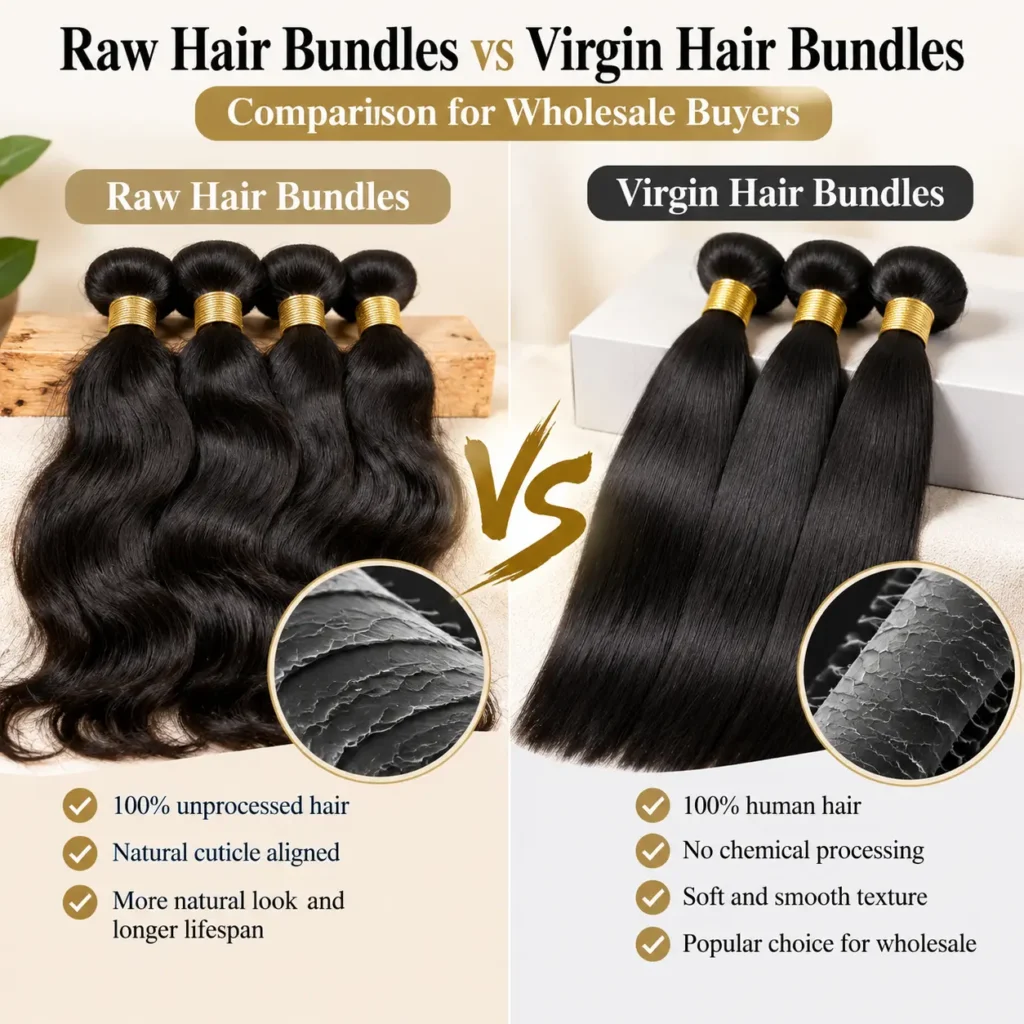
For example, virgin human hair bundles generally refer to human hair that has not undergone certain chemical treatments before manufacturing, while Remy hair usually emphasizes the alignment of hair cuticles in the same direction. Raw hair bundles are commonly marketed as minimally processed hair that retains more of its natural characteristics.
However, terminology alone is not enough.
When talking with a human hair supplier, ask specific questions:
- What type and grade of hair is being quoted?
- Has the hair been chemically processed?
- Are the cuticles aligned?
- Can the hair be bleached or dyed?
- How long should the product last with proper care?
- Will bulk production use the same hair specification as the sample?
- What tolerance is allowed for length and bundle weight?
A professional supplier should be able to explain the product specifications clearly instead of relying only on labels such as “10A,” “12A,” or “premium grade.”
For B2B buyers, measurable specifications and consistent production are usually more important than a grade name.
2. Inspect Human Hair Bundle Quality Before Buying in Bulk
Never evaluate a bulk human hair bundle supplier only from website photos, social media videos, or a price list.
Whenever possible, test samples before moving to a large commercial order.
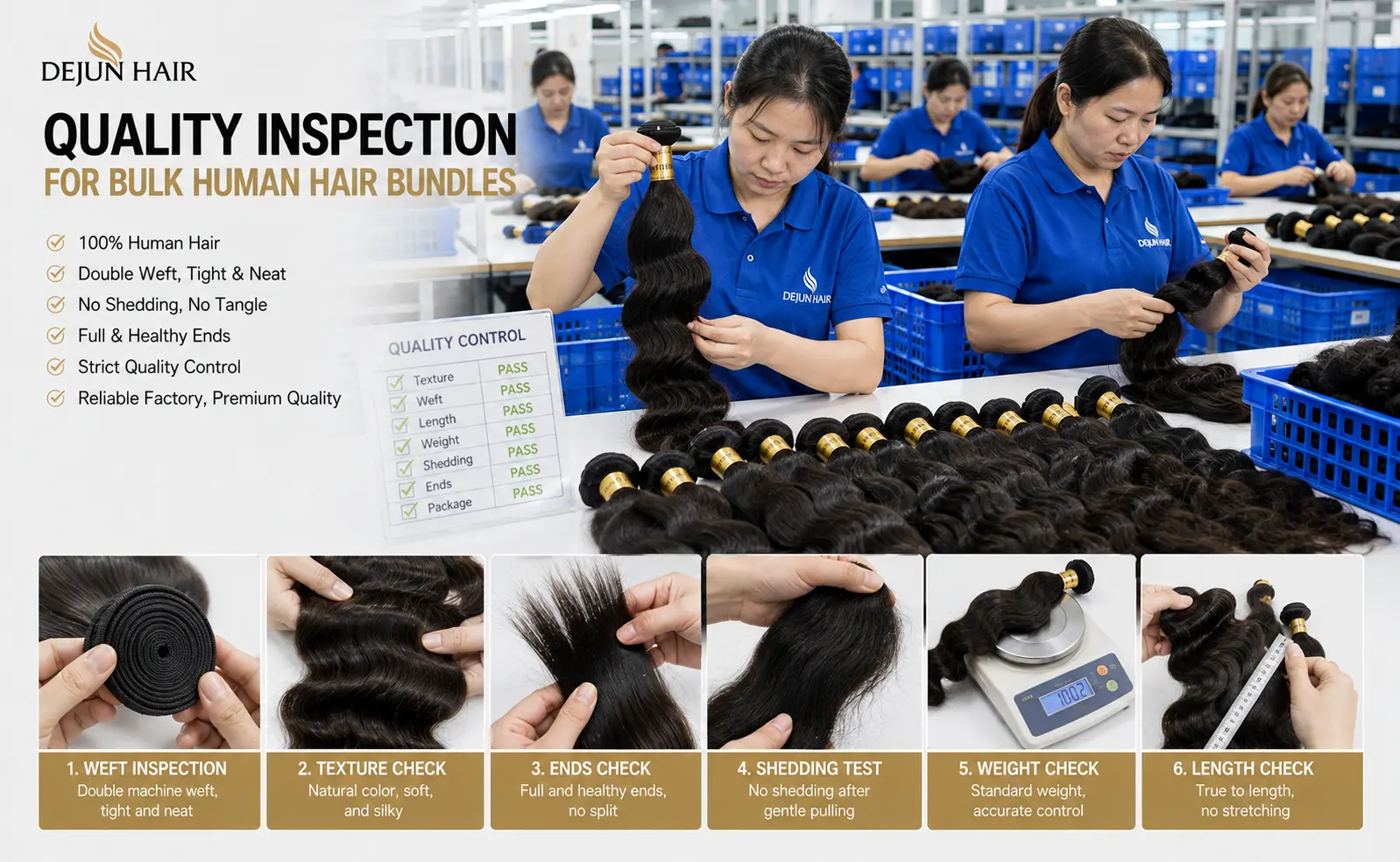
Check the Hair From Top to Ends
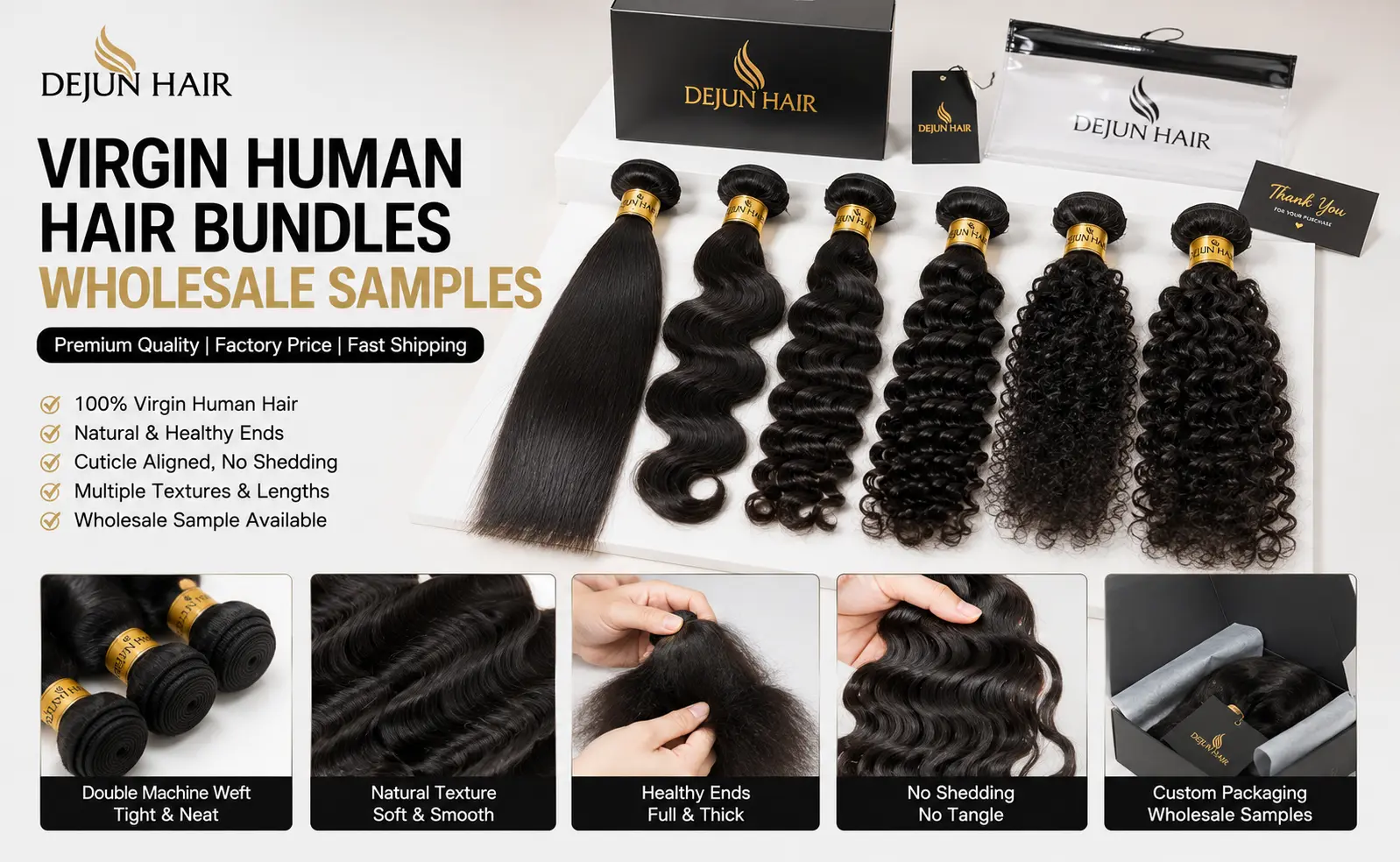
Run your fingers through the bundle several times. The hair should feel reasonably smooth and should not immediately develop excessive tangling.
Pay particular attention to the ends. Very thin, dry, or uneven ends can make a bundle appear less full once installed.
Longer bundles naturally have different weight distribution than shorter ones, so buyers should evaluate both overall weight and usable fullness rather than judging appearance alone.
Perform a Shedding Test
Gently comb or brush the sample several times and observe how much hair comes out.
A few loose strands can occur during handling, but excessive shedding may indicate poor weft construction or processing.
For wholesale buyers, shedding becomes especially important because a problem repeated across hundreds of bundles can create significant customer complaints and replacement costs.
Wash the Sample
A sample can look excellent immediately after styling at the factory. Washing gives you a better understanding of how the hair performs in normal use.
Check whether the hair:
- maintains its intended texture;
- becomes excessively tangled;
- develops an unusual smell;
- sheds heavily;
- feels dramatically different after washing.
For curly, deep-wave, loose-wave, or other textured human hair bundles, also evaluate how well the curl or wave pattern returns after washing and drying.
Test Heat and Color Performance When Relevant
If your customers commonly straighten, curl, dye, or bleach their hair, your sample testing should reflect those actual use cases.
Do not assume every product marketed as human hair will perform identically under aggressive chemical processing.
If coloring performance is important to your business, tell the supplier your target application before ordering. This allows the factory to recommend a more appropriate hair grade rather than simply quoting the cheapest option.
3. Verify Bundle Weight and Length Consistency
Bundle specifications can significantly affect your actual wholesale cost.
Suppose Supplier A offers a lower price per bundle, but the bundles are consistently lighter than Supplier B’s. The cheaper quotation may no longer represent better value.
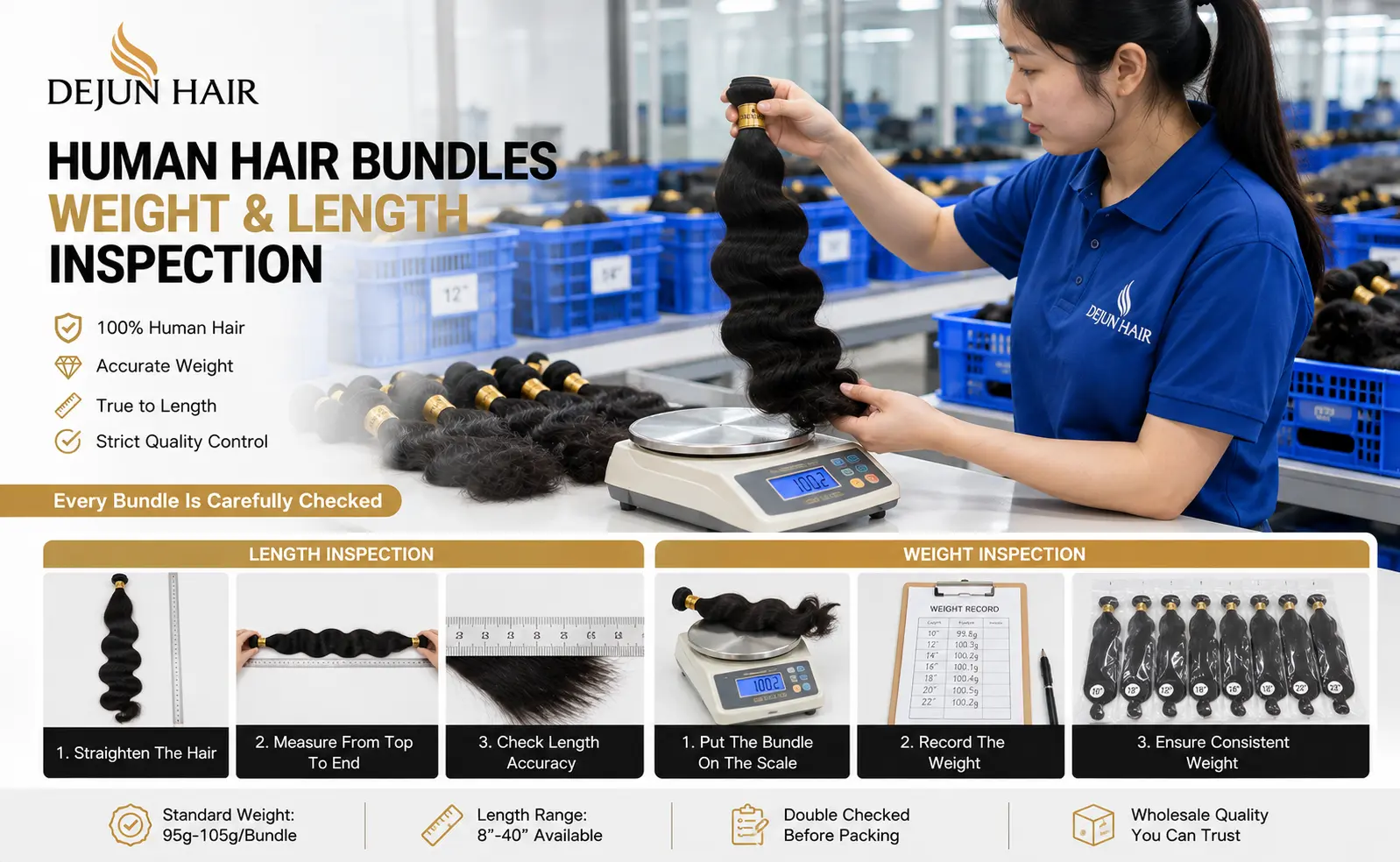
Ask your human hair bundles wholesale supplier to specify the target weight of each bundle and the acceptable production tolerance.
When receiving samples, use a scale to check the actual weight.
You should also verify length correctly. Wavy and curly hair should generally be stretched before comparing its full length with the ordered specification.
For a commercial order, consistency matters just as much as a single measurement.
A retailer selling standardized 18-inch, 20-inch, and 22-inch bundles needs customers to receive a predictable product each time they reorder. Large differences between batches can quickly damage trust in the retailer’s brand.
This is why established wholesale hair vendors should have clear specifications and inspection procedures for length, weight, texture, and appearance.
4. Determine Whether the Supplier Has Real Manufacturing Capability
Not every company presenting itself as a manufacturer controls production directly.
Trading companies can still be useful in some supply chains, but buyers looking for OEM customization, stable bulk production, or long-term pricing should understand who actually manufactures their products.
When evaluating a human hair manufacturer, ask about:
- factory location;
- years in production;
- processing facilities;
- production lines;
- quality-control procedures;
- warehouse capacity;
- ready-stock availability;
- daily or monthly output;
- experience with large export orders.
Photos and videos of production can provide additional information, but serious buyers may also request a live video inspection or arrange a factory visit where practical.
Direct manufacturing capability becomes particularly important as your business grows. If a best-selling product suddenly requires a much larger reorder, you need to know whether your supplier can increase production without sacrificing consistency.
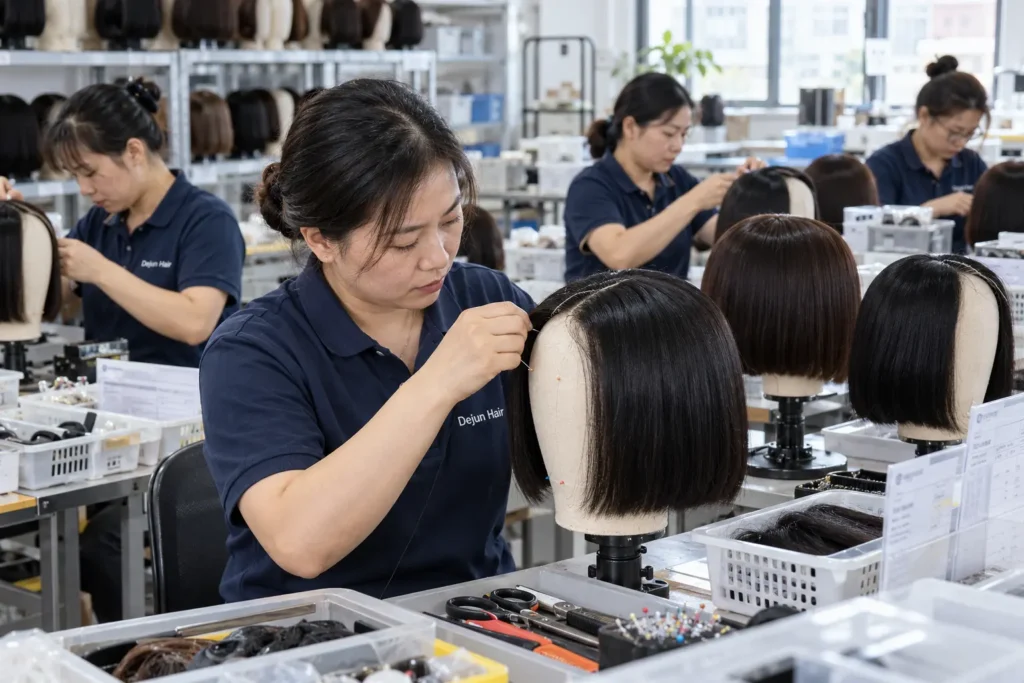
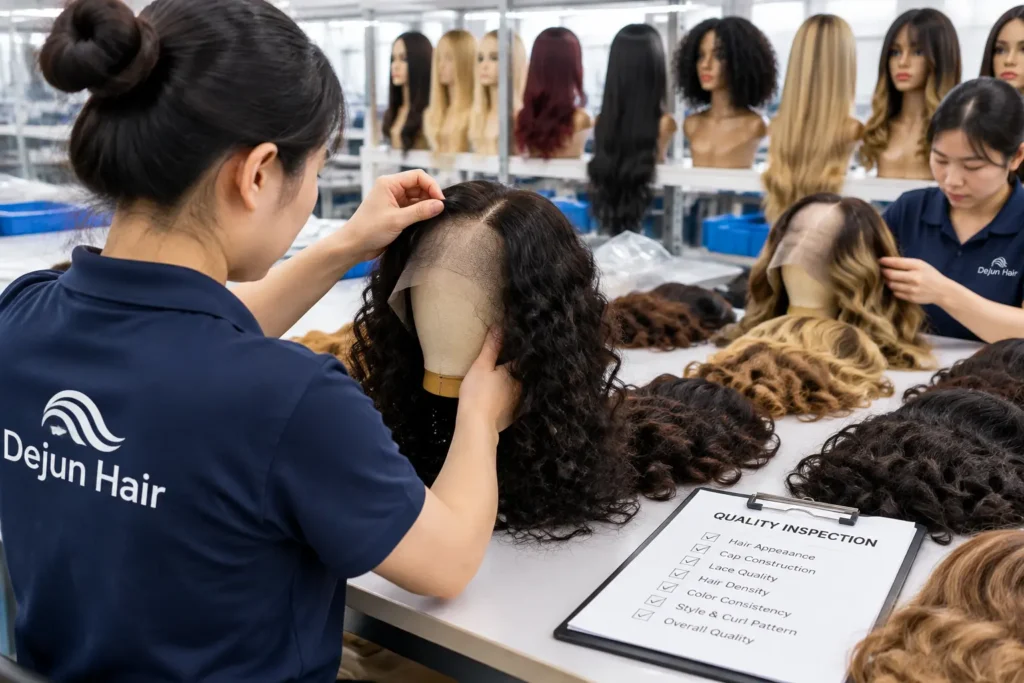
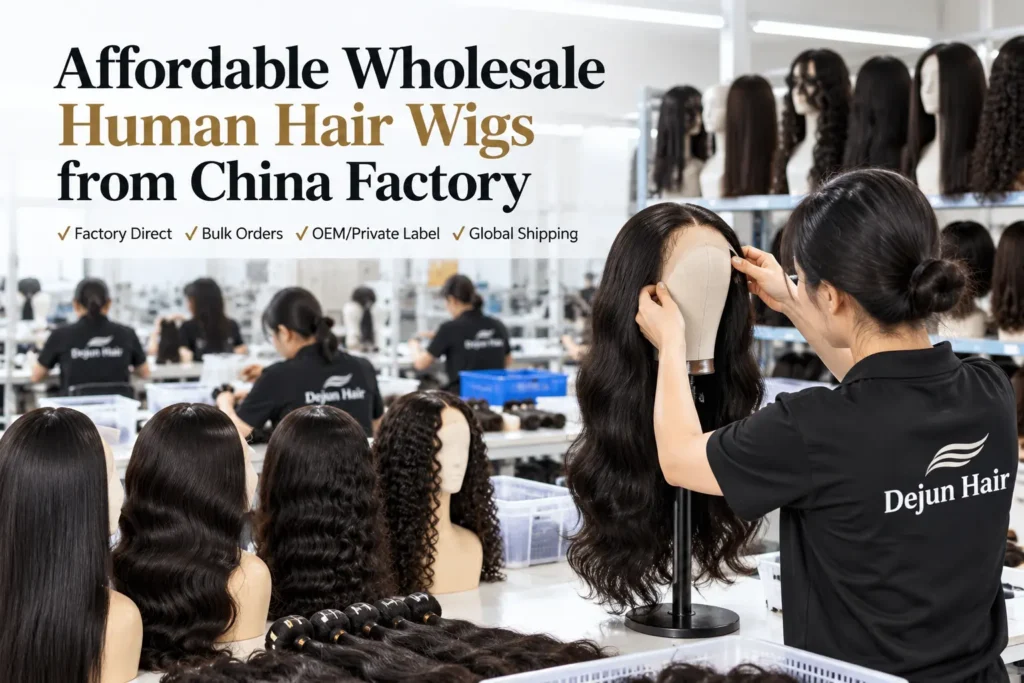
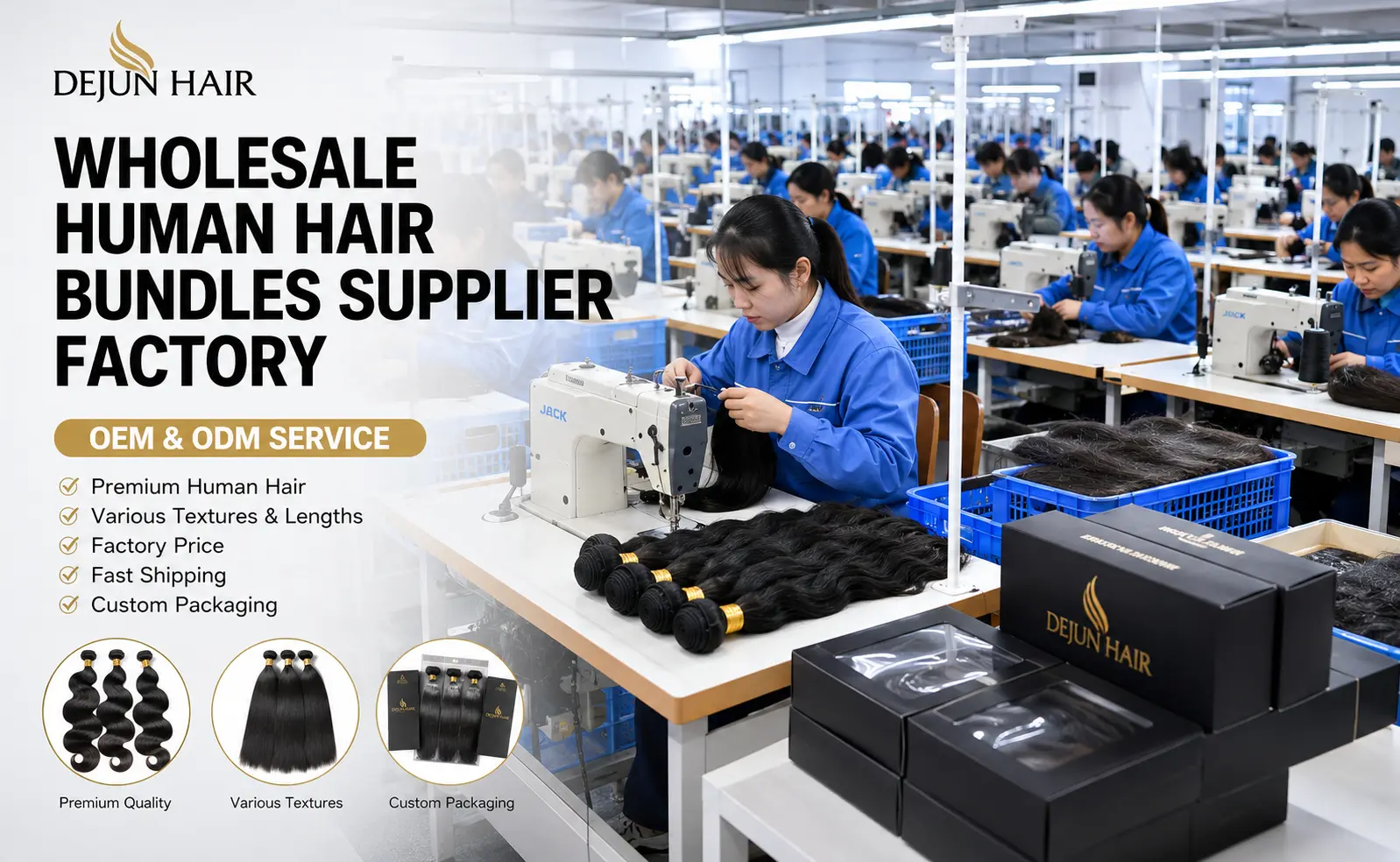
At Dejun Hair, for example, our production operations in Shaoyang, Hunan, cover multiple stages, including hair processing, cap and lace work for wig products, styling, inspection, and warehousing. Having production and quality control within the supply chain allows specifications to be monitored more closely from order confirmation through shipment.
For buyers, the key principle is simple: verify production capability before your order volume becomes large enough that it becomes a problem.
5. Compare MOQ and Mixed-Order Flexibility
MOQ is especially important for new distributors, salon owners, and entrepreneurs testing a new market.
A high MOQ may give you a better unit price, but it can also force you to invest too much capital in untested products.
A flexible wholesale human hair bundles supplier should be able to explain different order options for ready-stock and customized products.
Questions worth asking include:
- What is the MOQ for stock bundles?
- Can different lengths be mixed in one order?
- Can different textures be combined?
- Can I mix colors?
- What is the MOQ for custom packaging?
- Is there a different MOQ for OEM products?
- Can I start with samples or a small trial order?
For a new hair business, a safer sourcing path is often:
Sample testing → small mixed order → sales validation → repeat order → larger bulk purchase
This approach allows you to test both the product and the supplier before committing significant working capital.
For example, instead of buying a large quantity of only 24-inch body-wave bundles, a retailer might initially test several popular lengths and textures. Sales data from that trial order can then guide the next purchase.
At Dejun Hair, we support flexible sourcing arrangements for different buyer types, including stock wholesale and negotiated customization requirements, because a growing salon does not necessarily need the same purchasing structure as a large regional distributor.

6. Compare Wholesale Prices Based on Specifications, Not Just Numbers
Price is important, but the lowest quotation is not automatically the lowest-cost purchase.
When comparing hair bundles wholesale offers, make sure each quotation is based on equivalent specifications.
Compare:
Hair type + processing level + length + bundle weight + texture + quality consistency + packaging + MOQ + customization + shipping terms
If one quotation is significantly lower than the others, ask why.
The difference may result from hair grade, bundle weight, processing, packaging, production specifications, or other factors.
This does not mean inexpensive products are necessarily poor quality. Different markets need different price points. A beauty supply distributor serving a price-sensitive market may require a different product range from a premium salon selling high-end virgin human hair bundles.
The goal is therefore not simply to find the cheapest bulk hair supplier. It is to find the supplier that can consistently produce the right quality at the price point your target customers will accept.
A good supplier should help you match product specifications to your market instead of automatically recommending the most expensive grade.
7. Evaluate the Supplier’s Product Range
A broader product range can simplify purchasing as your business grows.
You may begin with straight or body-wave bundles and later need closures, frontals, colored hair, curly textures, wigs, or other wholesale hair products.
Working with a supplier that covers several related categories can reduce the complexity of managing multiple factories.
For bundle buyers, useful product categories may include straight human hair bundles, body wave bundles, deep wave human hair bundles, loose wave bundles, curly bundles, and kinky straight bundles.
Many salons and retailers also prefer complete combinations such as human hair bundles with closure, because matching bundles and closures from the same supplier can help maintain more consistent texture, color, and hair quality.
Businesses selling multiple textures can also use a supplier’s broader range to build mixed orders and test emerging styles without immediately adding another vendor.
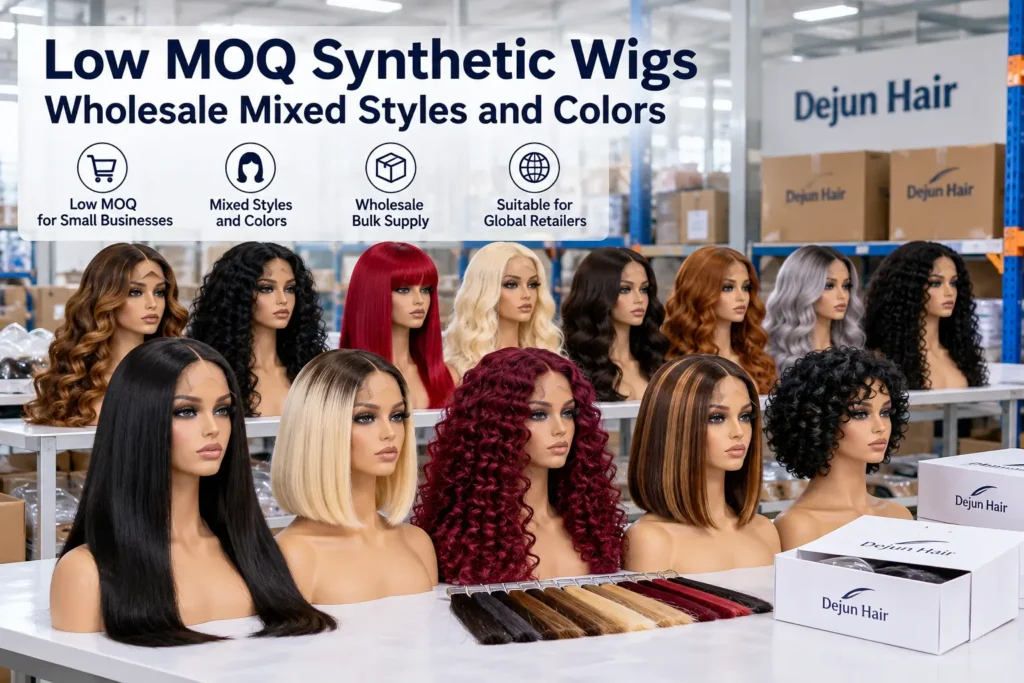
For buyers expanding from bundles into ready-to-sell wig products, sourcing complementary wholesale human hair wigs from the same manufacturing supply chain may also simplify product development and purchasing.
8. Check OEM and Private-Label Capabilities
If you are building your own hair brand, product quality is only part of the sourcing equation.
Your supplier may also need to support brand development.
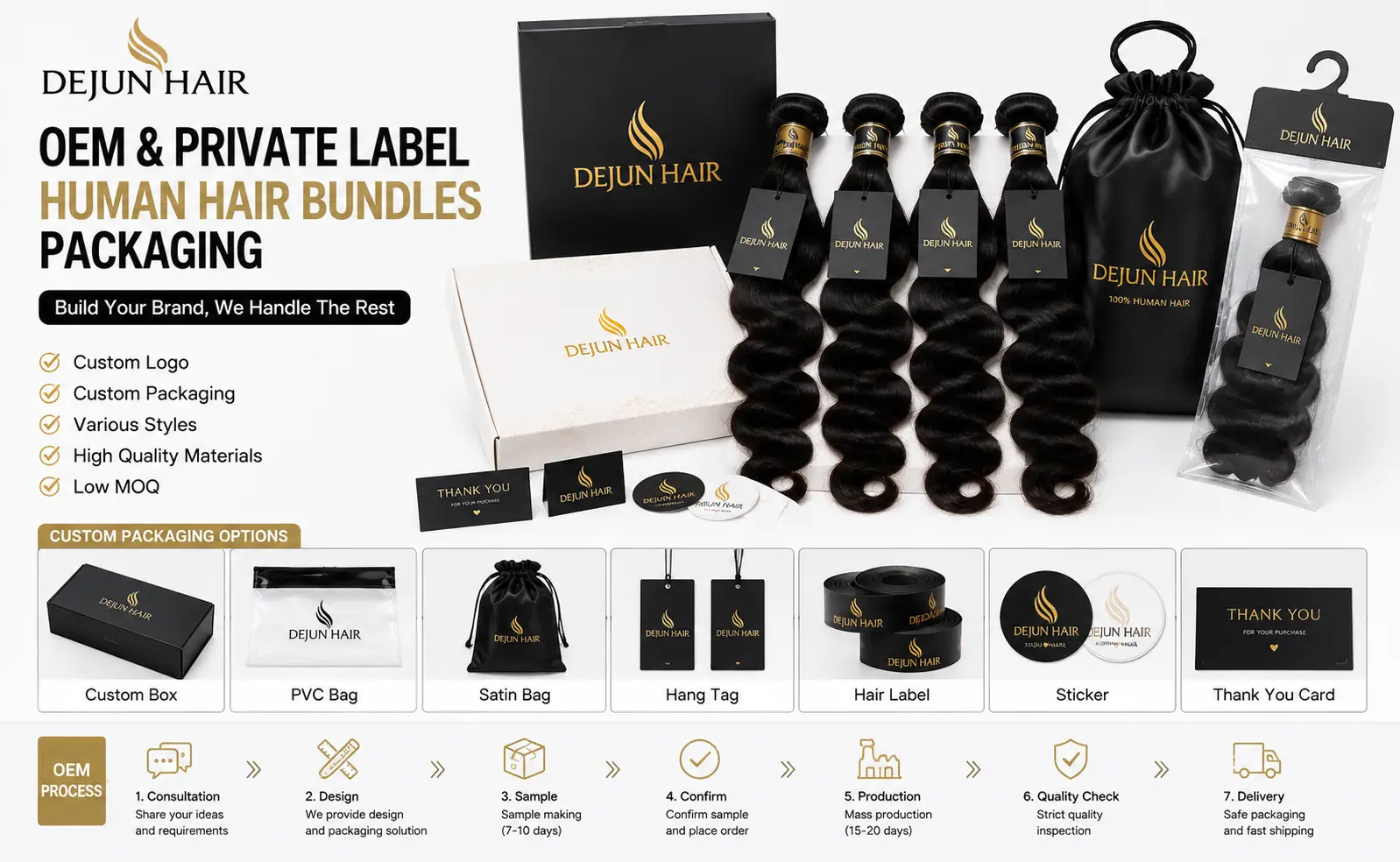
Common OEM human hair bundle services include:
- custom packaging;
- logo printing;
- branded hang tags;
- customized labels;
- branded bags or boxes;
- custom colors;
- custom textures;
- customized product specifications.
Before placing a private-label order, confirm the MOQ, artwork requirements, sample process, packaging cost, and lead time.
Do not leave packaging details until the end of production. A small mistake in logo placement, color, dimensions, or label information can affect an entire shipment.
An experienced OEM supplier should confirm customization specifications before mass production and, where appropriate, provide a pre-production sample or proof for approval.
For growing brands, private label hair bundles can create a more professional customer experience and reduce dependence on generic products that competitors can easily replicate.
9. Evaluate Production Capacity and Lead Times
Imagine that one of your bundle combinations becomes a bestseller and you suddenly need three times your normal quantity.
Can your supplier deliver?
Production capacity is often overlooked during initial sourcing because a small sample order is easy to fulfill. The real test comes when volume increases.
Ask potential suppliers about:
- normal production lead time;
- peak-season lead time;
- ready-stock quantities;
- capacity for repeat orders;
- large-volume order capability;
- customized-order lead times;
- packaging lead times.
Do not rely only on promises such as “fast delivery.”
Ask for realistic timelines based on your actual specifications and quantity.
A reliable human hair supplier for a hair business should also communicate early when a custom process or large order requires additional production time.
Predictability is more valuable than an unrealistic delivery promise that cannot be met.
10. Understand Shipping and Export Support
International B2B sourcing does not end when production is finished.
Shipping costs, documentation, transit time, customs procedures, and logistics reliability can all influence your final landed cost.
When considering where to buy human hair bundles wholesale, ask whether the supplier has experience shipping to your country or region.
Useful questions include:
- Which shipping methods are available?
- What is the estimated transit time?
- Is air freight available?
- Can larger orders be shipped by sea?
- What export documents can the supplier provide?
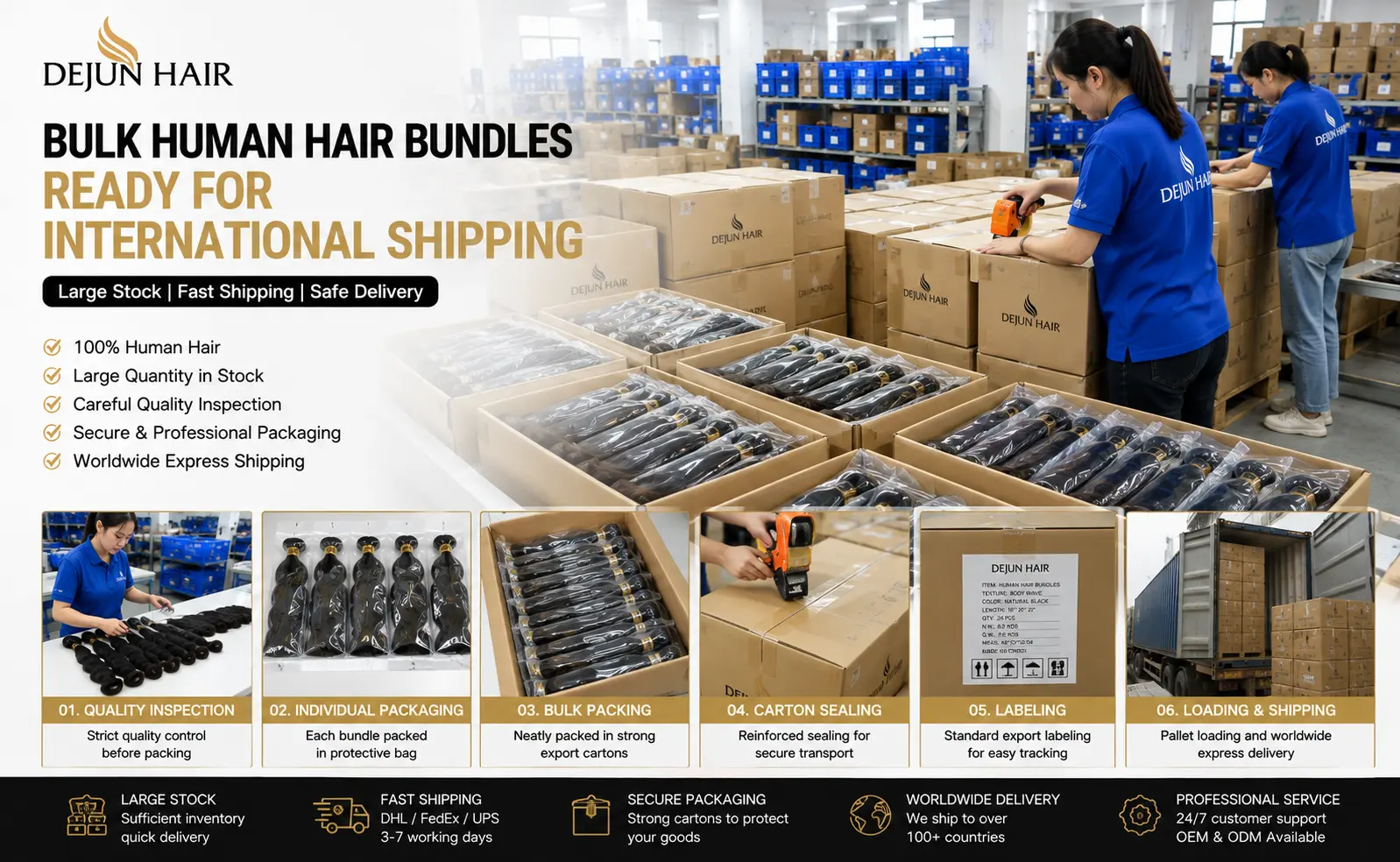
- How is the shipment packed?
- Can the supplier work with your own freight forwarder?
Buyers in African, European, and North American markets may have different logistics requirements. A supplier with export experience can help you prepare appropriate commercial documentation and compare available shipping routes.
Dejun Hair has worked with overseas B2B buyers across different markets, so logistics planning is treated as part of the sourcing process rather than an afterthought.
However, buyers should still confirm their local import requirements and total landed cost before finalizing a large order.
11. Examine the Supplier’s Quality-Control Process
Receiving one excellent sample does not guarantee that your next 500 bundles will be of the same quality.
That is why batch consistency should be one of your most important supplier-selection criteria.
Ask what happens during quality inspection before shipment.
Depending on the product specification, a factory may inspect factors such as:
- hair appearance;
- texture consistency;
- smoothness;
- shedding;
- bundle construction;
- length;
- weight;
- color;
- quantity;
- packaging.
At Dejun Hair, products go through multiple quality checks before shipment. The objective is not simply to make one good sample but to reduce variation when buyers move from trial orders to repeat and larger-volume orders.
This distinction matters for wholesalers.
A retail customer may judge one bundle. A distributor must manage the quality of hundreds or thousands of units over multiple orders.
For that reason, repeatable quality is one of the strongest indicators of a reliable wholesale supplier.
12. Test the Supplier With Samples and a Trial Order
Sample testing is one of the simplest ways to reduce sourcing risk.
However, buyers should not stop after approving one sample.
A more practical supplier evaluation has two stages.
Stage 1: Sample Evaluation
Test:
- texture;
- softness;
- shedding;
- tangling;
- length;
- weight;
- washing performance;
- styling performance;
- color or bleaching performance when required.
Stage 2: Small Commercial Trial
After approving samples, place a manageable wholesale order containing the products you are most likely to sell.
This tests something a single sample cannot: production consistency.
Compare the commercial order with the approved sample.
Are the texture, color, weight, length, and overall quality consistent?
Also evaluate the supplier itself:
Was communication clear? Was production completed on time? Was packaging correct? Did the quantity match the order? Were shipping documents prepared properly?
For businesses searching for the best wholesale human hair bundles supplier, these operational details are just as important as the initial hair sample.
13. Evaluate Communication and After-Sales Support
A long-term supplier should solve problems, not disappear after payment.
Pay attention to communication throughout the sourcing process.
A professional supplier should be willing to clarify specifications, explain product differences, discuss MOQ, provide production updates, and respond to reasonable quality concerns.
Before ordering, ask about the policy for verified manufacturing defects.
You should understand:
- how problems should be documented;
- how quickly claims should be reported;
- what qualifies as a manufacturing defect;
- whether replacement or another solution is available.
Technical support can also be valuable.
Hair-care instructions, washing recommendations, storage guidance, and styling advice can help wholesalers and salons educate their own customers and reduce avoidable complaints.
This is particularly important for first-time importers and smaller hair businesses that may not yet have an experienced internal sourcing team.
14. Watch for Common Supplier Red Flags
A professional website or attractive social media account does not automatically mean a supplier is reliable.
Be cautious when you notice several of the following warning signs:
- Product specifications are vague or constantly changing.
- The supplier cannot clearly explain the difference between hair grades.
- Bundle weights or lengths are not defined.
- Prices are dramatically lower without a reasonable explanation.
- Sample testing is discouraged.
- Production information cannot be provided.
- Quotations change repeatedly without changes to specifications.
- Customization details are not confirmed in writing.
- Delivery promises appear unrealistic.
- There is no clear process for dealing with defective products.
No supplier will be perfect in every situation. The objective is to determine whether the company communicates transparently and has systems for managing quality, production, and problems when they occur.
15. Questions to Ask a Wholesale Human Hair Bundles Supplier
Before selecting a supplier, prepare a consistent set of questions so you can compare vendors fairly.
Ask:
- What type of human hair do you supply?
- Do you offer Remy, virgin, or raw hair bundles?
- Has the hair been chemically processed?
- What is the standard weight per bundle?
- What lengths and textures are available?
- Can I order samples before purchasing in bulk?
- What is your MOQ for stock products?
- Can I mix lengths, textures, or colors?
- What is the MOQ for OEM or private-label orders?
- Can you customize packaging and hang tags?
- What is the normal production lead time?
- How do you inspect hair before shipment?
- Can you handle larger repeat orders?
- What shipping methods do you offer?
- How do you handle verified manufacturing defects?
The quality of the supplier’s answers can tell you a great deal.
Experienced human hair vendors should be able to answer most sourcing questions clearly and explain when requirements depend on product type, order volume, or customization.
16. Why Factory-Direct Sourcing Can Benefit Hair Businesses
For buyers who need repeat orders, customization, or larger quantities, working directly with a manufacturer can offer several advantages.
First, there are fewer layers between the buyer and production team. This can make it easier to communicate specifications and resolve production questions.
Second, factory-direct sourcing may provide greater flexibility for MOQ, mixed orders, custom specifications, and private-label projects.
Third, buyers can discuss pricing based on actual production requirements and order volume rather than relying entirely on reseller inventory.
Most importantly, direct manufacturing relationships can become more valuable as your business scales.
Dejun Hair has operated as a hair manufacturing business in Shaoyang, Hunan for approximately 20 years, supplying both human-hair and synthetic-hair product categories. Our model supports ready-stock wholesale as well as OEM/ODM requirements for overseas buyers ranging from smaller salons to larger distributors.
For buyers, however, the principle applies regardless of which factory you choose: look for a supplier that can grow with your business rather than simply complete your first order.
Conclusion: Choose Consistency Over the Cheapest First Order
Finding a reliable wholesale human hair bundles supplier requires more than comparing price lists.
Start by defining exactly what type of hair your market needs. Then test samples, verify bundle weight and length, examine manufacturing capability, compare MOQ policies, review OEM options, and understand production and shipping capacity.
Most importantly, evaluate consistency.
The best supplier relationship is not necessarily the one that gives you the lowest price on your first order. It is the one that can repeatedly deliver the agreed quality, specifications, quantities, packaging, and lead time as your business grows.
For new buyers, a sensible sourcing strategy is simple:
Test samples → place a mixed trial order → evaluate consistency → scale successful products.
If you are sourcing bulk human hair bundles, virgin hair products, or private-label hair products for your wholesale, salon, or online business, Dejun Hair can help you evaluate suitable specifications, MOQ options, packaging requirements, and shipping solutions.
Contact Dejun Hair to request human hair bundle samples, discuss your target specifications, or get a factory-direct wholesale quotation.
Frequently Asked Questions
How do I find a reliable wholesale human hair bundles supplier?
Evaluate more than price. Check hair quality, bundle weight, manufacturing capability, MOQ, sample availability, quality-control procedures, customization options, production capacity, shipping experience, and after-sales support. Always test samples before committing to a large order.
How can I check human hair bundle quality before buying wholesale?
Check softness, texture consistency, ends, shedding, tangling, length, and bundle weight. Wash the sample and test styling performance. If your customers dye or bleach hair, request a suitable hair grade and conduct the relevant color test before bulk ordering.
What is the MOQ for wholesale human hair bundles?
MOQ varies according to the supplier, product, inventory, and customization requirements. Ready-stock bundles often allow more flexible quantities, while custom colors, specifications, or private-label packaging may require higher MOQs. Confirm the MOQ for both stock and OEM orders before purchasing.
What is the difference between raw hair and virgin human hair bundles?
The terms are used differently across the market. Raw hair is generally marketed as minimally processed hair that retains more natural characteristics, while virgin hair generally refers to human hair without certain previous chemical treatments. Because definitions can vary between suppliers, buyers should verify actual specifications and test samples rather than relying only on product labels.
Can I mix different lengths and textures in a wholesale order?
Many manufacturers allow mixed orders, especially for ready-stock products, although policies vary. This can be useful for salons, distributors, and new businesses because it allows buyers to test several lengths and textures without investing heavily in one SKU.
Can human hair bundles be customized with my brand?
Yes. Manufacturers with OEM/private-label capabilities may offer customized packaging, logos, hang tags, labels, colors, textures, and other specifications. MOQ and lead time normally depend on the level of customization.
Should I order samples before buying human hair bundles in bulk?
Yes. Sample testing helps you evaluate hair quality, shedding, tangling, weight, length, washing performance, and styling performance before committing to a larger purchase. After sample approval, a small commercial trial order is also recommended to evaluate batch consistency.
Google official and wholesale wig factory industry reference links:

Dejun Hair
Direct from Chinese Wig Factories | One-Stop Wholesale Supplier of Wigs for International Trade.