How Much Do Wholesale Synthetic Wigs Cost? Pricing, MOQ & Profit Guide
If you are planning to buy wholesale synthetic wigs, price is probably one of the first questions you ask. But for retailers, beauty supply stores, salon owners, and online wig sellers, simply comparing the lowest unit price can lead to expensive purchasing mistakes.
The cost of synthetic wigs can vary significantly depending on fiber quality, length, density, cap construction, lace design, color, order quantity, packaging, and customization. A basic machine-made synthetic wig and a premium heat-resistant synthetic lace front wig may both be labeled “synthetic wigs,” but they are very different products from a sourcing and resale perspective.
MOQ matters as well. A small mixed order may help you test demand with less inventory risk, while a larger synthetic wigs bulk order may offer a better unit cost. Your real purchasing decision should therefore consider not only the supplier’s quotation, but also landed cost, product quality, expected retail price, inventory turnover, and after-sales risk.
This guide explains wholesale synthetic wigs prices, the factors behind supplier quotations, how MOQ affects purchasing costs, and how to calculate a realistic margin before placing a bulk order.
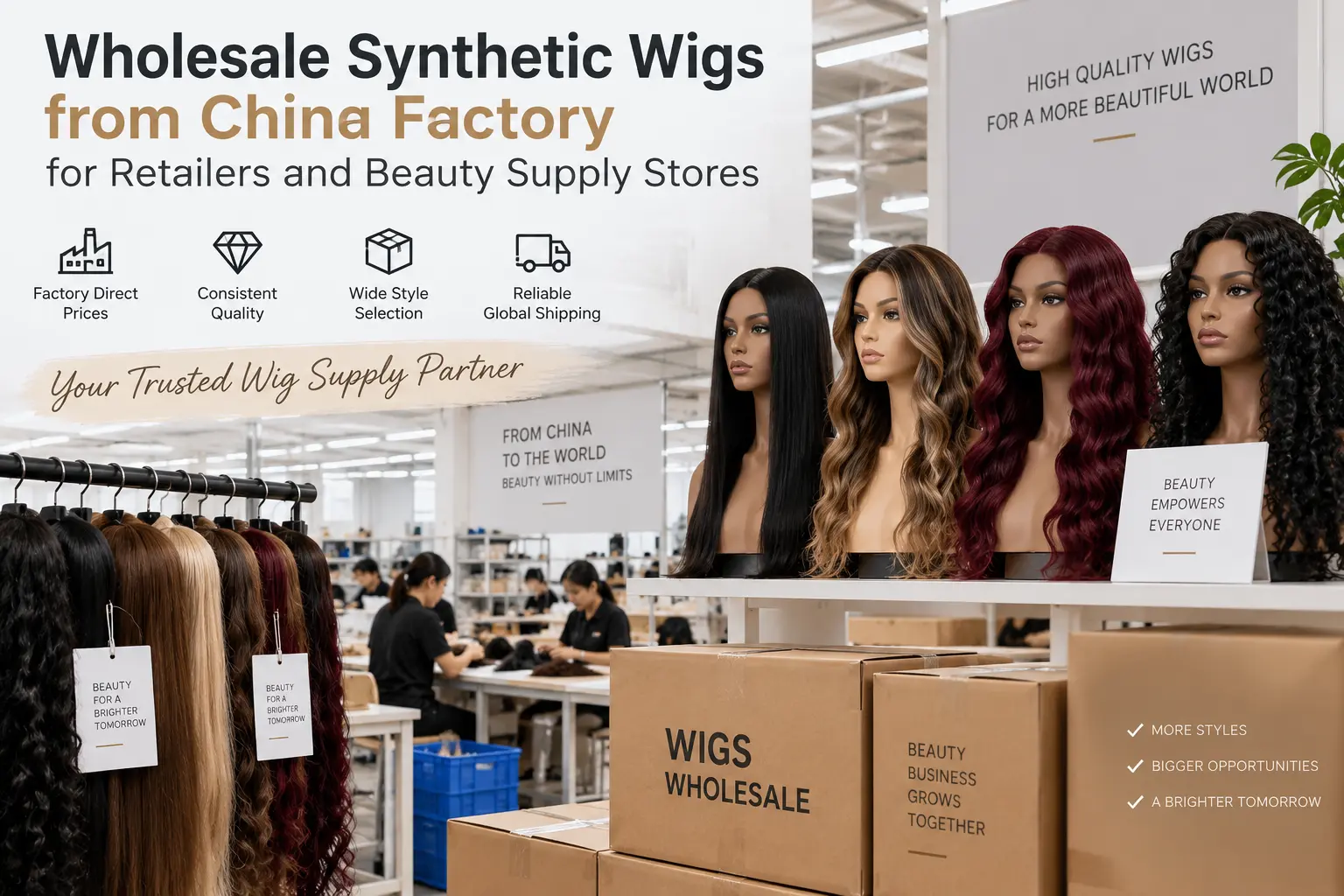
How Much Do Wholesale Synthetic Wigs Cost?
There is no single standard synthetic wigs wholesale price that applies to every product.
For wholesale buyers, synthetic wigs generally fall into several pricing levels depending on construction and specifications:
| Synthetic Wig Category | Relative Wholesale Cost | Main Cost Drivers | Suitable Buyers |
|---|---|---|---|
| Basic machine-made synthetic wigs | $ | Standard fiber, simple cap, basic styling | Budget retailers and distributors |
| Short synthetic wigs | $–$$ | Specifications, packaging, logo, and MOQ | Beauty stores, salons and online sellers |
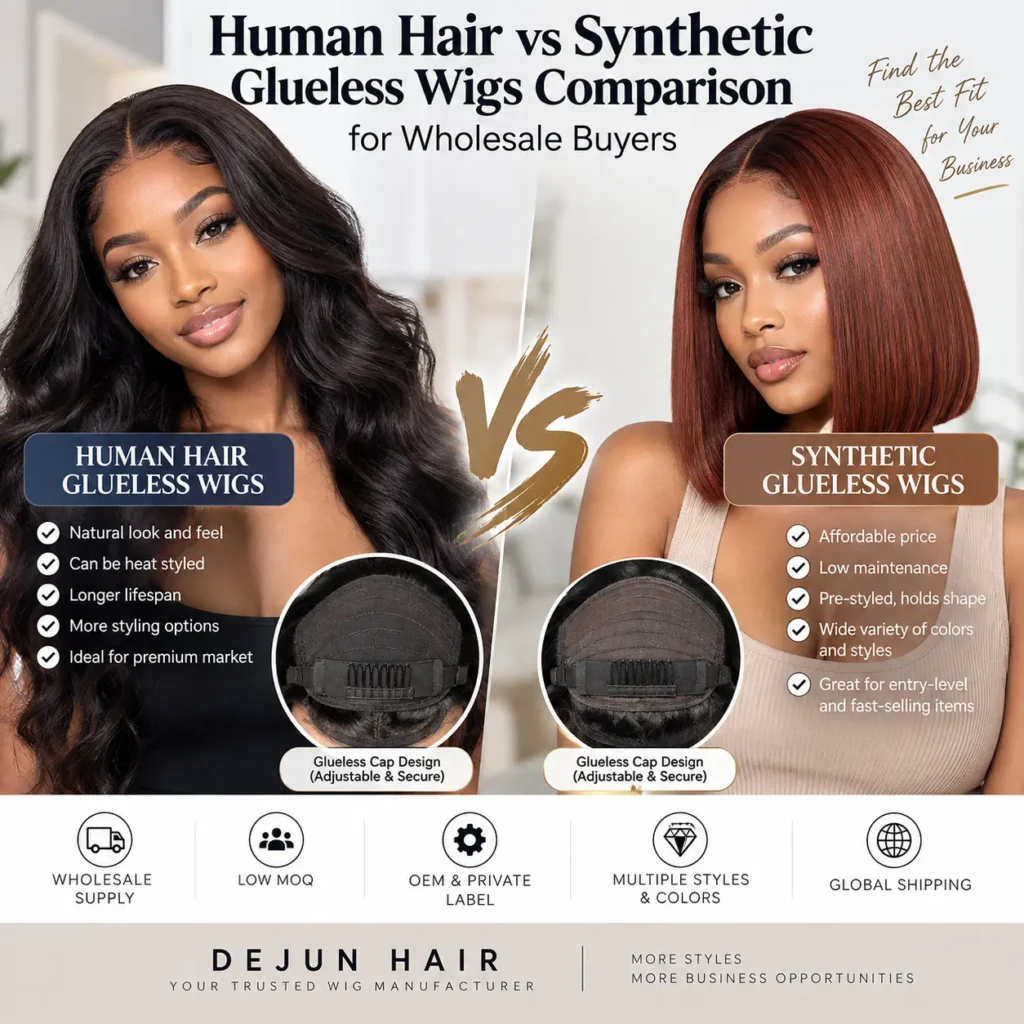
| Heat-resistant synthetic wigs | $$ | Higher-grade fiber and heat resistance | Fashion retailers and salons |
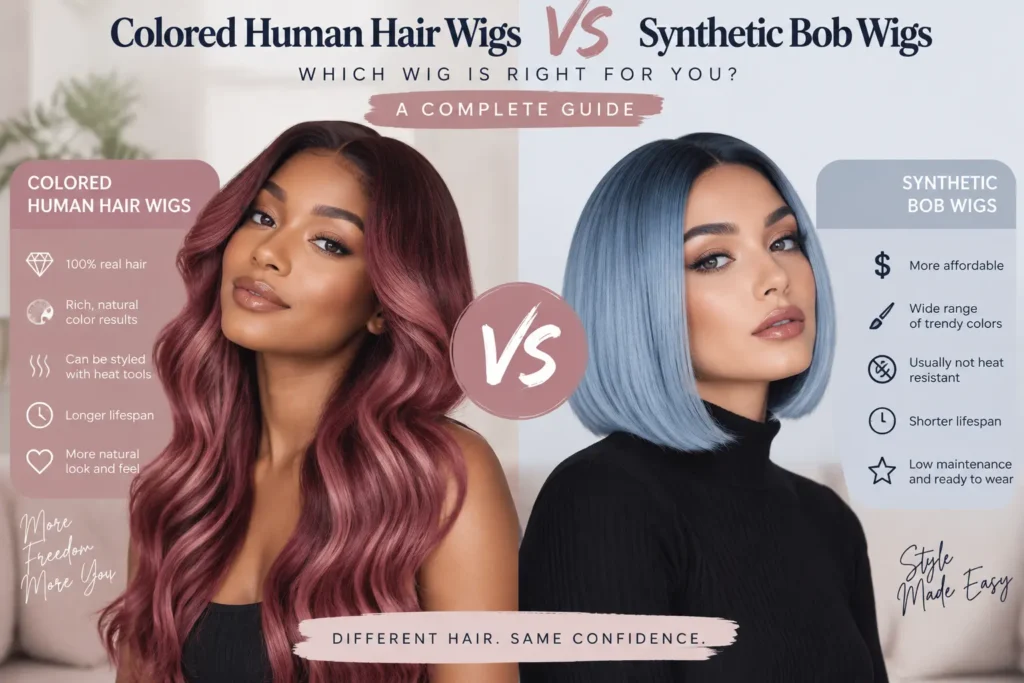
| Colored/fashion synthetic wigs | $$ | Beauty stores, salons, and online sellers | Social sellers and trend-focused stores |
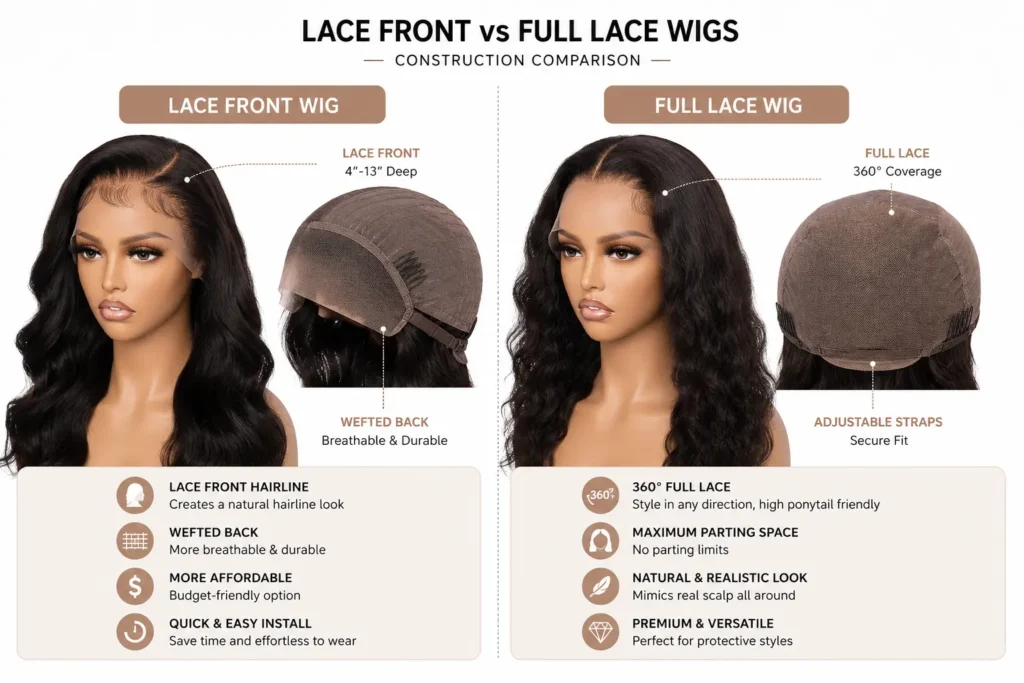
| Synthetic lace front wigs | $$–$$$ | Lace, hairline work and construction | Beauty supply stores and online retailers |
| Custom/private-label synthetic wigs | Varies | Specifications, packaging, logo and MOQ | Established retailers and private-label brands |
The table should be used as a cost-positioning guide rather than a fixed quotation. Two wigs in the same category can still have different prices because their specifications are different.
For example, a short machine-made wig using standard synthetic fiber will normally cost less to manufacture than a longer heat-resistant synthetic wig with greater fiber volume, a lace front and a more detailed hairline.
This is why professional buyers should request quotations based on a clearly defined specification rather than asking only, “What is your cheapest synthetic wig?”
Buyers who want to start with practical, fast-moving products can also compare wholesale short synthetic wigs designed for salons, distributors, and retail businesses. Dejun Hair’s current short-wig range supports heat-resistant fibers, mixed styles, low-MOQ sourcing, and OEM/ODM options.
What Determines Wholesale Synthetic Wigs Prices?
Understanding the quotation structure makes it much easier to compare synthetic wig supplier wholesale prices accurately.
1. Synthetic Fiber Quality
Fiber is one of the most important cost factors.
Entry-level synthetic fiber wigs are usually designed for affordability and basic everyday use. Higher-quality fibers can offer a softer feel, more natural-looking luster, improved shape retention, and better resistance to tangling or frizz.
Heat-resistant fibers add another level of functionality. Depending on the specific fiber and manufacturer’s specifications, they may tolerate controlled heat styling that ordinary synthetic fibers cannot.
For a retailer, the question is not simply whether one fiber is cheaper. Ask:
- Does the fiber look overly shiny or artificial?
- How does it feel after washing?
- How easily does it tangle?
- Does the style recover after washing and air-drying?
- Is it genuinely heat-resistant, and what temperature does the supplier specify?
- Is quality consistent between production batches?
An extra dollar saved on a wig is not useful if poor fiber performance leads to refunds, negative reviews, or unsold inventory.
2. Length and Fiber Volume
Longer wigs generally require more synthetic fiber, so length affects manufacturing cost.
Density matters for the same reason. A fuller wig requires more material and may require additional production work.
This means bulk synthetic wig prices should always be compared using equivalent specifications. Comparing a lightweight 10-inch wig from one supplier with a fuller 24-inch wig from another tells you very little about which factory is actually more competitive.
Ask suppliers to quote the same length, approximate density or weight, fiber type, and construction when conducting a price comparison.
3. Cap Construction
A simple machine-made cap is generally less expensive to manufacture than a more complex cap requiring additional materials or manual work.
Cap quality also affects the end customer’s experience. Adjustable straps, combs, elastic components, breathability, and overall construction influence fit and comfort.
For value-focused markets, a well-made basic cap can be commercially attractive because it keeps costs controlled. For customers who expect greater realism or convenience, investing in a better construction may support a higher retail price.
4. Lace and Hairline Design
Adding lace usually increases the cost of a synthetic wig.
Synthetic lace front wigs require additional materials and more detailed construction than basic non-lace wigs. Lace quality, lace area, and hairline workmanship can all influence the final quotation.
For retailers, this additional cost may be worthwhile when customers are willing to pay more for a natural-looking hairline.
The important question is whether your target customer values the feature enough to justify the additional inventory investment.
5. Color and Styling Complexity
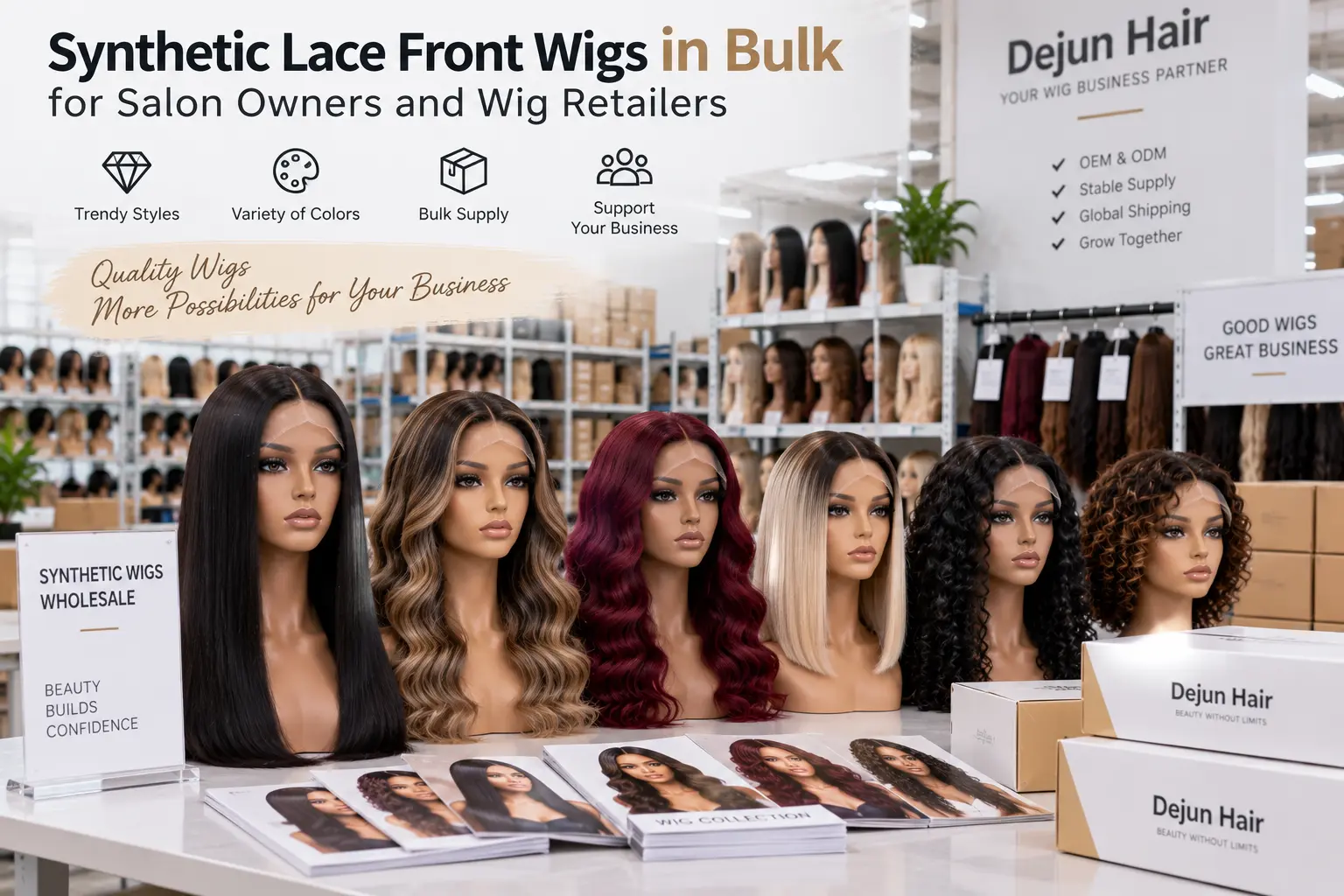
Natural shades are generally easier to standardize for bulk production. Fashion colors, mixed tones, ombre effects, highlights, and certain complex styles can require additional processing.
Color also affects inventory strategy.
If you are testing a new market, ordering large quantities of many unusual shades can create unnecessary stock risk. A better approach may be to start with proven core colors and add smaller quantities of fashion colors.
Retailers targeting younger, fashion-driven customers can also use wholesale bob wigs to test shorter fashion styles in natural and custom colors. Dejun Hair currently offers bob options in both human hair and heat-resistant synthetic fiber, with OEM customization available for bulk buyers.
6. Packaging and Private Label Requirements
Standard factory packaging is usually the lowest-cost option.
If you are building your own brand, however, you may require:
- Custom logo bags or boxes
- Hang tags
- Product labels
- Care cards
- Barcodes or SKU labels
- Custom inserts
- Retail-ready packaging
These services add cost, but they should not automatically be treated as unnecessary expenses.
Well-designed private label synthetic wigs can help an online seller or beauty supply business create a recognizable brand instead of competing only on product price.
The key is to calculate packaging as part of the total landed cost and determine whether your target retail price supports it.
7. Order Quantity
Quantity is another major factor behind wig wholesale prices.
Larger orders can improve production efficiency and spread certain setup, packaging, and handling costs across more units. This can create room for volume-based pricing.
However, the cheapest unit cost is not always the best purchasing decision.
Buying 1,000 units at a lower price is worse than buying 100 units at a slightly higher price if most of the larger order remains unsold.
For growing businesses, inventory turnover should come before chasing the lowest possible unit price.
How Does MOQ Affect Wholesale Synthetic Wigs Pricing?
The synthetic wig wholesale MOQ tells you the minimum quantity a supplier is willing to accept under a particular purchasing arrangement.
But there is rarely one universal MOQ covering every product and customization option.
Ready-Stock Orders
Ready-stock products generally provide the greatest flexibility.
A buyer may be able to combine multiple styles, lengths, or colors within a mixed wholesale order, depending on current inventory and the supplier’s order rules.
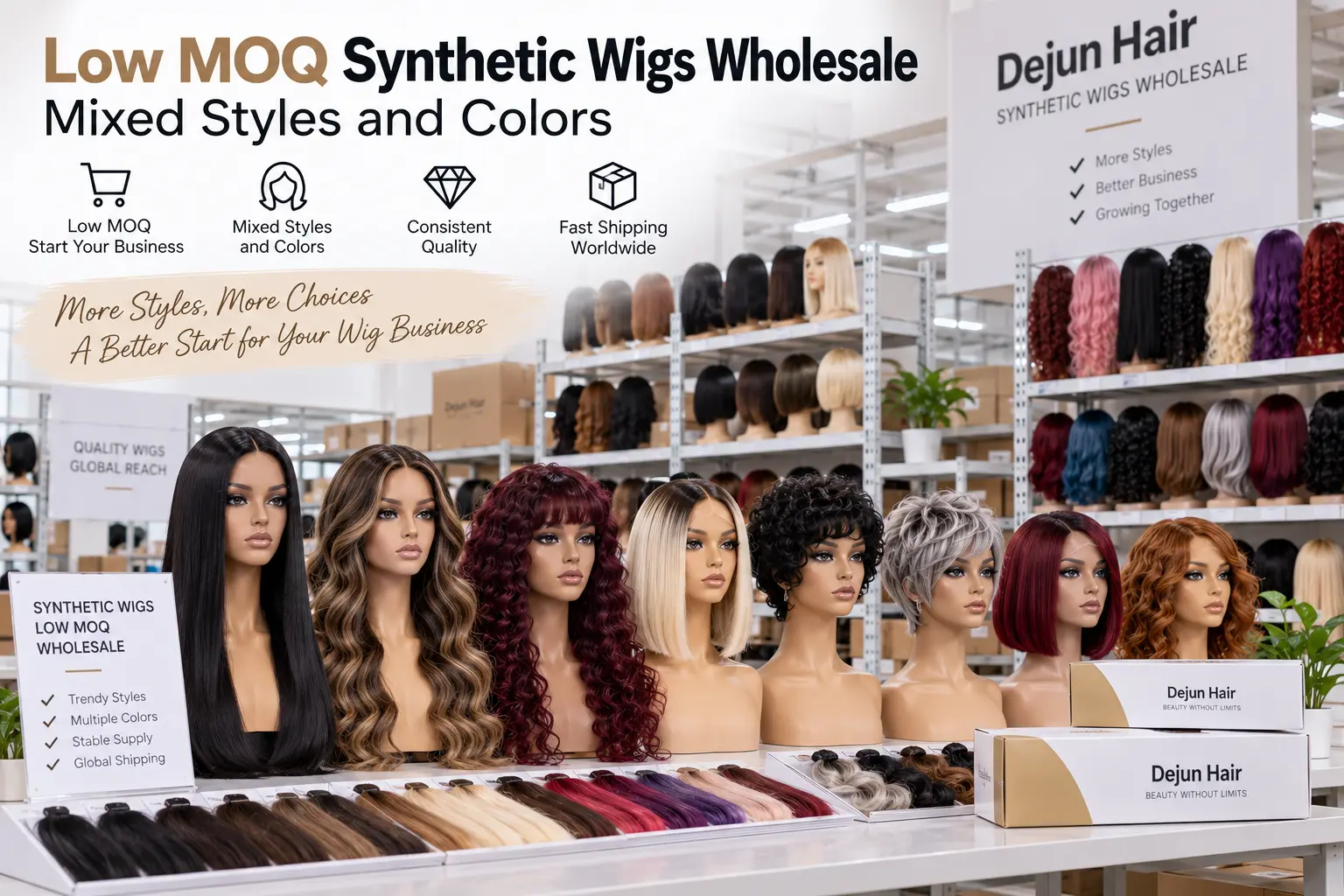
This is particularly useful for buyers searching for low MOQ synthetic wigs wholesale, including:
- New wig businesses
- Independent online stores
- Small beauty supply stores
- Salon owners
- Social media sellers
- Buyers testing a new regional market
A lower MOQ reduces the amount of cash tied up in inventory and allows you to identify best-selling SKUs before scaling.
Sample Orders
Synthetic wig samples should be viewed as a risk-control tool rather than simply another expense.
Before committing to a major order, use samples to evaluate fiber appearance, softness, shedding, cap fit, stitching, color accuracy, hairline construction, and packaging.
A sample unit may cost more than the eventual bulk unit price because the order does not benefit from production scale. Shipping per unit will also be much higher for one or two samples.
That does not make the sample “expensive.”
If testing a few pieces prevents you from purchasing hundreds of unsuitable wigs, the sample has done its job.

OEM and Private-Label Orders
The MOQ for OEM synthetic wigs may differ from the ready-stock MOQ because customization may require separate materials, production preparation, custom colors, or packaging.
The more customized the product, the more important it becomes to discuss MOQ item by item.
At Dejun Hair, the sourcing approach can be adjusted according to the project, including ready-stock wholesale, mixed orders, sample testing, and customized OEM/ODM production. Rather than forcing every buyer into the same order structure, the objective is to match purchasing volume with the buyer’s market stage.
Bulk Orders
Once you know which products sell consistently, a larger bulk wig order becomes more attractive.
At this stage, ask about quantity-based pricing tiers.
For example, instead of requesting one price, ask the manufacturer to quote several quantities:
| Order Level | What You Should Evaluate |
|---|---|
| Sample | Product quality and market suitability |
| Small wholesale order | Sell-through and customer response |
| Medium bulk order | Unit-cost improvement and inventory turnover |
| Large bulk order | Best pricing, production capacity, and logistics efficiency |
This gives you a much clearer picture of how your costs may change as the business grows.
Cheap Synthetic Wigs Wholesale vs. Better Quality: Which Makes More Profit?
For many first-time buyers, wholesale cheap synthetic wigs seem like the fastest route to a high margin.
That assumption can be misleading.
Imagine Supplier A offers a wig for less than Supplier B. On paper, Supplier A appears more profitable. But after receiving the goods, you discover inconsistent colors, excessive tangling, weak stitching, and uncomfortable caps.
The actual cost is no longer just the purchase price.
You may also face:
- Customer refunds
- Product replacements
- Discounting of slow-moving stock
- Negative reviews
- Additional customer-service time
- Lost repeat purchases
- Damage to your store’s reputation
In contrast, affordable synthetic wigs wholesale should mean products that achieve the right balance between cost, quality, and market positioning—not simply the lowest-priced wigs available.
For wholesalers, the more useful question is:
Which product gives me the best combination of landed cost, sell-through rate, acceptable return rate, and repeat-purchase potential?
That is a much better definition of profitability.
Calculate Landed Cost Before Comparing Suppliers
The factory quotation is only one part of your inventory cost.
A simplified calculation is:
Landed Cost per Wig = Product Cost + Customization/Packaging + Freight + Import-Related Costs + Local Delivery, divided appropriately by the number of sellable units
Depending on your destination and shipping arrangement, additional costs may include freight, customs duties, taxes, brokerage, insurance, or local delivery.
This is particularly important when comparing international suppliers.
Supplier A may quote a lower factory price but use less efficient packaging or offer a shipping method that makes your delivered cost higher. Supplier B may have a slightly higher unit quotation but provide better packing efficiency or logistics support.
Compare like with like.
Ideally, obtain quotations with clearly stated:
- Product specification
- Quantity
- Packaging
- Incoterm
- Production lead time
- Shipping option
- Payment terms
- Customization charges
You can then calculate the cost of getting each sellable unit into your warehouse rather than comparing headline prices.
How to Price Synthetic Wigs for Resale
Once you know landed cost, you can estimate your wig business profit margin.
Suppose this purely illustrative example applies to one SKU:
- Landed cost per wig: $12
- Retail selling price: $30
- Gross profit per wig: $18
Your gross margin would be:
($30 − $12) ÷ $30 × 100 = 60%
But a 60% gross margin is not a 60% net profit margin.
Retailers may still need to pay for:
- Advertising
- E-commerce platform fees
- Payment processing
- Warehouse expenses
- Staff
- Influencer commissions
- Discounts and promotions
- Returns and replacements
- Domestic fulfillment
Therefore, when deciding how to price synthetic wigs for resale, work backward from your complete cost structure rather than simply doubling the factory price.
For example, a beauty supply store with relatively low customer-acquisition costs may operate differently from a Shopify seller spending heavily on paid advertising.
The right retail price depends on both the product and your sales model.
What Should Different Buyers Prioritize?
Not every buyer should source synthetic wigs in bulk the same way.
Synthetic Wigs Wholesale for Retailers
Retailers should focus heavily on SKU economics.
Start by identifying several core products with broad customer appeal, then add fashion-oriented SKUs in controlled quantities.
Monitor:
- Sell-through
- Gross margin
- Return rate
- Customer reviews
- Reorder frequency
Increase quantities only after the data shows which products deserve more inventory.
Synthetic Wigs Wholesale for Beauty Supply Stores
Beauty supply stores often need variety because customers expect to compare colors, lengths, and styles in person.
Mixed orders can therefore be particularly valuable.
Instead of putting the entire purchasing budget into one SKU, consider combining dependable natural shades with smaller quantities of trend-driven colors and styles.
Synthetic Wigs Wholesale for Salon Owners
Salon owners should consider how the wig fits into their service model.
A slightly higher-quality synthetic wig may make more commercial sense if it produces better client satisfaction and supports styling, fitting, or consultation services.
Salons should pay particular attention to cap comfort, natural appearance, fiber quality, and repeat availability.
Online and Social Media Sellers
TikTok, Instagram, and independent-store sellers often need visually distinctive products.
Color, texture, and trend responsiveness can therefore matter as much as price.
However, avoid purchasing excessive quantities simply because a style is currently popular. Social trends can change quickly, making flexible MOQ and replenishment capability especially valuable.
How to Get Better Bulk Synthetic Wigs Prices Without Sacrificing Quality
There are several ways to control purchasing costs without immediately moving to lower-quality products.
First, standardize your specifications. Constantly changing fiber, cap, colors, and packaging makes purchasing more complicated and can prevent you from benefiting from repeat production.
Second, use mixed orders where available. This can allow you to reach a practical overall purchasing quantity without overstocking a single SKU.
Third, test products before scaling. Samples and small wholesale orders help identify quality problems before significant capital is committed.
Fourth, separate essential customization from optional customization. A new retailer may need a logo label and simple branded packaging, but an elaborate custom box may not be necessary during the market-testing stage.
Fifth, consolidate proven products into larger orders once sales data supports the decision.
Finally, build a long-term relationship with a capable wig manufacturer. Repeat buyers with predictable specifications and order schedules are generally in a better position to discuss stable pricing, production planning, and customization than buyers who constantly switch suppliers based on the lowest quotation.
How to Compare Synthetic Wig Suppliers Beyond Price
A reliable wholesale wig supplier should help you understand what you are paying for.
Before placing an order, ask:
- What type and grade of synthetic fiber is used?
- Is the fiber heat-resistant? If so, what temperature range is recommended?
- What are the wig’s length, approximate density or weight, and cap specifications?
- What is the MOQ for ready-stock products?
- Can I mix styles and colors in one order?
- What is the MOQ for custom colors or constructions?
- Can I order samples before bulk production?
- What OEM and private-label services are available?
- What are the production and delivery lead times?
- How do you inspect fiber, color, cap construction, and finished products?
- How are defective products handled?
- What international shipping support is available?
A quotation without clear specifications is difficult to evaluate.
For example, “$X per wig” means very little unless you know exactly what fiber, construction, length, color, packaging, and quantity that price represents.
Why Factory-Direct Sourcing Can Improve Cost Control
Buying directly from a manufacturer can provide more than a lower quotation.
For wholesale buyers, the larger advantage is visibility and control over the supply chain.
A factory capable of managing fiber processing, cap construction, styling, inspection, and packaging can communicate more directly about specifications, quality standards, production schedules, and customization.
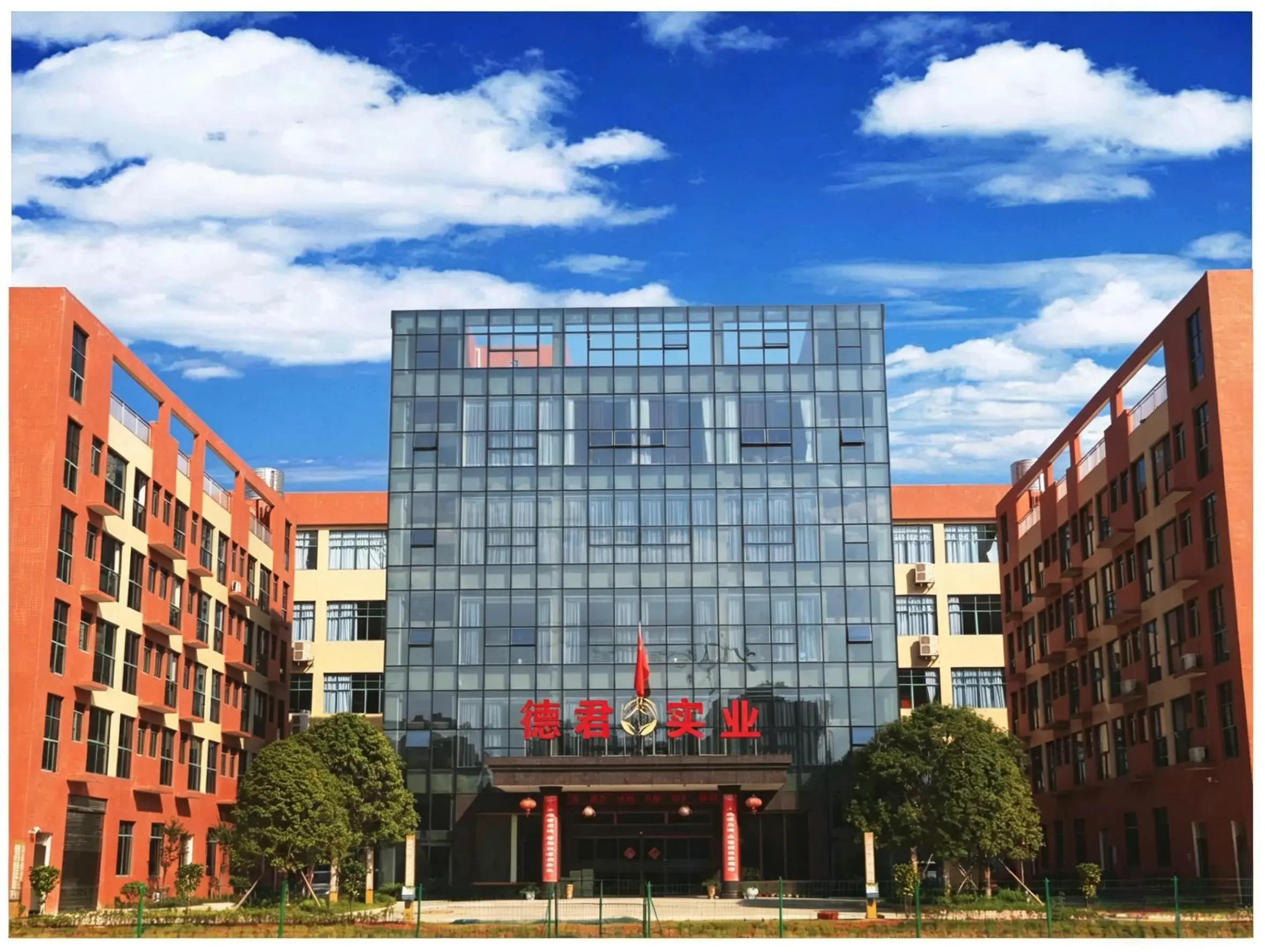
Dejun Hair is a wig manufacturer based in Shaoyang, Hunan, China, with approximately 20 years of local manufacturing experience. Our product range covers both human hair and synthetic products, allowing wholesalers, salons, and retailers to build different price tiers within the same supply strategy.
For synthetic products, buyers can source ready-stock products, discuss mixed orders, test samples, and develop private label synthetic wigs based on their business requirements.
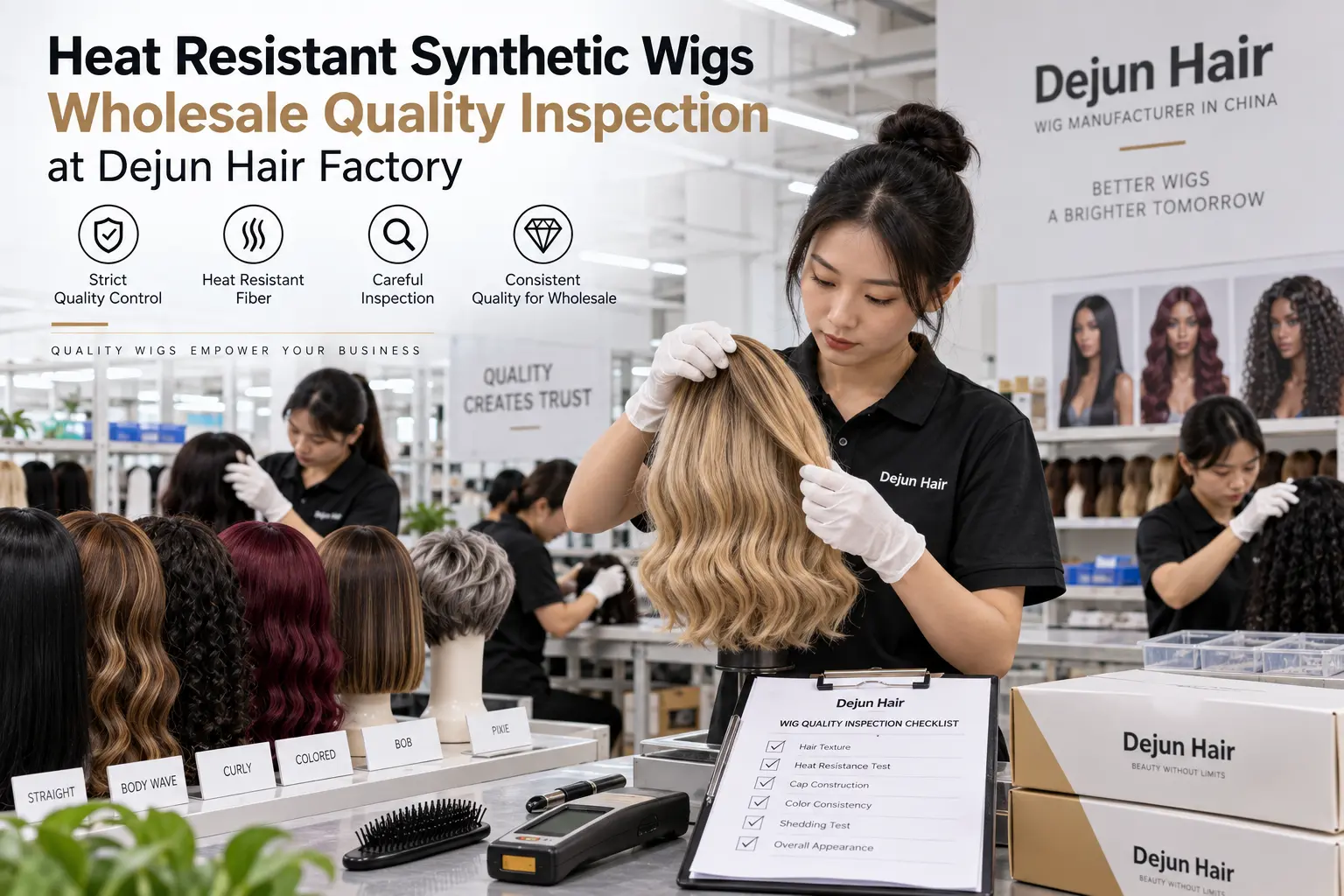
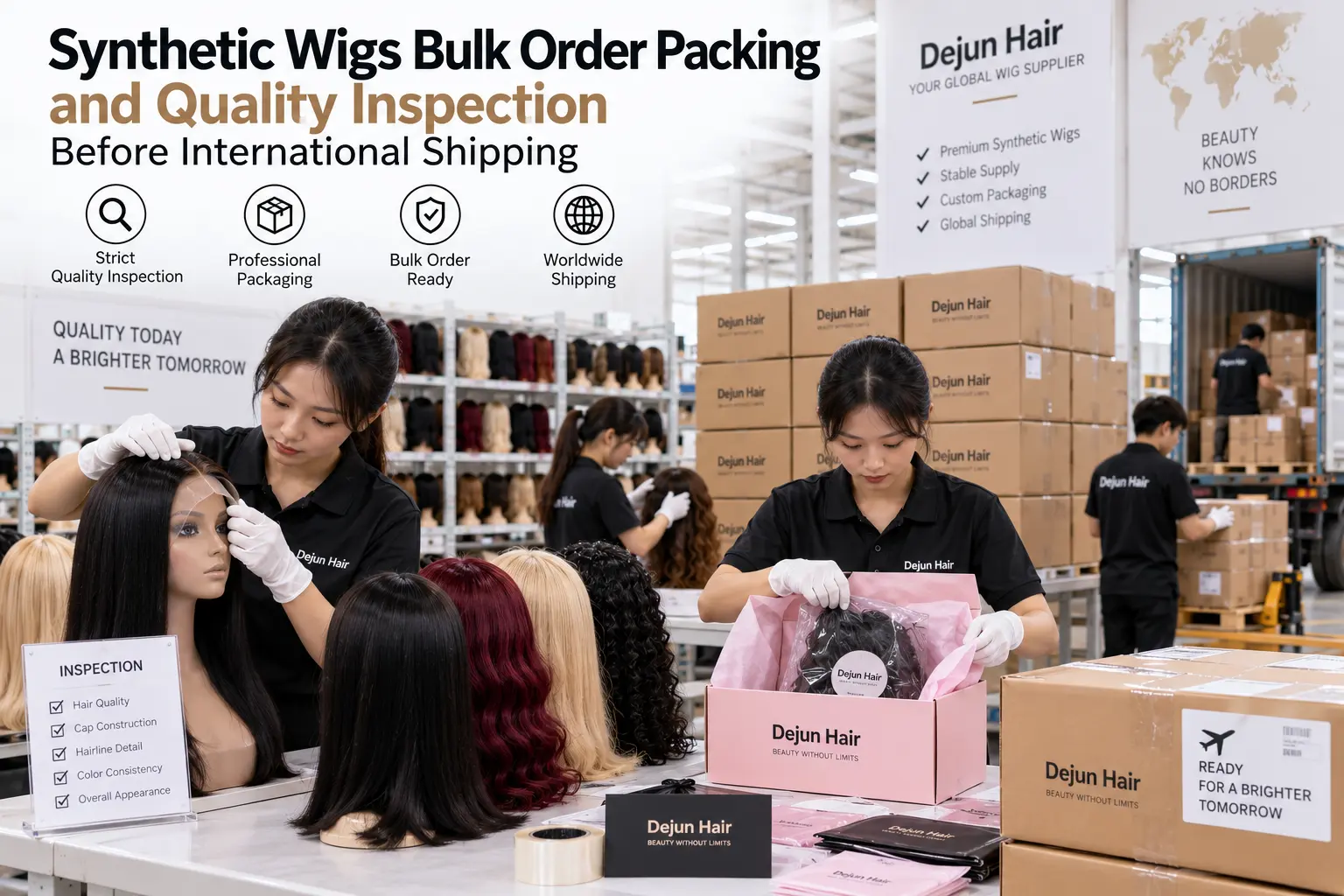
Our factory also performs quality checks covering factors such as fiber condition, construction, color consistency, and sizing before shipment.
This matters because successful sourcing is not about getting one cheap shipment. It is about being able to reorder a commercially successful product with consistent specifications.
Final Buying Checklist for Wholesale Synthetic Wigs
Before confirming a purchase, review the complete commercial picture:
| Factor | Question to Ask |
|---|---|
| Product | Does the fiber and construction fit my target market? |
| Price | Am I comparing equivalent specifications? |
| MOQ | Can I test demand without excessive inventory? |
| Samples | Have I physically checked the product before scaling? |
| Quality | Is the quality consistent enough for repeat sales? |
| Customization | Which OEM features actually add value to my brand? |
| Capacity | Can the supplier handle my future order volume? |
| Lead Time | Can I replenish fast-selling products reliably? |
| Logistics | What is my true landed cost? |
| Margin | Is there enough margin after selling expenses? |
| After-Sales | What happens if defective products are found? |
Ultimately, the best wholesale synthetic wigs are not necessarily the products with the lowest factory price.
The better sourcing decision is the product that gives your business an appropriate price, quality level, MOQ, inventory risk, and resale margin.
Start with samples or a manageable mixed order. Track which styles actually sell. Calculate landed cost instead of factory price alone. Then increase purchasing volume on proven SKUs.
This approach gives retailers, beauty supply stores, salon owners, and distributors a much stronger foundation for profitable growth.
Frequently Asked Questions About Wholesale Synthetic Wigs
How much do wholesale synthetic wigs cost?
Wholesale synthetic wig prices vary according to fiber quality, length, density, cap construction, lace, color, styling, quantity, and customization. Basic machine-made wigs generally occupy the lowest cost tier, while heat-resistant, lace-front, and customized synthetic wigs typically cost more. Request a specification-based quotation rather than relying on a generic price.
What is the typical synthetic wig wholesale MOQ?
There is no universal MOQ. Ready-stock products may support lower quantities and mixed orders, while OEM or private-label production may require different minimums depending on colors, specifications, packaging, and manufacturing requirements. Always confirm MOQ for the exact product you want to purchase.
Can I buy low MOQ synthetic wigs wholesale?
Yes. Some manufacturers offer ready-stock products, sample orders, and mixed wholesale orders that allow smaller businesses to test multiple styles without committing to a large quantity of one SKU. Availability depends on the supplier and current stock.
Are cheap synthetic wigs profitable to resell?
They can be, but purchase price alone does not determine profitability. Fiber quality, customer satisfaction, return rates, inventory turnover, and retail pricing all affect actual profit. An inexpensive wig with a high return rate may ultimately cost a retailer more than a slightly higher-quality product.
Are synthetic lace front wigs more expensive?
Generally, lace-front construction adds materials and manufacturing work compared with basic machine-made wigs. Lace type, lace area, and hairline workmanship can further affect the price. Retailers should determine whether their customers will pay a sufficient premium for the more natural appearance.
How can I calculate the profit margin on synthetic wigs?
First, calculate your landed cost, including the product, packaging, shipping, and applicable import or local costs. Subtract landed cost from your selling price to estimate gross profit. Then account for advertising, platform fees, fulfillment, discounts, returns, and other operating expenses when assessing actual profitability.
Can I order samples before placing a synthetic wigs bulk order?
A professional supplier should be able to explain its sample policy. Sample testing is particularly valuable for checking fiber feel, color, construction, fit, and overall finish before increasing order volume.
Can wholesale synthetic wigs be customized with my brand?
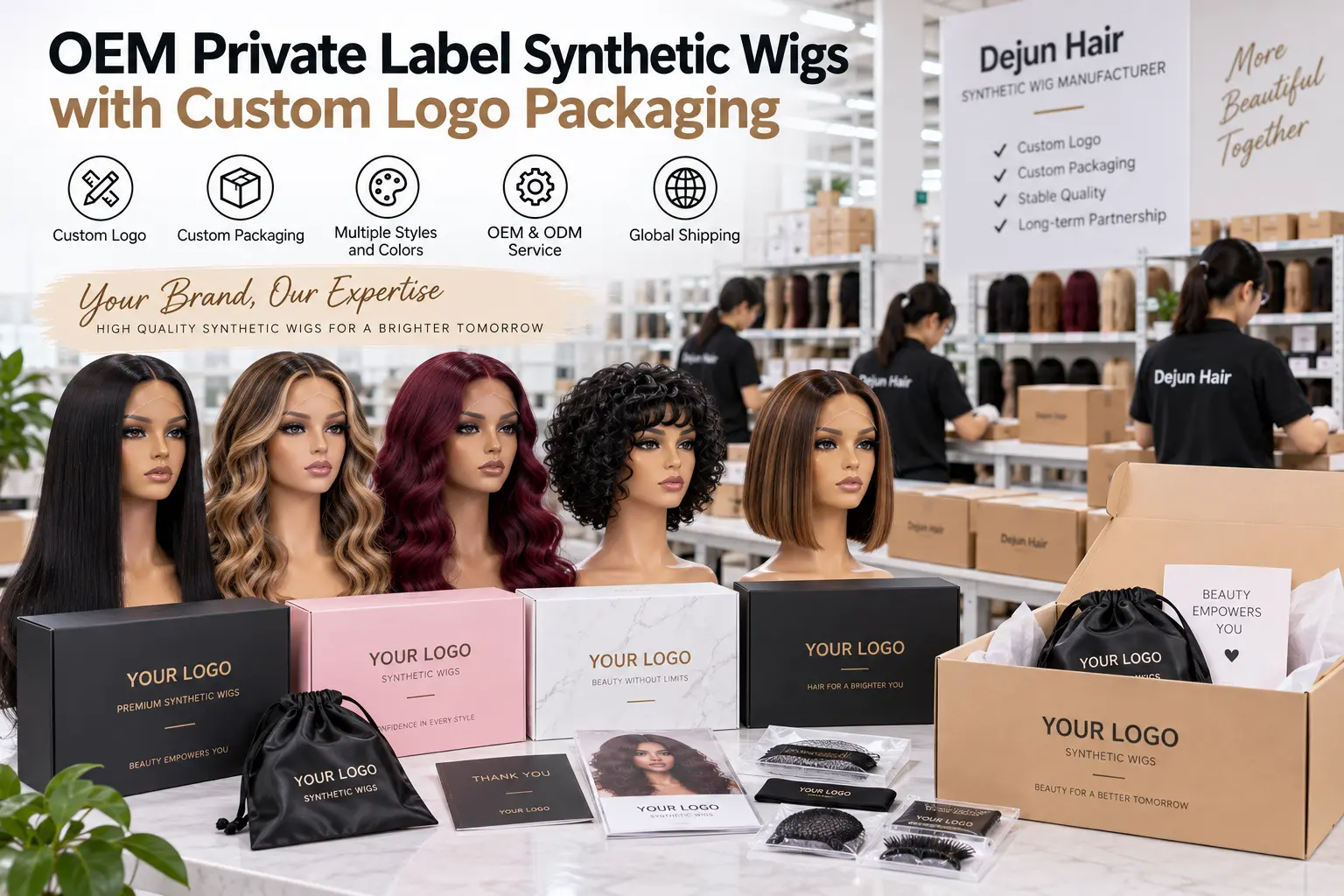
Yes, depending on the manufacturer and MOQ. Common OEM synthetic wigs and private-label options can include custom colors, specifications, logo labels, hang tags, bags, boxes, and other retail packaging.
Request Wholesale Pricing, MOQ & Samples
Planning your next synthetic wig collection?
Send Dejun Hair the styles, colors, quantities, target market, and customization requirements you need. Our team can help you evaluate suitable synthetic wig options, MOQ arrangements, and OEM/private-label requirements before you commit to a larger order.
Request a current factory-direct wholesale quote, product catalog, or sample to calculate your real sourcing cost before placing a bulk order.
Google official and wholesale wig factory industry reference links:
Dejun Hair
Direct from Chinese Wig Factories | One-Stop Wholesale Supplier of Wigs for International Trade.