How Much Do Wholesale Human Hair Wigs Cost? Complete Pricing Guide
If you are sourcing wholesale human hair wigs for a salon, beauty supply store, online wig business, or distribution network, price is probably one of the first questions you ask a supplier.
But there is rarely one simple answer.
Two wigs may both be described as 18-inch, 100% human hair lace wigs, yet their factory prices can be very different. The difference may come from hair quality, density, lace size, cap construction, color processing, order quantity, or customization. A lower quotation can also become more expensive later if inconsistent quality leads to returns, replacements, or unsellable inventory.
So, how much do wholesale human hair wigs cost, and how can you tell whether a supplier’s quotation is reasonable?
This guide explains typical wholesale price ranges, the main factors that affect cost, how MOQ changes the price per piece, and how to compare quotations based on total sourcing value rather than the lowest number on a price list.
How Much Do Wholesale Human Hair Wigs Cost?
As a general sourcing reference, wholesale human hair wigs may range from around $30–$50 for shorter, simpler entry-level products to $200–$300 or more per piece for longer, denser, premium lace or high-grade human hair wigs.
The actual price can fall outside these ranges depending on the exact specification.
| Human Hair Wig Type | Typical Wholesale Reference Range* | Main Price Drivers |
|---|---|---|
| Short Human Hair Bob Wig | $30–$80+ | Length, density, hair quality, cap |
| Closure Wig | $40–$100+ | Closure size, lace, density, hair grade |
| Lace Front Human Hair Wig | $50–$150+ | 13×4/13×6 lace, length, density |
| Glueless Human Hair Wig | $50–$160+ | Lace area, cap design, pre-customization |
| HD Lace Human Hair Wig | $70–$200+ | HD lace, hair grade, knot work |
| Full Lace Human Hair Wig | $100–$300+ | Labor, full-lace construction, length |
| Long 26–30+ Inch Human Hair Wig | $100–$300+ | Long hair supply, density, hair quality |
| Custom Colored Human Hair Wig | $60–$250+ | Base hair quality, bleaching and coloring |
*These figures are broad sourcing reference ranges, not a fixed Dejun Hair price list. Actual human hair wig wholesale prices vary by specification, raw-hair market conditions, quantity, customization, packaging, and supplier.
This is why asking only, “What is your price for a 20-inch wig?” is not enough.
For a meaningful comparison, buyers should request quotations based on the same hair quality, length, density, lace specification, cap construction, color, quantity, and customization requirements.

What Determines Wholesale Human Hair Wig Prices?
Understanding the cost structure behind wholesale human hair wigs makes it much easier to identify whether a low price represents genuine value or simply a different product specification.
1. Human Hair Quality and Hair Grade
Hair quality is one of the largest contributors to the final wholesale human hair wigs cost.
Not all products labeled “human hair” have the same characteristics. Differences may include hair source, cuticle condition, previous chemical treatment, strand consistency, percentage of shorter hairs, and how the hair has been sorted and processed.
Depending on the product and supplier, you may encounter terms such as:
- 100% human hair
- Remy human hair
- Virgin human hair
- Raw human hair
- Processed human hair
Higher-quality hair that has been carefully selected and sorted generally costs more because the usable raw material is more expensive and more difficult to source consistently.
For example, virgin human hair wigs wholesale will normally occupy a different price level from heavily processed entry-level human hair products. Raw hair can cost even more when genuine sourcing, limited processing, and premium strand characteristics are required.
This is also why buyers should never evaluate hair only by the supplier’s grade name. No universally standardized “8A, 10A, 12A” grading system guarantees identical quality across factories.
Before increasing your order quantity, use a sample to evaluate shedding, tangling, ends, length, weight, color consistency, and performance after washing. Our guide on how to check the quality of 100% human hair wigs before bulk ordering provides a more detailed inspection process.
2. Wig Length
Length has a major influence on human hair wig factory price.
A 12-inch wig and a 30-inch wig require very different raw materials. Long, healthy human hair is less abundant and more expensive to source, especially when the buyer also requires consistent ends and premium hair quality.
For this reason, prices usually rise as you move through length groups such as:
- 10–14 inches
- 16–20 inches
- 22–26 inches
- 28–30 inches
- 32 inches and above
The increase is not necessarily linear. The additional cost between 12 and 14 inches may be relatively modest, while moving from 26 inches to 30 inches can have a much greater effect.
For wholesale buyers, this matters when building a product assortment. Instead of stocking every style in every length, many retailers use mid-length products as their core inventory and purchase very long wigs in smaller quantities until demand is proven.
3. Hair Density
Density is another specification that buyers should check carefully when comparing human hair wigs’ price per piece.
Common specifications include:
- 150% density
- 180% density
- 200% density
- 250% density
A higher-density wig uses more hair, so the raw-material cost normally increases.
This creates a common problem when comparing suppliers. Supplier A may quote a lower price for an 18-inch wig, but it may be 150% density, while Supplier B is quoting 180% or 200%.
The quotations are not directly comparable.
A better rule for B2B buyers is:
Same hair quality + same length + same density + same lace specification + same cap construction = meaningful price comparison.
Always confirm these details before deciding that one supplier is more expensive than another.
4. Lace Type and Lace Size
Lace can significantly affect wholesale lace front wig prices because both the amount and quality of lace influence material and production costs.
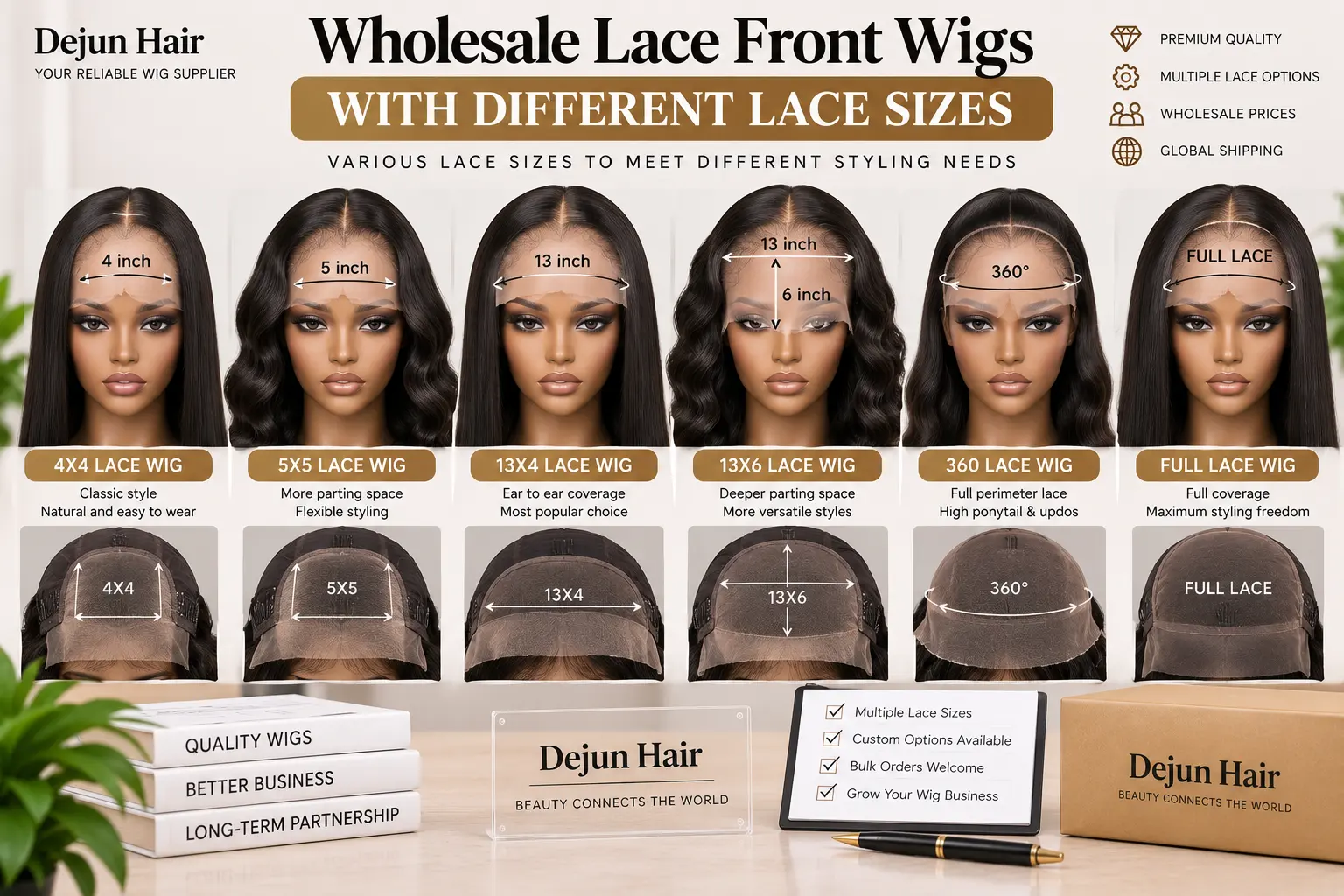
Common constructions include:
| Lace Construction | General Cost Level | Common Buyer Use |
|---|---|---|
| 4×4 Closure | Lower | Affordable retail ranges |
| 5×5 Closure | Low–Medium | Glueless/wear-and-go ranges |
| 13×4 Lace Front | Medium | Mainstream lace wig inventory |
| 13×6 Lace Front | Medium–High | Greater styling flexibility |
| Full Lace | High | Premium wig collections |
Lace material matters as well.
Transparent lace may offer a more economical solution for some product lines, while high-quality HD lace generally raises the cost. Buyers therefore need to verify exactly what “HD lace” means in the quotation rather than relying on the product name alone.
If lace construction is an important part of your inventory, compare your supplier’s wholesale lace front wigs using identical lace dimensions, material, hair quality, and density.
5. Wig Construction and Cap Design
A machine-made wig generally requires less manual work than a lace front or full lace construction.
A full lace wig, for example, involves much more detailed ventilation and handwork. This contributes to its higher price.
The growing glueless wigs wholesale category introduces another consideration. Glueless products may include adjustable bands, combs, elastic structures, pre-cut lace, pre-plucked hairlines, or other wear-and-go features.
Each additional production step can add to cost.
The question for retailers should therefore not simply be:
“Which construction is cheapest?”
It should be:
“Which construction provides the right balance of cost, customer demand, ease of use, and resale price for my market?”
6. Hair Color and Chemical Processing
Natural black is usually easier and less costly to produce than complex custom colors.
Products such as:
- #613 blonde
- Burgundy
- Piano highlights
- Ombre
- Balayage
- Two-tone colors
- Custom fashion colors
may require bleaching, coloring, toning, or multiple processing stages.
These processes add labor and production costs. They can also affect hair performance if the base hair is not suitable for aggressive processing.
This means an extremely cheap #613 or heavily colored wig should be evaluated carefully. Buyers need to consider not only its appearance when new but also softness, shedding, tangling, color stability, and performance after washing.

Wholesale Human Hair Wig Prices by Product Type
The type of wig you stock also influences your purchasing budget and resale strategy.
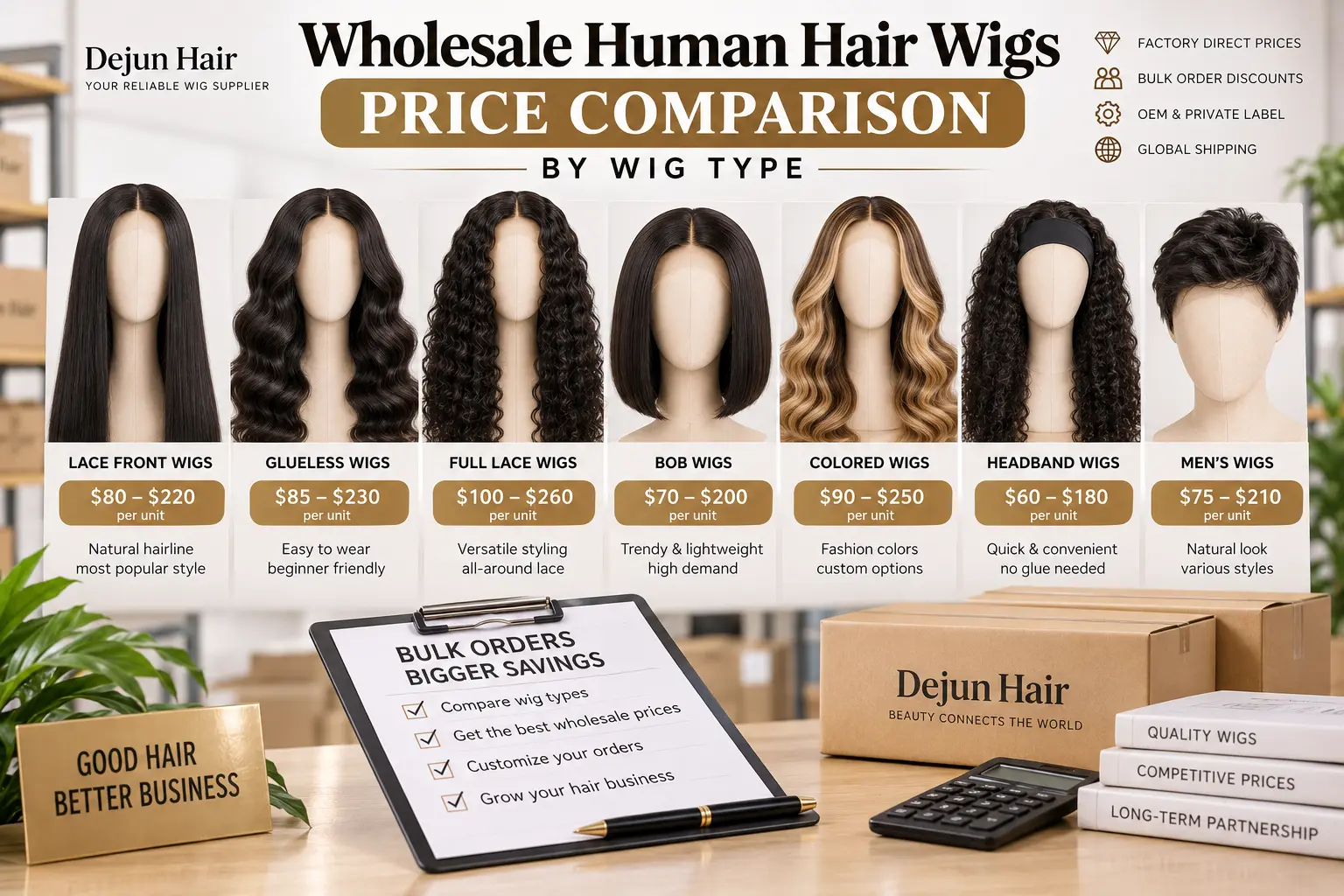
Human Hair Bob Wigs
Bob wigs are often a practical entry point for retailers because shorter lengths require less hair than long styles. This can make them suitable for customers looking for affordable human hair wigs without moving completely into synthetic products.
Straight bobs, closure bobs, lace front bobs, colored bobs, and glueless bobs can each occupy different price levels.
For new wig businesses, several bob styles can provide a useful lower-price category alongside higher-ticket long wigs.
Lace Front Human Hair Wigs
Lace front wigs remain an important category for salons and wig retailers because they combine a natural-looking front hairline with a lower production cost than many full lace designs.
Prices vary significantly according to 13×4 versus 13×6 construction, lace material, length, density, hair quality, and whether services such as pre-plucking or knot bleaching are included.
Glueless Human Hair Wigs
Glueless designs are particularly relevant to online sellers targeting customers who want convenient installation.
However, buyers should compare the complete specifications. A basic adjustable wig and a pre-plucked, pre-cut, HD lace wear-and-go wig may both be marketed as “glueless,” but they are not equivalent products.
Full Lace Human Hair Wigs
Full lace wigs generally sit toward the premium end of the market because their construction requires more lace and more labor.
They may make sense for retailers whose customers prioritize styling flexibility and are willing to accept a higher retail price. For a price-sensitive market, however, stocking large quantities without testing demand can tie up unnecessary capital.
Colored Human Hair Wigs
Colored wigs can create opportunities for higher-value fashion collections, but pricing depends heavily on the color process.
Simple dark shades may add relatively little cost, while blonde, highlighted, balayage, or complex custom colors can require substantially more processing.
When planning a colored collection, compare both acquisition cost and the retail premium your customers are actually willing to pay.

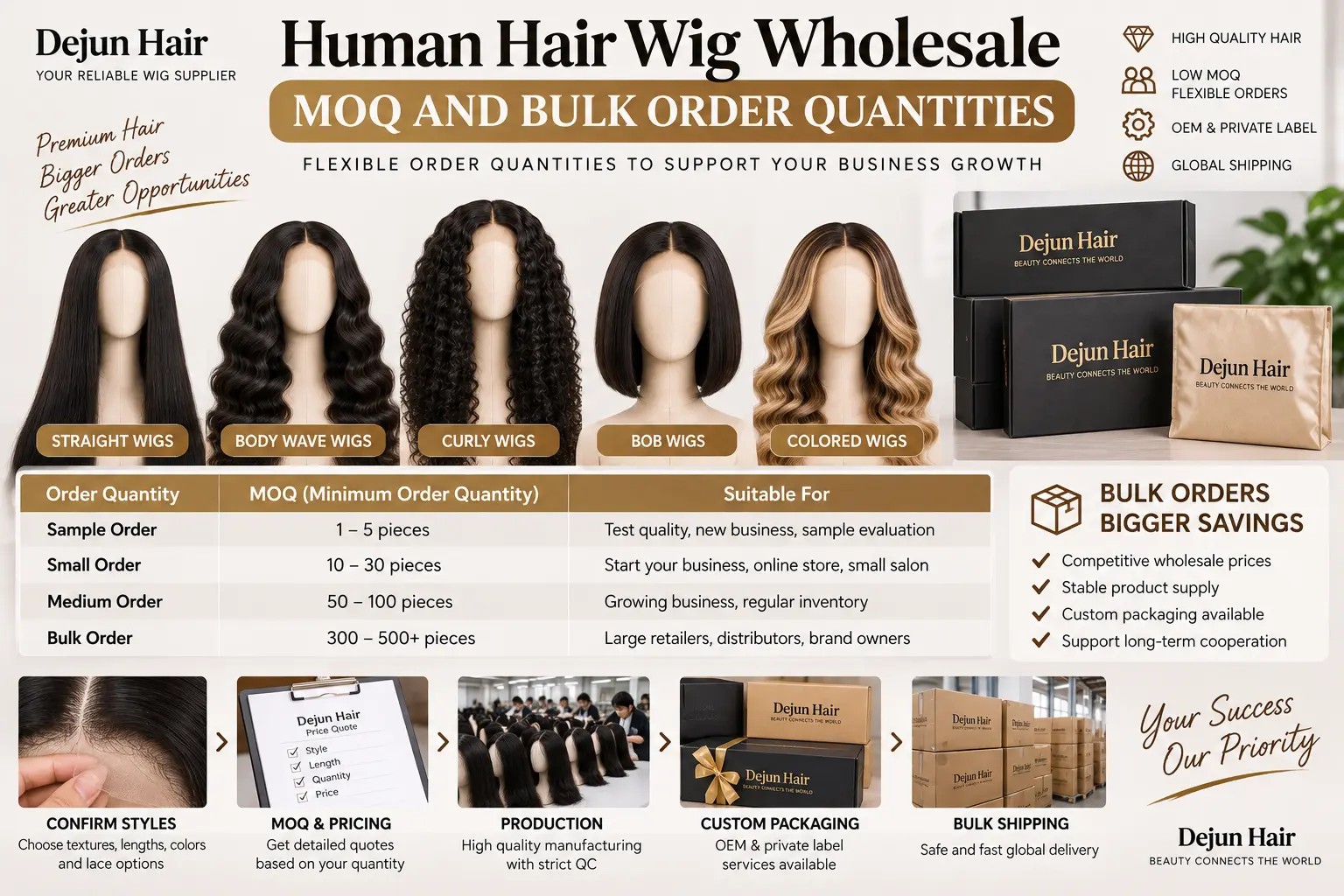
How Does MOQ Affect Wholesale Human Hair Wig Prices?
Wig wholesale MOQ and order quantity can affect the price per piece, but the relationship is more complicated than “buy more, and everything becomes cheaper.”
A supplier may handle several types of orders:
- Sample orders
- Small wholesale orders
- Mixed-style orders
- Standard bulk orders
- OEM/private-label orders
- Large-volume production orders
Larger quantities can improve production efficiency and allow a factory to spread certain setup, packaging, and administrative costs across more units. This can create opportunities for better bulk pricing.
However, customized products may have separate MOQs because special lace, colors, cap specifications, packaging, or printed materials need dedicated production.
For smaller businesses, flexibility can sometimes be more valuable than achieving the absolute lowest unit price.
Imagine that Supplier A requires 100 identical units to obtain the lowest price, while Supplier B allows you to combine several lengths and styles in a smaller mixed order. Even if Supplier B’s unit price is slightly higher, the mixed order may reduce inventory risk and help you discover which SKUs actually sell.
This is particularly important for salons, new online sellers, and distributors entering a new market.
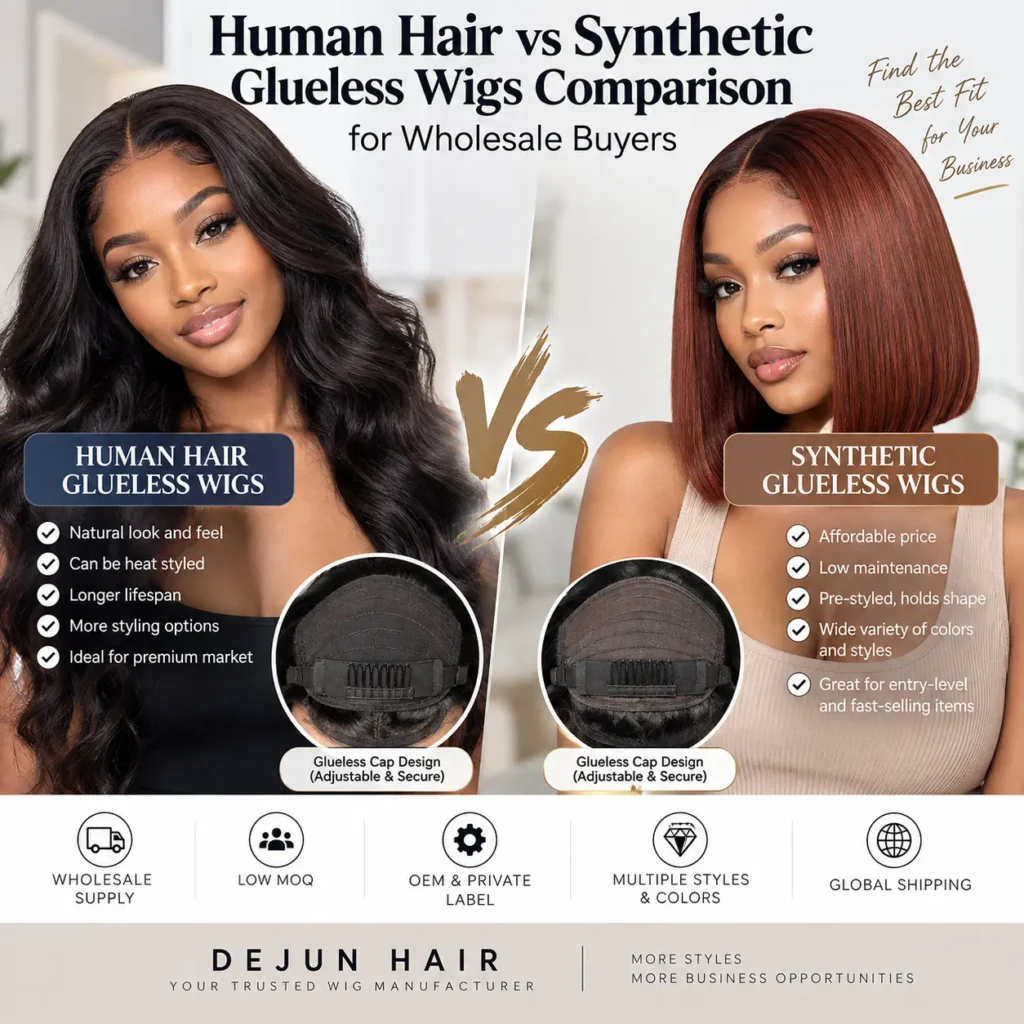
At Dejun Hair, we work with different buyer profiles, from small mixed wholesale orders to larger-volume production and OEM requirements. The appropriate MOQ therefore depends on whether you are purchasing available stock or requesting customized production.
Does OEM and Private Labeling Increase the Cost?
Usually, yes—but not every customization affects the price in the same way.
OEM human hair wigs and private-label orders can include:
- Custom logo
- Branded packaging
- Hang tags
- Custom wig caps
- Specific densities
- Custom lengths
- Lace specifications
- Custom colors
- New style development
- Sample development
Some expenses are primarily setup costs, while others affect the unit cost of every wig.
For example, creating a custom package design may involve an initial setup or printing requirement. Increasing a wig from 150% to 200% density, on the other hand, increases the amount of hair used in every unit.
This distinction is important when calculating whether private labeling makes financial sense.
For an established wig brand ordering repeatedly, the initial customization cost can be distributed across many units and future orders. For a startup testing its first collection, a simpler packaging solution and smaller initial assortment may protect cash flow.
A good human hair wig manufacturer should help you separate essential product specifications from optional customization instead of pushing every possible upgrade into the first order.
Factory Price vs. Trading Company Price: What Are You Paying For?
Buying from a factory does not automatically guarantee that every quotation will be the cheapest, but direct manufacturing can make the cost structure and customization process easier to understand.
With a direct manufacturer, buyers can often communicate more directly about:
- Hair specifications
- Production requirements
- Lace construction
- Custom colors
- Packaging
- Quality control
- Production schedules
- Repeat-order consistency
This becomes particularly valuable for private-label brands because changes can be communicated closer to the production line.
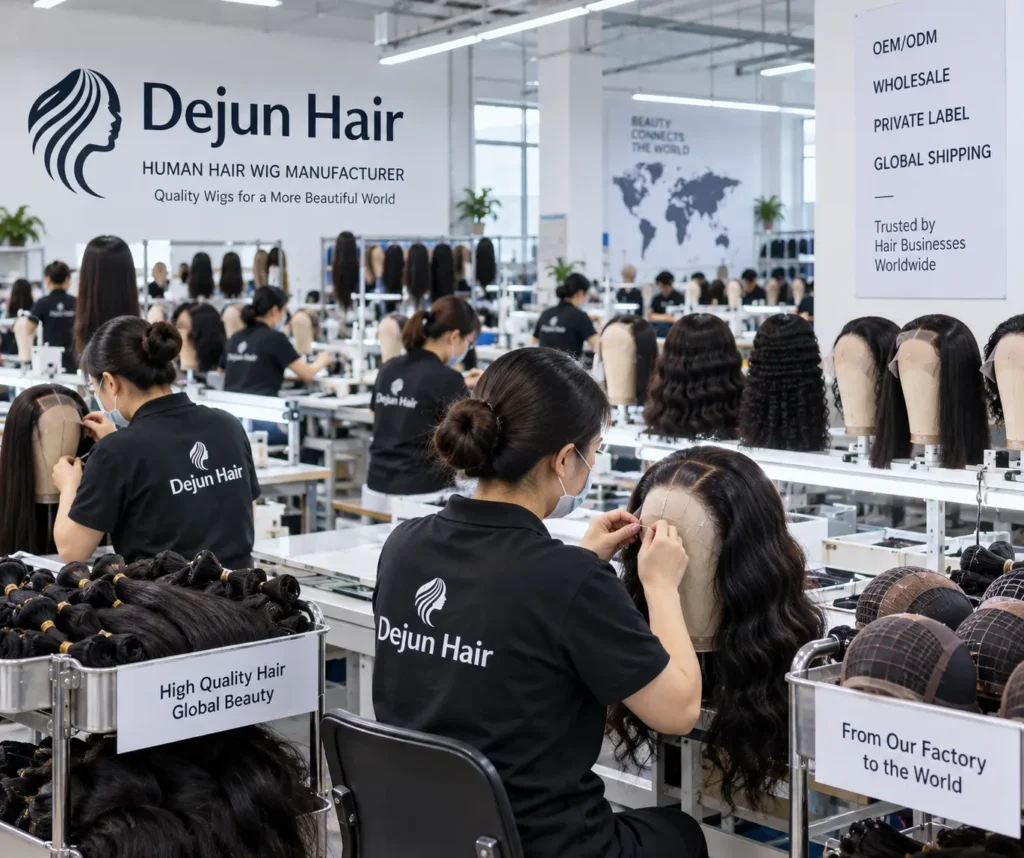
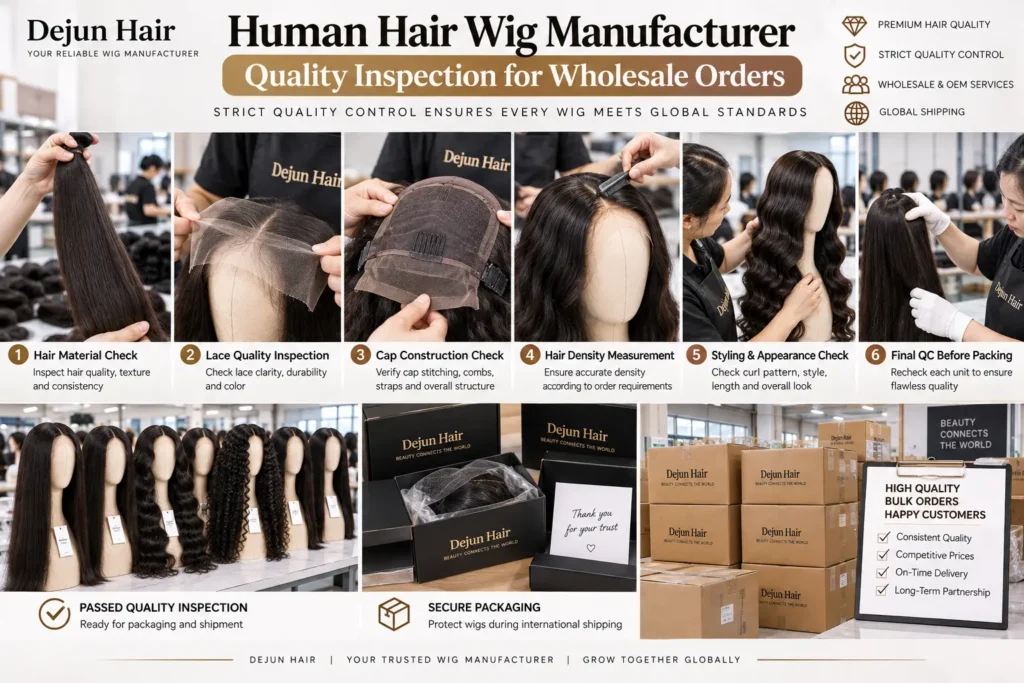
Dejun Hair has operated as a wig manufacturer in Shaoyang, Hunan, for around 20 years, with production processes covering hair preparation, cap making, lace work, styling, quality inspection, and warehousing. For overseas buyers, this type of manufacturing setup is particularly useful when orders move from sample testing to repeat bulk production.
However, whether you work with a factory or another type of human hair wig supplier, you should still inspect samples, confirm specifications in writing, and compare total sourcing value.
Don’t Compare Unit Price Alone: Calculate Your Landed Cost
One of the biggest mistakes in bulk human hair wig sourcing is choosing a supplier entirely on unit price.
The better number to calculate is landed cost.
A simplified formula is:
Landed Cost = Product Cost + Customization + Packaging + Freight + Duties/Taxes + Clearance + Other Import Costs
Suppose one supplier offers a wig for $65 and another offers a comparable product for $70.
At first glance, the $65 product appears better.
But if the first supplier requires expensive shipping, uses packaging you need to replace, or delivers products with a higher defect rate, your real cost may exceed the $70 option.
Quality consistency also has a commercial cost. If a retailer has to refund customers due to excessive shedding, tangling, incorrect density, or inconsistent colors, the loss extends far beyond the factory price of the defective wig.
For this reason, experienced buyers evaluate:
Unit cost + logistics + quality consistency + defect risk + inventory turnover + after-sales cost.
That provides a much more realistic picture of profitability.
How to Calculate Your Human Hair Wig Resale Margin
Wholesale price matters because it determines how much room you have for retail expenses and profit.
Two useful formulas are:
Gross Profit = Selling Price − Landed Cost
Gross Margin = Gross Profit ÷ Selling Price × 100%
For example, assume the landed cost of a wig is $80, and your selling price is $160.
Your gross profit before other operating expenses is:
$160 − $80 = $80
Your gross margin is:
$80 ÷ $160 × 100 = 50%
But that 50% is not your final net profit.
An online seller may still need to pay for advertising, influencer commissions, payment processing, local fulfillment, customer service, returns, website costs, and discounts. A salon may have rent, staff, installation, styling, and other operating expenses.
Therefore, when deciding how to price human hair wigs for resale, work backward from your realistic retail price and required margin rather than simply adding an arbitrary percentage to the supplier’s quotation.
How to Compare Quotes From Human Hair Wig Suppliers
When comparing different best human hair wigs wholesale vendors, put their quotations into the same specification format so you can evaluate hair quality, density, lace construction, MOQ, customization, and total sourcing cost on an equal basis.
Before making a decision, check:
- Is the hair quality genuinely comparable?
Ask about hair type, processing, and expected performance—not only the grade name. - Is the length specification identical?
Confirm how straight, body wave, and curly lengths are measured. - Is the density the same?
A lower-density wig should not be compared directly with a higher-density product. - What lace size and material are included?
4×4, 5×5, 13×4, 13×6, HD lace, and full lace have different cost structures. - What cap construction is included?
Check adjustable bands, combs, cap size, glueless structures, and other features. - What customization is included?
Logo, packaging, tags, colors, pre-plucking, and other services may be quoted separately. - What is the MOQ?
Compare both minimum quantities and mixed-order flexibility. - What is the production lead time?
A slightly cheaper product has limited value if repeated delays leave your best-selling SKUs out of stock. - How does the supplier control quality?
Ask about shedding, tangling, color, sizing, construction, and pre-shipment inspection. - How are defective products handled?
Clear after-sales terms reduce the financial risk of bulk sourcing.
If you are still evaluating potential partners, our guide on how to choose a reliable wholesale human hair wigs supplier explains the broader supplier-selection process.
How to Get an Accurate Wholesale Human Hair Wig Quote
If you ask a factory only for its “wig supplier price list,” you may receive dozens or hundreds of prices that are difficult to compare.
A more efficient approach is to send a clear sourcing specification.
Include:
- Wig style
- Human hair type/quality requirement
- Texture
- Length
- Density
- Lace size
- Lace material
- Cap size or construction
- Color
- Quantity per SKU
- Total order quantity
- Logo requirements
- Packaging requirements
- Destination country
For example, instead of writing:
“How much are your human hair wigs?”
send a request such as:
“Please quote 50 pieces of 18-inch straight human hair glueless wigs, 180% density, 5×5 lace, natural black, with 10 pieces each across five styles. Please provide pricing for standard packaging and private-label packaging, plus production lead time and shipping options to my country.”
The second request gives the factory enough information to prepare a much more useful quotation.
Why Work With a Direct Human Hair Wig Manufacturer?
For wholesale buyers, a reliable manufacturing partner should provide more than a low human hair wigs bulk price.
The real objective is to build a supply chain that can maintain product quality as your business grows.
Dejun Hair is a wig factory based in Shaoyang, Hunan, China, with around 20 years of local manufacturing experience. Our production covers human hair and synthetic wig categories, with in-house processes for hair preparation, cap construction, lace sewing, styling, inspection, and warehousing.
For B2B buyers, our supply model supports:
- Stock wholesale orders
- Flexible mixed-product purchasing
- Human hair and synthetic wig categories
- OEM/ODM development
- Private-label packaging
- Custom logo and hang tags
- Length, density, cap, lace, and color customization
- Sample evaluation
- Bulk production
- Pre-shipment quality inspection
- Shipping support for overseas markets
More importantly, the appropriate product specification should match the buyer’s market.
A beauty supply distributor serving a highly price-sensitive market may need a very different product mix from an online brand selling premium HD lace wigs. The goal is not to add the most expensive specification to every product. It is to select the quality, features, MOQ, and price level that create a sustainable resale opportunity.
Frequently Asked Questions About Wholesale Human Hair Wig Prices
How much does a human hair wig cost wholesale?
Wholesale human hair wig prices can range from roughly $30–$50 for some shorter, simpler entry-level products to $200–$300 or more for premium long, high-density, HD lace, or full lace wigs. The exact price depends on hair quality, length, density, lace, construction, color, quantity, and customization.
Why are some wholesale human hair wigs much cheaper?
Lower prices may result from shorter lengths, lower density, smaller lace areas, simpler caps, lower-cost hair, heavier processing, large production quantities, or fewer customization services. A low price is not necessarily a problem, but buyers should confirm that they are comparing identical specifications.
What is the MOQ for wholesale human hair wigs?
There is no universal wig wholesale MOQ. MOQ varies by supplier, product, stock availability, and customization. Ready-stock orders may allow smaller or mixed quantities, while custom colors, caps, packaging, and OEM production may require higher minimums.
Are human hair wigs cheaper when buying in bulk?
They can be. Larger orders may allow a manufacturer to improve production efficiency and spread setup costs across more units. However, the discount depends on the product and specification, so buyers should request quantity-based quotations rather than assume a fixed percentage.
Are longer human hair wigs more expensive?
Yes, in general. Longer wigs require more expensive raw hair, and long high-quality strands are more difficult to source consistently. Price increases can become more significant at 26, 28, 30 inches and above.
Does HD lace increase the wholesale wig price?
Usually. Genuine high-quality HD lace generally costs more than standard lace, and the final price also depends on lace size, wig construction, knot work, and other customization.
Does custom packaging increase wholesale costs?
Usually, but the amount depends on the packaging material, printing method, design, quantity, and supplier requirements. Ask whether packaging costs are one-time setup charges or recurring per-unit costs.
Can I mix different wig styles in one wholesale order?
Some manufacturers allow mixed orders, particularly for stock products. This can be valuable for salons and new retailers that want to test different lengths, textures, and styles without holding too much inventory in one SKU.
Should I buy directly from a human hair wig factory?
Direct factory sourcing can be beneficial when you need detailed specification control, OEM customization, bulk production, and repeat-order consistency. However, buyers should still verify samples, production capability, QC procedures, communication, and after-sales policies before scaling an order.
How do I get a wholesale human hair wig price list?
Contact the supplier with your required wig types, lengths, densities, lace specifications, colors, quantities, packaging requirements, and destination. A specification-based quotation is usually more useful than a generic price list because wholesale human hair wig prices can vary substantially between configurations.
Conclusion: Compare Value, Not Just Wholesale Wig Prices
There is no single answer to how much wholesale human hair wigs cost. A short closure wig and a 30-inch high-density HD lace wig are fundamentally different products, even though both may be advertised as 100% human hair wigs.
For a safer purchasing decision, remember three principles:
First, compare identical specifications—not product names alone.
Second, calculate landed cost rather than focusing only on factory price per piece.
Third, test product quality and supplier reliability before scaling your order.
The best sourcing decision is not necessarily the cheapest wig. It is the product that gives your business the right combination of quality, wholesale price, MOQ, customization, delivery reliability, resale margin, and customer satisfaction.
Planning your next wholesale human hair wig order? Send Dejun Hair your preferred wig styles, hair quality, lengths, densities, lace specifications, colors, quantities, destination, and private-label requirements. We can help you evaluate suitable specifications and prepare a factory quotation based on your actual sourcing needs.
Google official and wholesale wig factory industry reference links:

Dejun Hair
Direct from Chinese Wig Factories | One-Stop Wholesale Supplier of Wigs for International Trade.