Human Hair vs Synthetic Glueless Wigs: A Wholesale Buyer’s Guide to Cost, Quality & Market Fit
For wholesalers, salon owners, beauty supply stores, and online wig sellers, choosing between human hair and synthetic glueless wigs is more than a product-quality decision. It affects your purchasing budget, retail price, inventory turnover, customer satisfaction, and ultimately your profit strategy.
This is why human hair vs synthetic glueless wigs should be compared from a business perspective rather than simply asking which material looks better.
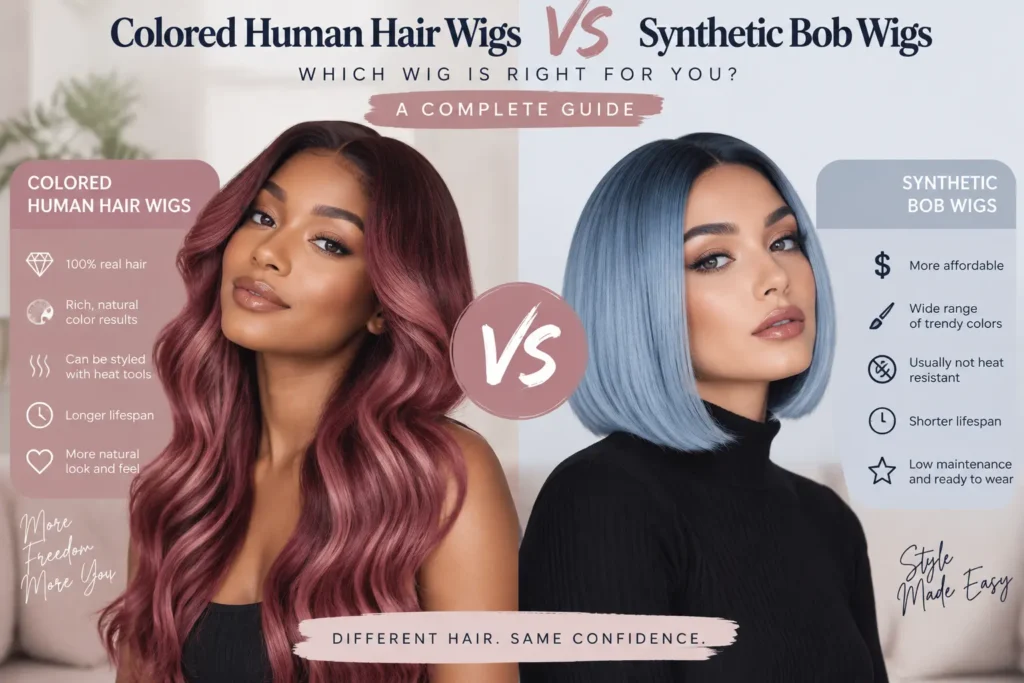
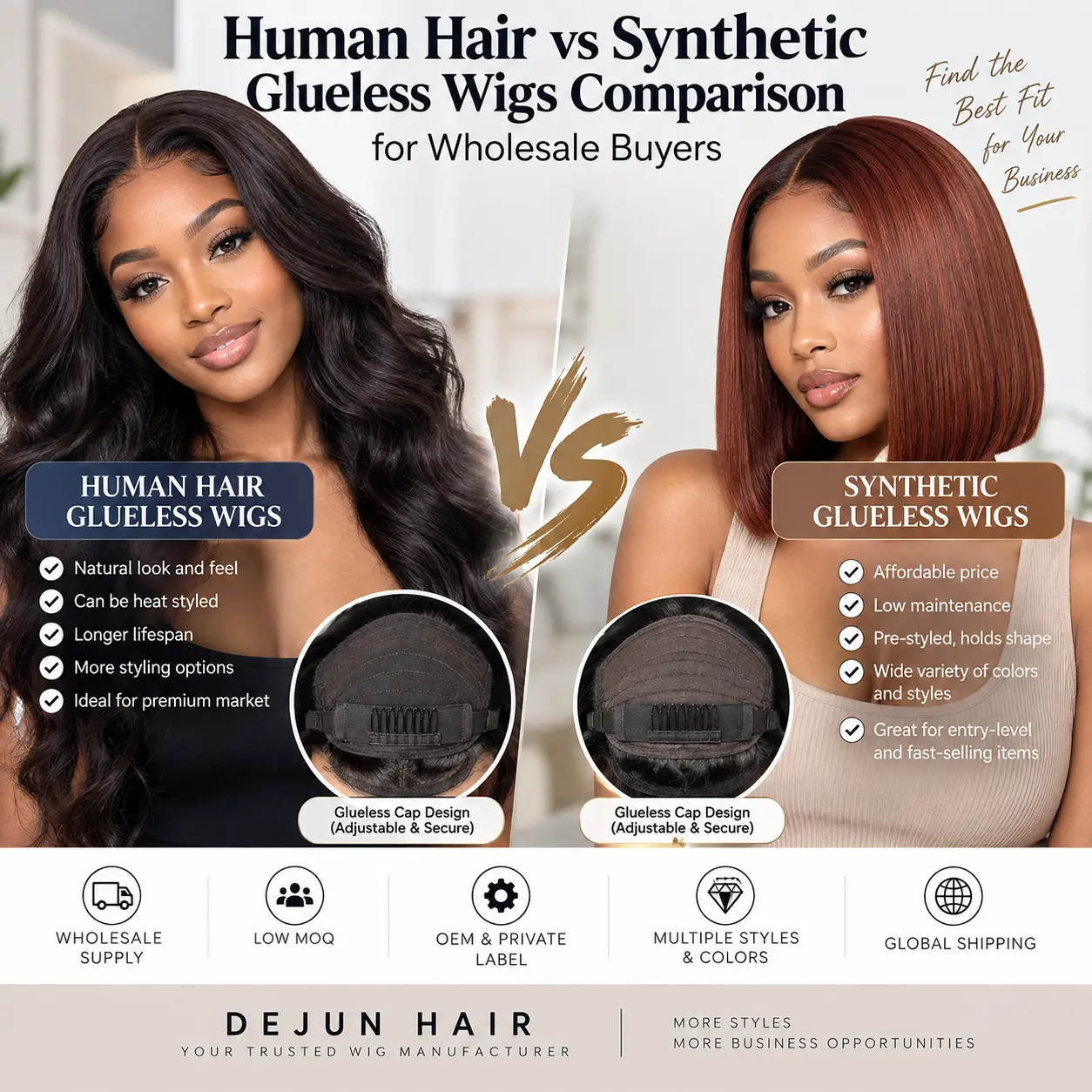
Human hair glueless wigs generally offer a more natural feel, greater styling flexibility, and stronger premium positioning. Synthetic glueless wigs, on the other hand, require less purchasing capital, retain their pre-set styles well, and allow sellers to test more colors and designs without tying up as much cash in inventory.
For a wholesale buyer, therefore, the better choice depends on your target customers, price range, sales channel, and inventory strategy.
This guide compares human hair vs synthetic glueless wigs for wholesale across cost, quality, styling, durability, maintenance, market positioning, inventory planning, and OEM customization to help you build a product mix that fits your business.
Human Hair vs Synthetic Glueless Wigs: Quick Comparison
Before examining each factor in detail, here is a practical comparison for wholesale buyers.
| Factor | Human Hair Glueless Wigs | Synthetic Glueless Wigs |
|---|---|---|
| Wholesale Cost | Higher | Lower |
| Natural Appearance | Excellent | Good to very good, depending on fiber |
| Hair Movement | Very natural | Depends on fiber quality |
| Heat Styling | High flexibility | Limited to heat-resistant fibers |
| Coloring | Usually possible, depending on hair quality | Generally not recommended |
| Style Retention | Requires restyling | Strong pre-set style retention |
| Maintenance | Moderate to high | Low |
| Expected Product Life | Generally longer | Generally shorter |
| Inventory Investment | Higher | Lower |
| Color Selection | Natural and custom colors | Very wide fashion-color range |
| Retail Positioning | Mid-range to premium | Budget to mid-range |
| Best Fit | Salons, premium retailers, established brands | Startups, fashion sellers, price-sensitive markets |
| OEM Potential | Extensive | Extensive |
The table highlights an important point: synthetic vs human hair glueless wigs is not simply a low-quality-versus-high-quality comparison. Each material serves a different commercial purpose.
A successful wholesale strategy may therefore include both.
What Is a Human Hair Glueless Wig?
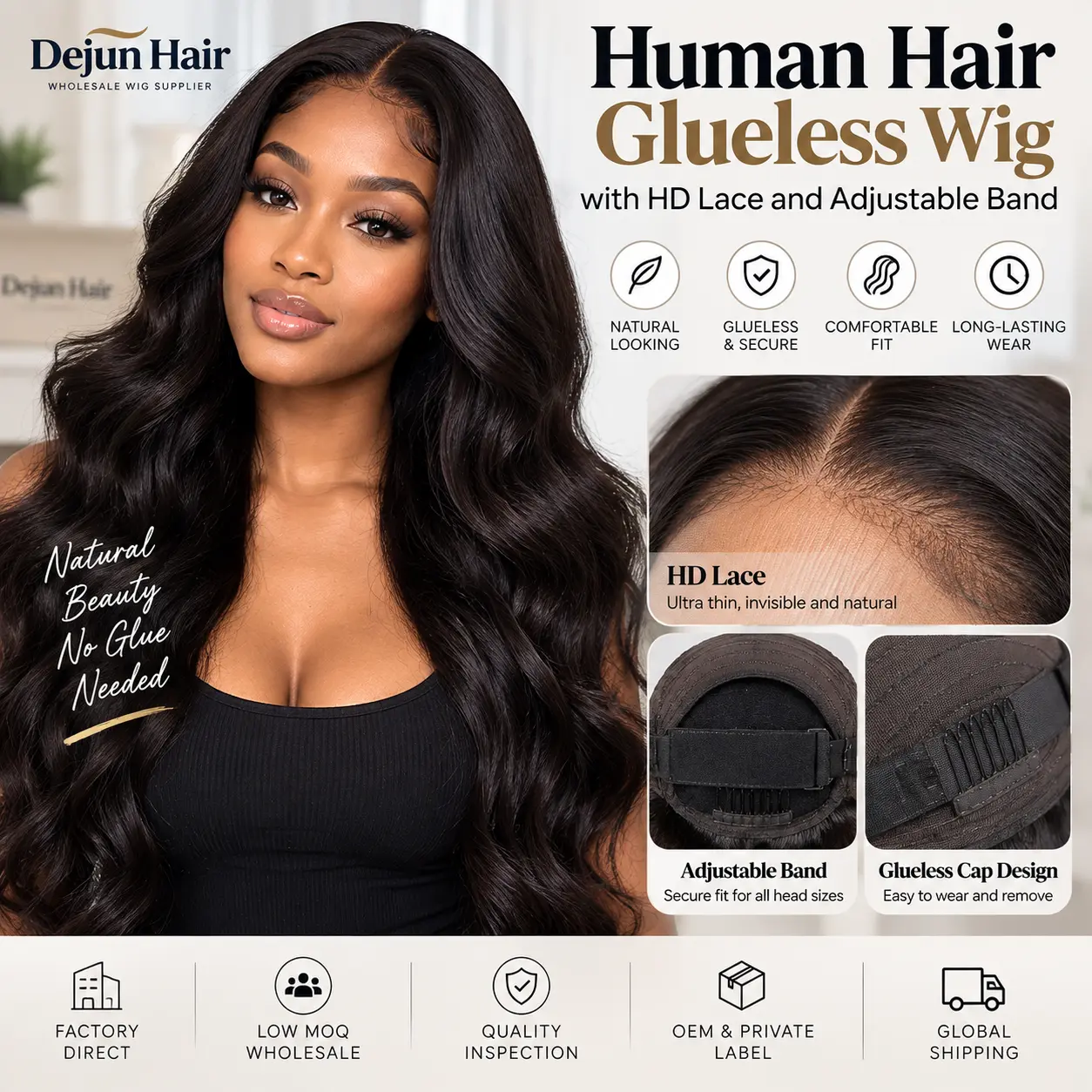
A human hair glueless wig is made with real human hair and uses a cap construction designed to stay secure without requiring adhesive for normal wear.
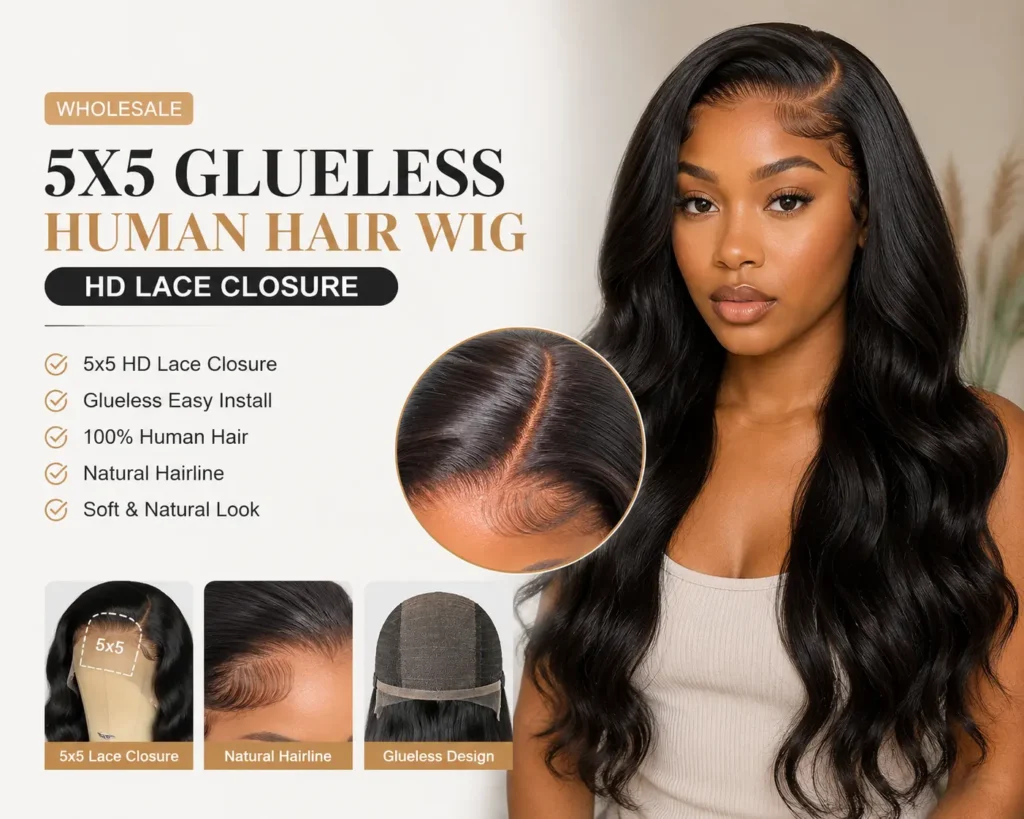
Depending on the design, the wig may use adjustable elastic bands, combs, clips, or other internal adjustment features. Closure-based designs such as the 5×5 glueless wig are especially popular because they combine a natural-looking lace area with convenient installation.
Higher-end products may also use HD or transparent lace, pre-plucked hairlines, bleached knots, and carefully selected Remy or virgin human hair.
For wholesale buyers, the major advantage of a human hair glueless wig is versatility. End customers can usually wash and restyle quality human hair, and suitable products can be curled or straightened with heat.
This makes human hair glueless wigs wholesale particularly relevant to salons, premium wig boutiques, online human hair brands, and sellers targeting customers who expect styling flexibility.
However, buyers should not assume that every product labeled “human hair” offers the same quality. Hair source, processing, cuticle condition, density, lace workmanship, cap construction, and quality control all affect the final product.
What Is a Synthetic Glueless Wig?
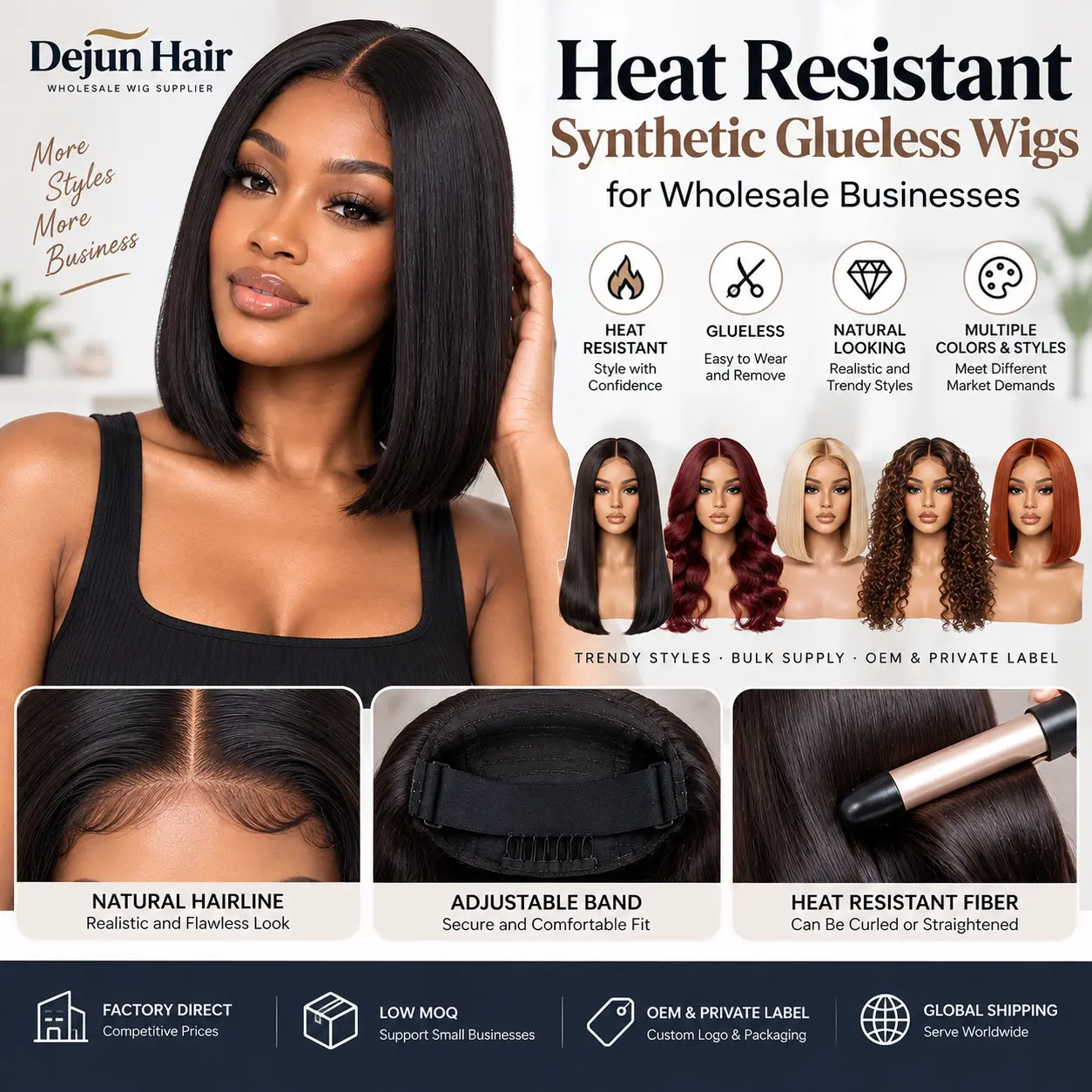
A synthetic glueless wig combines an adhesive-free cap construction with man-made hair fibers.
Modern synthetic fibers can offer much better softness, movement, and appearance than basic costume-grade fibers. Some products use heat-resistant synthetic wig fibers that allow limited heat styling within the manufacturer’s recommended temperature range.
One of the biggest commercial advantages is style retention.
A synthetic wig can be manufactured with a defined straight, wave, curl, bob, or layered pattern and typically requires less restyling after washing than human hair. This creates a strong convenience benefit for customers who want a ready-to-wear product.
Synthetic products also make it easier for retailers to offer multiple colors at accessible price points.
For sellers serving fashion-driven or price-sensitive consumers, synthetic glueless wigs wholesale can therefore provide an efficient way to expand product variety without making the same inventory investment required for premium human hair.
Human Hair vs Synthetic Glueless Wigs: Cost Comparison
Cost is usually the first major difference wholesale buyers notice.
Human hair is a naturally limited raw material that requires sourcing, sorting, processing, and quality grading. Premium Remy or virgin hair generally costs considerably more than synthetic fiber.
But wholesale buyers should avoid comparing products only by unit price.
Your real inventory cost includes:
- Unit purchasing price
- MOQ
- Shipping cost
- Packaging
- Customization
- Samples
- Defect or return risk
- Unsold inventory
- Reordering requirements
Consider two hypothetical product strategies.
A retailer may spend more per piece on a premium human hair glueless wig but sell it at a substantially higher retail price. Another retailer may invest the same total purchasing budget in a wider selection of synthetic wigs and generate more individual transactions.
Neither strategy is automatically more profitable.
The first focuses more heavily on value per unit, while the second can focus on inventory turnover and sales volume.
This distinction matters most for new businesses buying wholesale glueless wigs.
If working capital is limited, lower-cost synthetic products let the seller test more colors, textures, and lengths. Once customer demand becomes clearer, the business can invest more confidently in higher-value human hair inventory.
Quality and Natural Appearance
When comparing human hair vs. synthetic glueless wigs, natural appearance remains one of the strongest advantages of quality human hair.
Real human hair naturally reflects light, moves, and responds to styling in ways that synthetic fibers attempt to reproduce. Premium human hair also gives stylists more freedom to personalize the final look.
However, material alone does not determine whether a glueless wig looks natural.
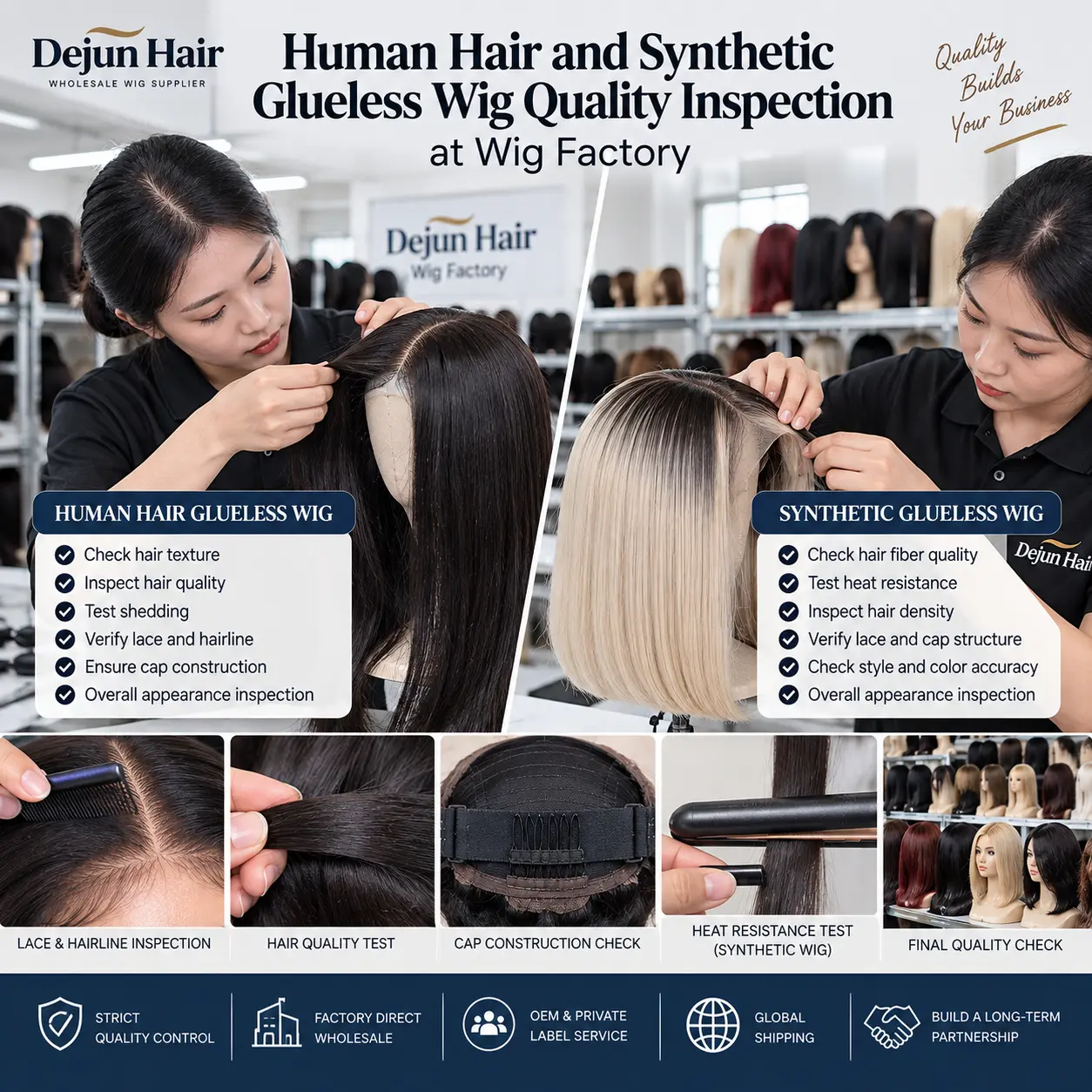
Wholesale buyers should inspect the complete construction, including:
Hair or fiber quality. Check softness, consistency, excessive shine, tangling, shedding, and how the material behaves after washing.
Lace quality. A high-quality HD lace glueless wig can create a much more natural hairline than a product using heavy or poorly matched lace.
Knots and hairline. Pre-plucked hairlines and appropriately processed knots can improve realism.
Density distribution. Excessive density around the front may make even an expensive human hair wig look unnatural.
Cap construction. Adjustable bands, combs, lace placement, stitching, and sizing influence both security and comfort.
This is why experienced wholesale buyers evaluate the complete wig instead of purchasing according to a “human hair” or “synthetic” label alone.
Styling Flexibility: Where Human Hair Has an Advantage
Styling is another major difference between the two materials.
A quality Remy human hair wig generally gives the wearer much greater freedom to straighten, curl, wash, and restyle the hair. Depending on its processing history and quality, human hair may also be suitable for professional coloring.
This flexibility is particularly valuable to salons.
A salon can purchase one base product and personalize the final style according to individual clients. Premium online brands can also market versatility as part of the product’s value proposition.
Synthetic wigs work differently.
Most are designed to preserve the style created during manufacturing. That is an advantage for customers who want a consistent wear-and-go wig, but it limits restyling flexibility.
Heat-resistant synthetic fibers can provide more options, but wholesalers should confirm the supplier’s specific fiber specifications and recommended heat limits. “Heat-resistant” should never be interpreted as having the same styling characteristics as human hair.
Maintenance: Synthetic Wigs Can Offer a Convenience Advantage
Human hair wins on styling flexibility, but synthetic hair can win on convenience.
Human hair wigs generally need more care to maintain their appearance. After washing, the wearer may need to blow-dry, straighten, curl, or otherwise restyle the hair.
Synthetic wigs are commonly designed to return closer to their original style after washing and drying. This can be attractive to customers who want a low-maintenance everyday product.
For wholesalers, this difference affects marketing.
A premium salon may emphasize:
“Natural human hair that can be professionally customized.”
A mass-market online seller may emphasize:
“Easy-to-wear, pre-styled, low-maintenance convenience.”
Both propositions can sell effectively—they simply target different customers.

Durability and Customer Expectations
Human hair glueless wigs usually have greater potential for long-term use than synthetic wigs when the hair quality, construction, and maintenance are appropriate.
But durability should be discussed carefully.
There is no single lifespan that applies to every human hair or synthetic wig. Frequency of wear, washing habits, heat exposure, chemical processing, friction, storage, fiber quality, lace construction, and customer care all affect product life.
From a business perspective, there is another important factor:
Higher prices usually create higher customer expectations.
A customer purchasing an inexpensive fashion wig may accept a shorter usable life if the style and price meet expectations.
A customer purchasing a premium human hair wig is much more likely to examine:
- Shedding
- Tangling
- Lace durability
- Hair softness
- Density
- Color consistency
- Hairline construction
- Long-term appearance
This means wholesale buyers should match quality-control standards to retail positioning.
Selling a premium-priced product with inconsistent hair or poor lace construction can create more expensive after-sales problems than selling a correctly positioned synthetic product.
Which Type Offers Better Profit Potential?
There is no universal answer because profit per wig and overall business profitability are different measurements.
Human Hair Glueless Wig Business Model
Human hair usually requires:
Higher purchasing investment → Higher retail positioning → Higher potential revenue per unit
This model can work well for premium salons, established wig stores, custom styling businesses, and online brands with customers willing to pay for natural appearance and styling flexibility.
Synthetic Glueless Wig Business Model
Synthetic wigs typically offer:
Lower purchasing investment → Accessible retail pricing → Wider SKU testing → Potentially faster inventory movement
This can be effective for fashion stores, beauty supply retailers, social-commerce sellers, startups, and businesses serving price-sensitive consumers.
Imagine that you have a fixed purchasing budget.
With human hair, you might stock fewer units across carefully selected lengths and textures.
With synthetic products, the same budget might allow you to test a much larger combination of colors and styles.
Therefore, when searching for the best glueless wigs for resale, don’t evaluate gross margin alone.
Consider:
Gross profit per unit × realistic sales volume × inventory turnover – returns and operating costs.
That gives you a much more useful picture of commercial performance.
Market Fit: Which Glueless Wigs Should You Stock?
Product selection should start with your customers rather than your supplier’s catalog.
| Business Type | Practical Product Direction |
|---|---|
| Premium Hair Salon | Human hair-focused |
| Human Hair Boutique | Human hair-focused |
| Beauty Supply Store | Human hair + synthetic |
| Fashion Wig Store | Synthetic + selected human hair |
| TikTok/Instagram Seller | Mixed range for product testing |
| Premium Online Wig Brand | Human hair-focused |
| New Wig Business | Controlled mixed inventory |
| Price-Sensitive Market | Synthetic + entry-level human hair |
| Multi-Price Retailer | Good/Better/Premium combination |
For example, an established salon may benefit from premium human hair because stylists can offer additional customization services.
An online seller that relies heavily on short-form social content may benefit from having many colors, cuts, and textures available for frequent new-product launches.
A beauty supply wholesaler serving different retailers may need both.
The question is therefore not simply, “Which wig is better?”
It is:
Which product gives my target customer the right balance of appearance, convenience, quality, and retail price?
Should Wholesale Buyers Stock Both Human Hair and Synthetic Glueless Wigs?
For many businesses, the most practical answer is a tiered assortment.
Instead of forcing every customer into one price range, retailers can build a product ladder.
Entry Level
Synthetic glueless wigs can attract customers who prioritize affordability, easy maintenance, fashion colors, and convenience.
Mid-Range
Higher-quality heat-resistant synthetic products and selected human hair designs can serve customers willing to spend more without immediately entering the premium category.
Premium
Virgin or high-quality human hair glueless wigs with better lace, hairline work, and cap construction can serve customers looking for natural appearance and styling versatility.
This Good–Better–Premium structure can help wholesalers and retailers serve different budgets while reducing dependence on one product category.
It can also create an upgrade path.
A customer who first purchases an affordable synthetic glueless wig may later purchase a premium human hair version after becoming comfortable with the glueless design.
MOQ and Inventory Strategy for Your First Wholesale Order
MOQ is especially important when testing a new product category.
A large MOQ on an unproven style can create dead inventory even if the unit price looks attractive.
For first orders, consider working with a glueless wig wholesale supplier that allows sample testing, low-MOQ ready stock, or mixed orders.
Instead of ordering one style in a large quantity, a new seller could test combinations such as:
- Straight
- Body wave
- Curly
- Bob
- Natural black
- Brown
- Blonde
- Selected fashion colors
The exact combination should reflect your local customers rather than a generic bestseller list.
After the first selling cycle, measure sell-through by material, style, length, color, and price point. Your second purchase can then concentrate more heavily on proven SKUs.
This approach is particularly valuable for small salons and e-commerce startups because it turns the first order into a controlled market test.
Human Hair vs Synthetic Glueless Wigs for Different Sales Channels
Your sales channel also affects product selection.
Salons
Human hair often makes sense because professional stylists can add value through cutting, curling, coloring, fitting, and personalization.
Beauty Supply Stores
A mixed assortment can serve both price-sensitive customers and customers looking for premium products.
Independent E-Commerce Stores
Product positioning matters more than having the largest possible catalog. A premium brand may focus primarily on human hair, while a fashion-focused store may use synthetic products to introduce more styles and colors.
Social Commerce
TikTok and Instagram sellers frequently need visually distinctive products and regular new content. Synthetic wigs can make broad style testing more affordable, while premium human hair products can support higher-ticket offers.
Distributors
Distributors serving multiple retailers often benefit from carrying several price levels because their downstream customers may serve very different consumer groups.
OEM/ODM Options for Human Hair and Synthetic Glueless Wigs
Material selection is only one part of product development.
An experienced wig manufacturer should also help wholesale buyers determine which specifications match their target price and market.
For human hair glueless wigs, OEM options may include:
- Hair grade
- Length
- Density
- Texture
- Color
- Lace material
- Lace size
- Cap size
- Adjustable band
- Hairline design
- Packaging
For synthetic wigs, customization may include:
- Fiber type
- Heat-resistant fiber options
- Color
- Curl or wave pattern
- Length
- Density
- Cap construction
- Packaging
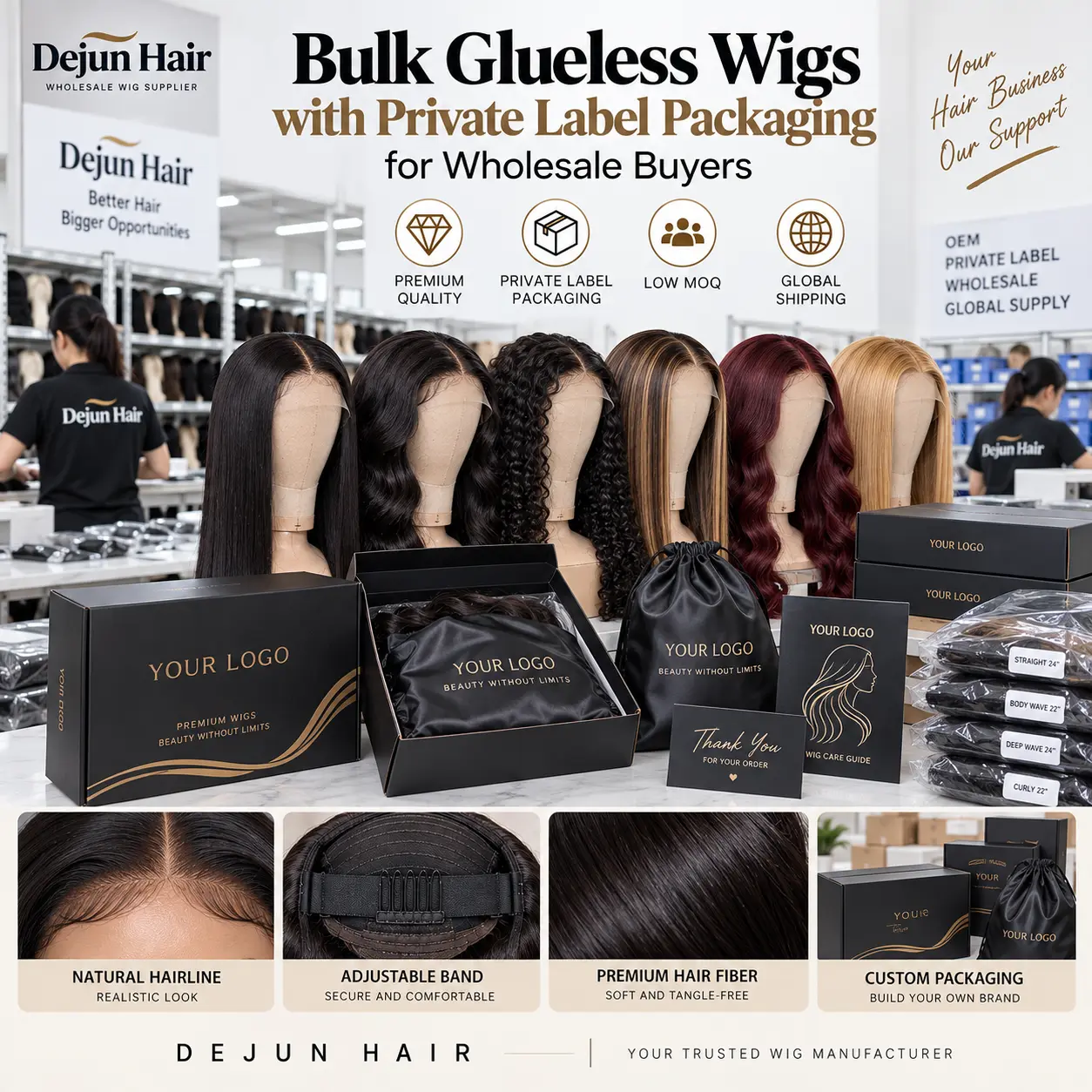
Businesses building their own brands can also develop private label wigs with custom boxes, hang tags, logo labels, inserts, and other branded packaging.
However, buyers should distinguish between ready-stock customization and full OEM development.
Changing packaging or adding a logo may require a relatively manageable MOQ, while developing a completely new fiber color, cap structure, or custom wig design can require different production quantities and lead times.
Ask your supplier to clarify these requirements before approving the project.
How to Evaluate a Glueless Wig Wholesale Supplier
Once you have decided on your human hair and synthetic product mix, supplier selection becomes the next major risk factor.
Before placing an order for bulk wigs, evaluate the supplier in several areas.
1. Material Transparency
The supplier should clearly distinguish human hair grades and synthetic fiber types instead of using vague quality labels.
2. Sample Availability
Test representative samples before scaling a new product.
Wash, comb, wear, and restyle them where appropriate. Check whether the product still meets your expectations after basic use.
3. Construction Quality
Inspect lace, stitching, adjustable bands, combs, cap size, density distribution, hairline construction, shedding, and finishing.
4. Batch Consistency
One good sample is not enough if bulk production cannot reproduce the same standard.
Ask how the factory controls raw materials and final inspection.
5. MOQ Flexibility
If you are testing a market, mixed styles and flexible quantities can be more valuable than obtaining the absolute lowest unit price.
6. OEM and Private Label Capability
Confirm exactly which elements can be customized, their MOQs, sample requirements, production time, and packaging options.
7. Production Capacity
For growing businesses, your supplier should be able to support repeat orders without major changes in quality or delivery performance.
8. Export and After-Sales Experience
International buyers also need reliable packing, shipping documentation, communication, and defect-resolution procedures.
A supplier should therefore be evaluated as a long-term supply-chain partner rather than simply as a source of low unit prices.
A Factory Perspective: Why Material Choice Is Only Part of the Quality Equation
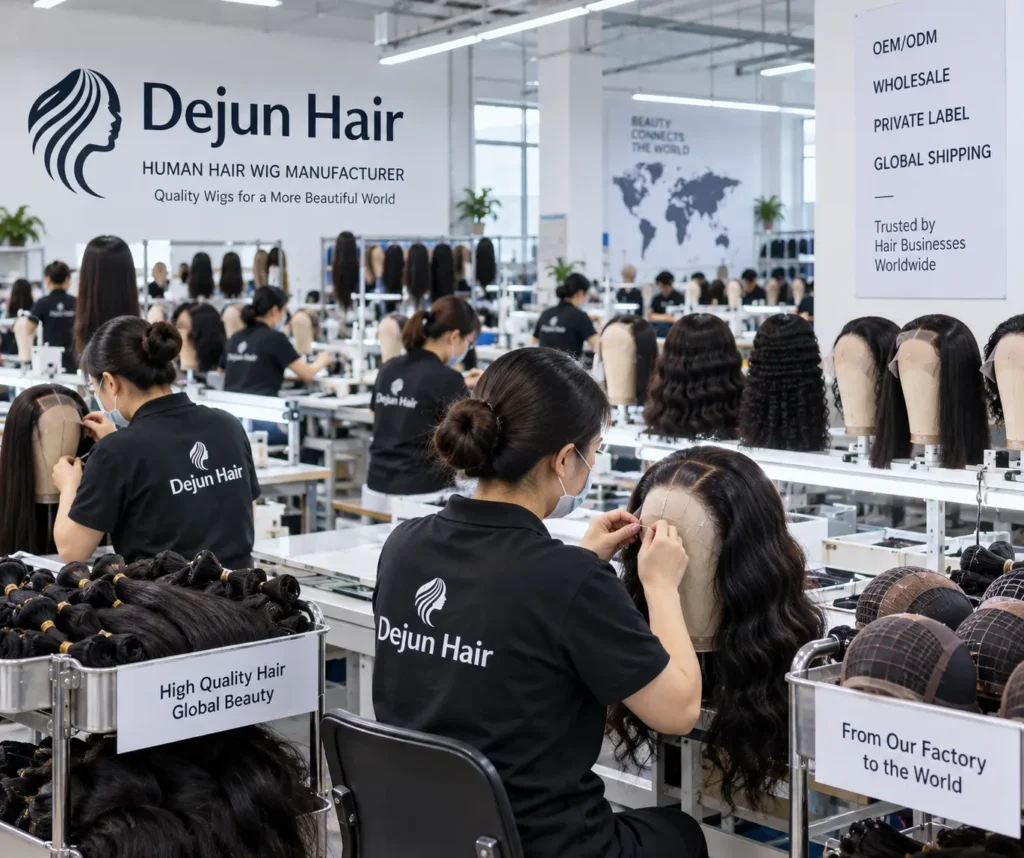
At Dejun Hair, we have worked in wig manufacturing in Shaoyang, Hunan, for approximately 20 years, producing both human hair and synthetic wig categories for overseas businesses.
From a manufacturer’s perspective, we often see buyers focus heavily on hair material while overlooking construction consistency.
In reality, two human hair wigs made from similar raw materials can perform very differently if their lace work, ventilation, cap construction, density control, styling, or quality inspection differs.
The same principle applies to synthetic wigs.
High-quality fiber combined with poor cap construction does not produce a reliable wholesale product.
Our production process therefore covers hair or fiber preparation, cap construction, lace work, styling, inspection, and warehousing. Products are checked for factors such as smoothness, construction security, color consistency, and sizing before shipment.
For wholesale customers, the goal should be consistent quality across repeat orders—not simply an impressive sample.
Human Hair or Synthetic Glueless Wigs: How to Make the Right Buying Decision
When comparing human hair vs synthetic glueless wigs, use these seven questions:
- Who is my target customer?
- What retail price can my market support?
- How much capital can I invest in inventory?
- Does my customer prioritize styling freedom or convenience?
- How quickly do I expect the inventory to turn?
- Which styles, colors, and lengths have proven local demand?
- Do I need OEM or private-label customization?
Choose human hair when natural feel, styling flexibility, premium positioning, and long-term product value are central to your offer.
Choose synthetic when affordability, low maintenance, style retention, color variety, and lower inventory investment are more important.
And if you serve several customer segments, consider stocking both.
Conclusion
The human hair vs synthetic glueless wigs decision should not be reduced to “premium versus cheap.”
Human hair glueless wigs provide natural movement, extensive styling possibilities, and strong premium positioning, but they require more purchasing capital and generally create higher customer expectations.
Synthetic glueless wigs offer lower entry costs, easy maintenance, consistent pre-styled looks, and greater flexibility for testing colors and designs.
For many wholesalers, salons, and online sellers, a carefully planned combination of both materials is more commercially useful than relying entirely on one category.
Start by identifying your customer segments and retail price points. Test a controlled mix of styles and materials, measure actual sell-through, and expand the products that perform best in your market.
If you are planning a new glueless wig collection, Dejun Hair supports human hair and synthetic wig sourcing, mixed wholesale orders, samples, and OEM/private-label customization. Share your target market, preferred styles, expected price range, and order quantity with our team, and we can help you develop a practical product combination for your business.
Frequently Asked Questions
Are human hair glueless wigs better than synthetic glueless wigs?
Not for every business. Human hair offers greater styling flexibility, natural movement, and premium positioning, while synthetic wigs can offer lower costs, easier maintenance, and more affordable style variety. The better wholesale option depends on your customers, retail price, and inventory strategy.
Are synthetic glueless wigs good for wholesale businesses?
Yes. Synthetic glueless wigs can be particularly useful for startups, beauty supply stores, fashion retailers, and sellers serving price-sensitive customers. Their lower purchasing cost can also make it easier to test multiple styles and colors.
Which glueless wigs are best for resale?
The best glueless wigs for resale are those that match your target customer’s budget and expectations. Premium salons may perform better with human hair, while fashion and value-focused stores may benefit from synthetic products. Multi-price retailers can stock both.
Can synthetic glueless wigs be heat styled?
Some can, but only when manufactured from heat-resistant fiber. Always follow the supplier’s recommended temperature range. Standard synthetic fibers should not automatically be treated as heat-safe.
How long do human hair and synthetic glueless wigs last?
There is no universal lifespan. Material quality, construction, frequency of wear, washing, styling, storage, heat exposure, and customer care all influence durability. Human hair generally has greater long-term-use potential, while synthetic wigs generally have a shorter usable life.
What MOQ should I look for when buying glueless wigs wholesale?
The ideal MOQ depends on your business stage. New buyers benefit from low-MOQ or mixed-style orders because they can test market demand before committing to large quantities. Established distributors may prioritize volume pricing and production capacity.
Can I order private label glueless wigs?
Yes. Depending on the manufacturer and order quantity, private-label options can include logo packaging, hang tags, labels, product inserts, custom specifications, colors, density, lace, cap construction, and other OEM features.
Should a new wig business start with human hair or synthetic glueless wigs?
A controlled mixed assortment can be useful when you do not yet have enough sales data. Synthetic products can help test affordable price points and fashion styles, while selected human hair wigs allow you to test premium demand. Use early sales data to guide future purchasing.
Industry reference resources for wholesale wig sourcing:

Dejun Hair
Direct from Chinese Wig Factories | One-Stop Wholesale Supplier of Wigs for International Trade.