Wholesale Human Hair Wigs Business Guide: How Salons and Resellers Increase Profit Margins
For salons, wig retailers, and online resellers, selling human hair wigs can offer attractive profit opportunities. However, a successful wig business is not built simply by buying at the lowest wholesale price and adding a markup.
The real profit depends on many connected factors: which styles you stock, how quickly your inventory sells, product quality, shipping costs, return rates, pricing strategy, customer retention, and the reliability of your supplier.
This is especially important when sourcing wholesale human hair wigs. A wig that costs a few dollars less may appear more profitable at first, but inconsistent density, excessive shedding, poor lace construction, or slow replenishment can quickly reduce the margin through refunds, replacements, discounts, and lost customers.
For salons and resellers that want sustainable growth, the better question is not simply, “How cheaply can I buy wigs?” It is:
How can I build a wholesale human hair wig business that generates healthy margins and repeat sales?
This guide explains the key areas that wig business owners should focus on—from product selection and inventory management to private labeling, marketing, and long-term supplier relationships.

1. Understand the Real Profit Margin of a Human Hair Wig Business
Before trying to increase profit, you need to understand where that profit actually comes from.
A basic calculation may look like this:
Selling Price – Wholesale Product Cost = Gross Profit
But this calculation does not show the complete picture.
For a real human hair wig business, you may also need to consider:
- International shipping and local delivery
- Customs and import-related expenses
- Packaging
- Marketing and advertising
- Payment processing fees
- Discounts and promotions
- Product returns and replacements
- Unsold inventory
- Salon labor or styling costs
A more useful calculation is:
Selling Price – Landed Product Cost – Marketing – Returns – Operating Expenses = Actual Profit
Consider two hypothetical wigs.
Wig A has a lower factory price but suffers from inconsistent density and tangling. Customers frequently complain, and several units have to be replaced.
Wig B costs slightly more but offers more consistent hair quality, construction, and appearance. Customers leave better reviews and are more willing to buy again.
Although Wig A has the lower purchasing price, Wig B may generate the better actual profit.
This is why successful salons and resellers should evaluate wholesale human hair wigs according to total business value rather than unit price alone.

2. Source Wholesale Human Hair Wigs More Strategically
Supplier selection is one of the biggest influences on profitability.
When buyers are learning how to start a wholesale human hair wigs business, it is easy to compare suppliers primarily by quotation. Price matters, but the lowest quotation is not automatically the best purchasing decision.
A professional human hair wig supplier should be evaluated across several areas:
- Hair quality consistency
- Manufacturing capability
- Quality control procedures
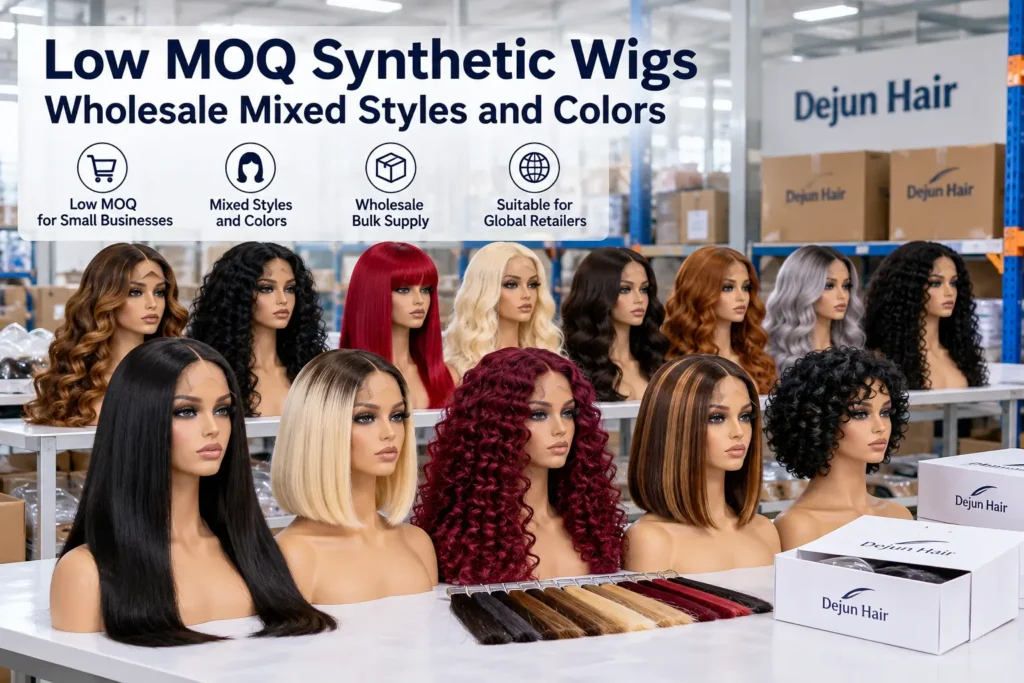
- MOQ requirements
- Mixed-order flexibility
- OEM and private-label capabilities
- Production lead time
- Stock availability
- International shipping experience
- After-sales support
Factory-direct sourcing can be particularly useful for growing businesses because it reduces unnecessary supply chain layers and simplifies communication about product specifications.
For example, an experienced manufacturer can discuss whether changing density, lace construction, packaging, or length combinations could help you reach a more suitable retail price point.
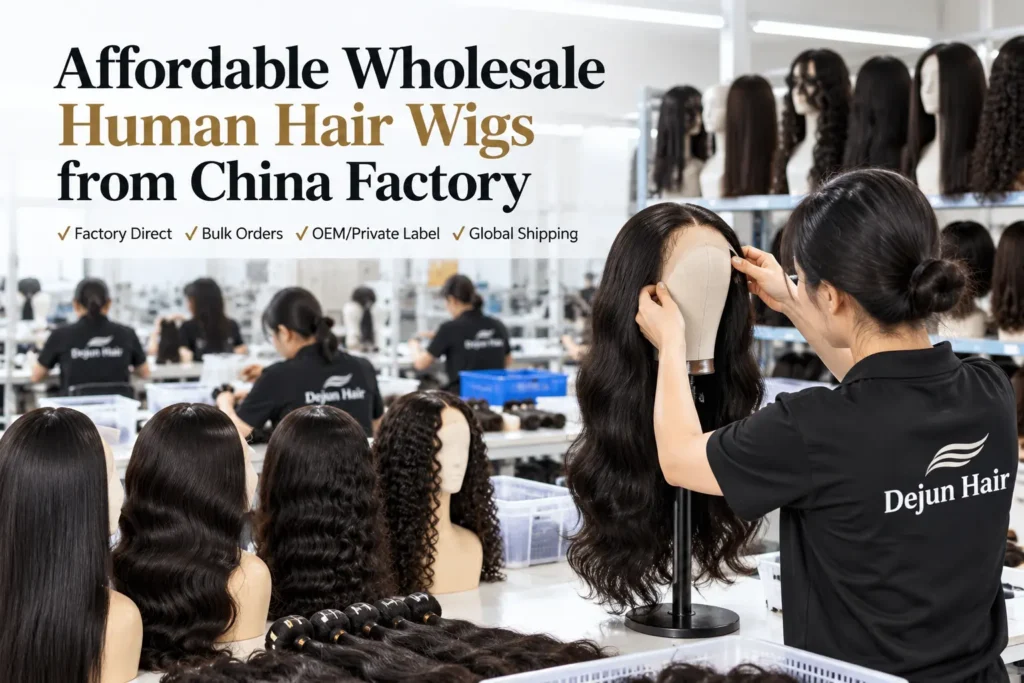
At Dejun Hair, our experience as a wig manufacturer in Shaoyang, China has shown us that professional buyers increasingly look beyond the initial quotation. They want a supplier that can maintain consistent specifications across repeat orders while supporting both stock purchasing and customized production.
For a growing wholesale wig business, this consistency is important because customers expect the product they reorder next month to perform like the product they purchased previously.
3. Choose Human Hair Wig Styles with Strong Sales Potential
One of the most practical answers to how to make profit selling human hair wigs is better product selection.
Not every wig deserves the same amount of inventory.
Instead of purchasing many styles simply because they are available, build your assortment around products that match your target customers, selling channels, and price levels.
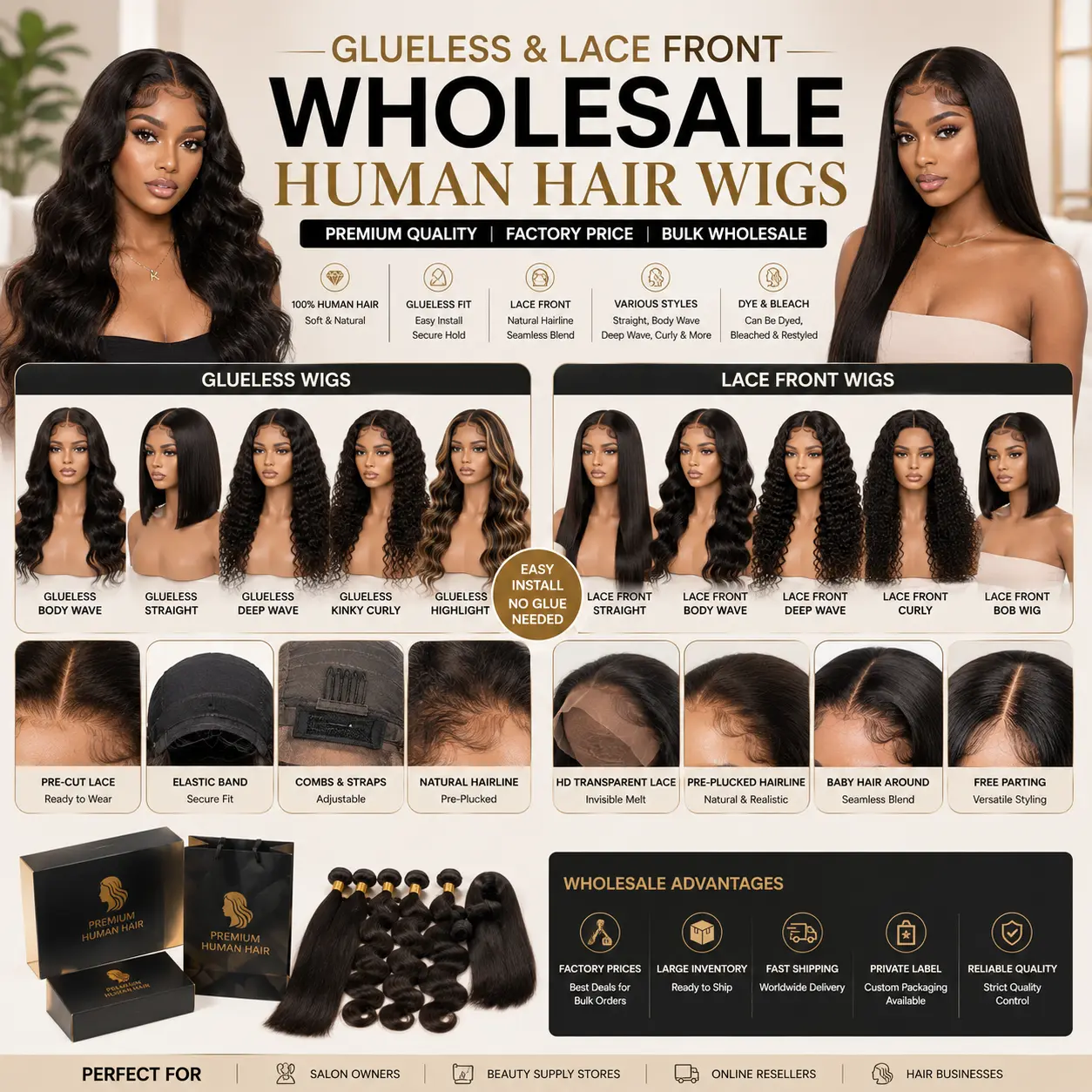
Glueless Wigs
Glueless wigs have become an important category for customers who value convenient installation and everyday wear.
For online resellers, social-commerce sellers, and salons serving customers who want simpler installation, sourcing glueless wigs wholesale can provide an attractive product category.
Consider testing different:
- Lengths
- Textures
- Densities
- Lace sizes
- Natural colors
Then increase purchasing quantities according to actual sales.
Lace Front Wigs
Lace front wigs remain an important category for both salon and retail businesses because they combine styling versatility with a natural-looking hairline.
Buyers sourcing wholesale lace front wigs should pay particular attention to lace quality, knotting, hairline construction, density distribution, and shedding.
These details directly affect customer satisfaction and therefore influence the real profit of the product.
Bob Wigs
Bob wigs can be valuable core products for a salon or resale business.
Their shorter lengths can make them accessible to a wider range of retail customers, while straight, body wave, natural black, blonde, and colored variations allow sellers to create multiple price and style options.
Straight Human Hair Wigs
Straight wigs are useful evergreen products because they are less dependent on short-term fashion trends.
A new reseller may use classic straight human hair wigs as part of a core inventory before investing heavily in more experimental styles.
Colored Human Hair Wigs
Blonde, burgundy, highlighted, ombre, and other colored human hair wigs can help retailers differentiate their collections.
They can also support stronger retail positioning when the color, hair quality, construction, and presentation justify the price.
The goal is not to stock every available wig. The goal is to identify the products with the strongest combination of demand, margin, and inventory turnover.

4. Use Flexible MOQ and Mixed Orders to Protect Cash Flow
Inventory is money sitting on a shelf until the product sells.
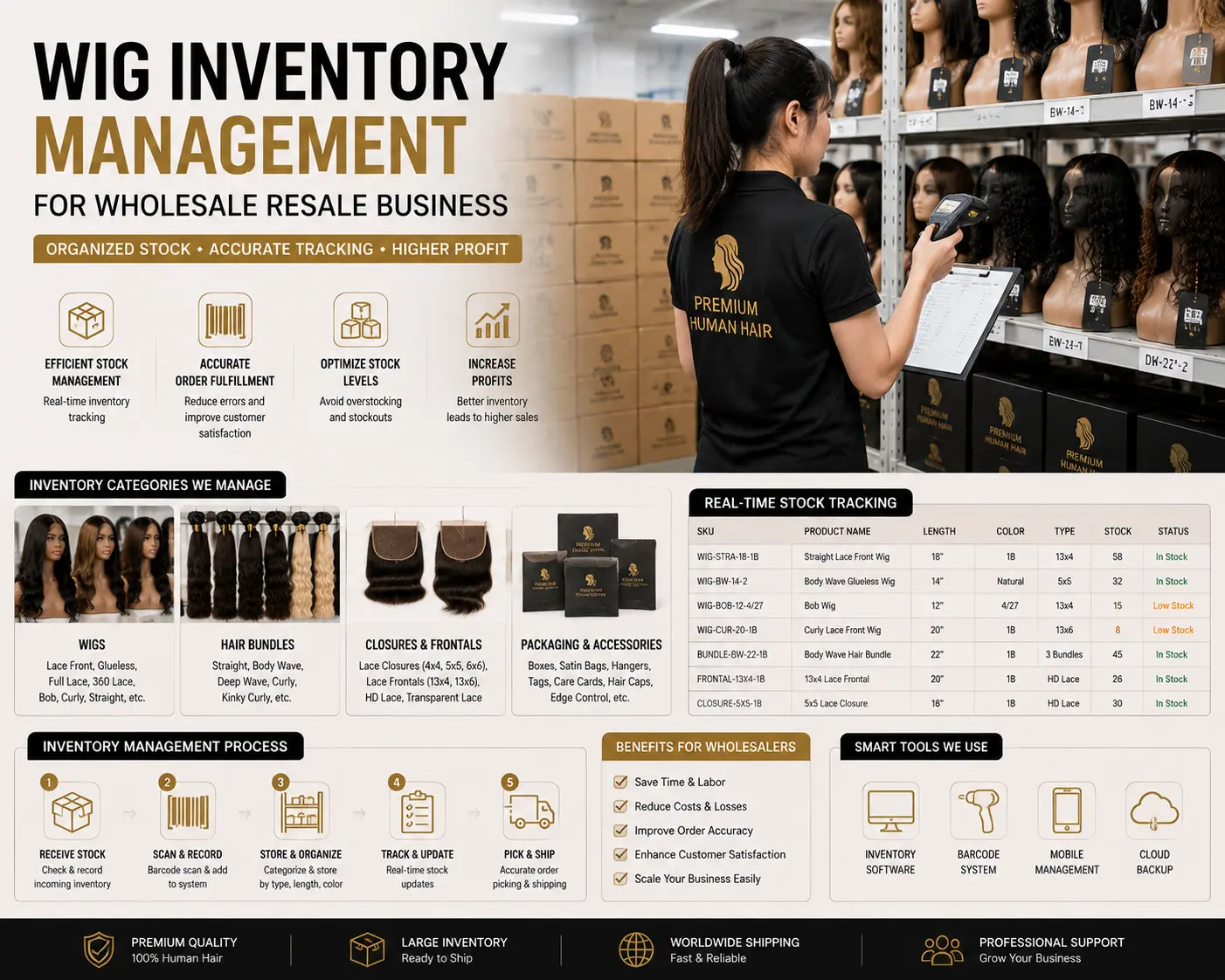
This makes wig inventory management especially important for smaller salons, new resellers, and entrepreneurs with limited working capital.
Imagine that you have enough budget for 100 wigs.
Putting the entire budget into one length and one style creates significant risk. If that SKU sells slowly, much of your cash becomes trapped in inventory.
A more flexible test order could include different:
- Wig constructions
- Textures
- Lengths
- Densities
- Colors
- Price levels
This gives you real market information before making a larger commitment.
For example, a reseller might discover that 18-inch glueless wigs sell much faster than expected, while a particular long lace style moves slowly. The next order can then be adjusted toward actual customer demand.
For beginners looking for human hair wig business ideas, this test-and-reorder approach is usually more practical than trying to predict every bestseller in advance.
A supplier that supports low-MOQ stock orders and mixed purchasing can therefore provide value beyond a slightly lower unit price.
Fast inventory turnover can be more valuable than a high theoretical margin on products that do not sell.
5. Protect Profit by Controlling Human Hair Wig Quality
Product quality and profitability are closely connected.
Poor-quality wigs can create hidden expenses through:
- Refunds
- Replacements
- Customer complaints
- Negative reviews
- Extra customer-service time
- Discounts
- Lost repeat customers
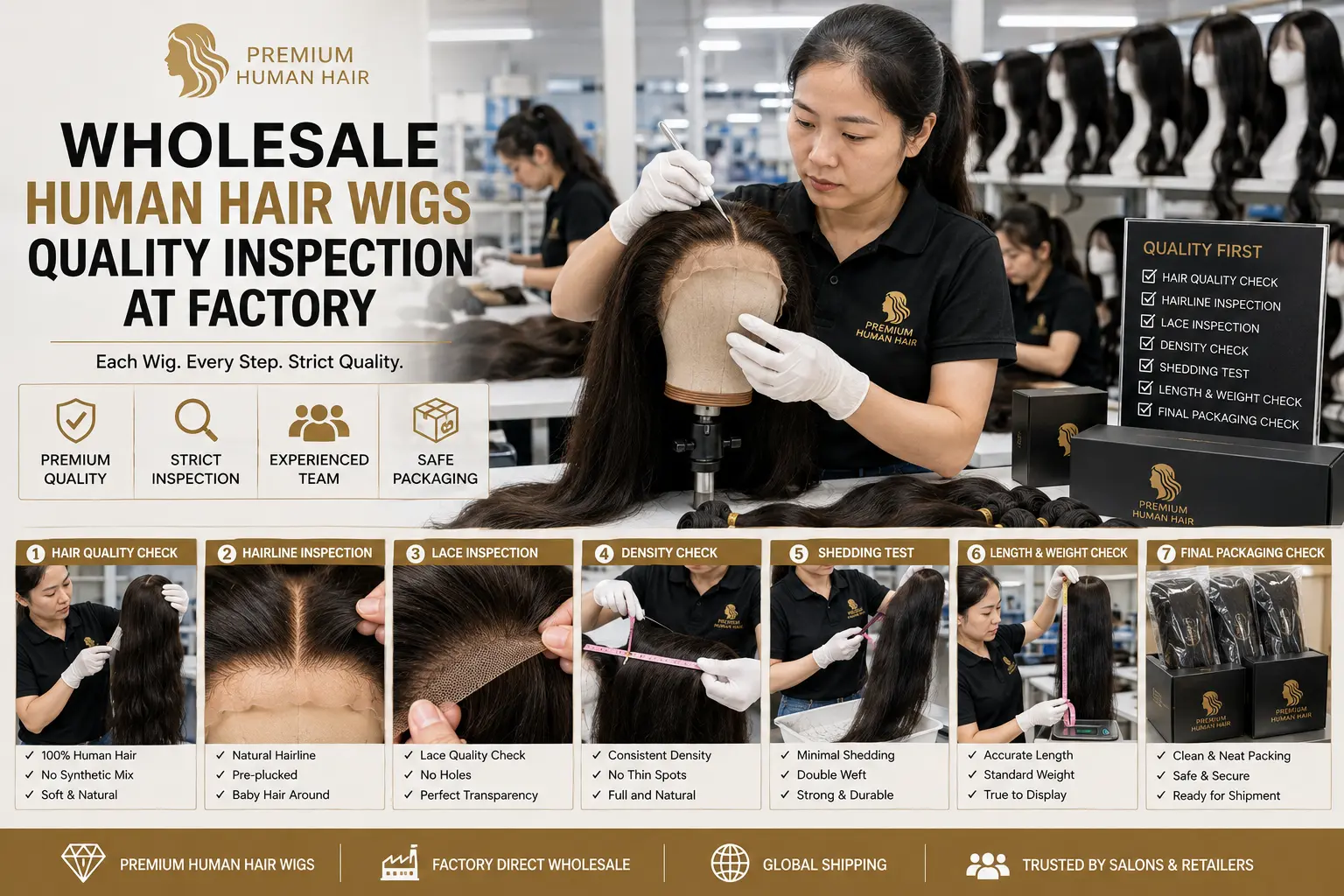
Before placing a large order of 100% human hair wigs, buyers should inspect more than appearance.
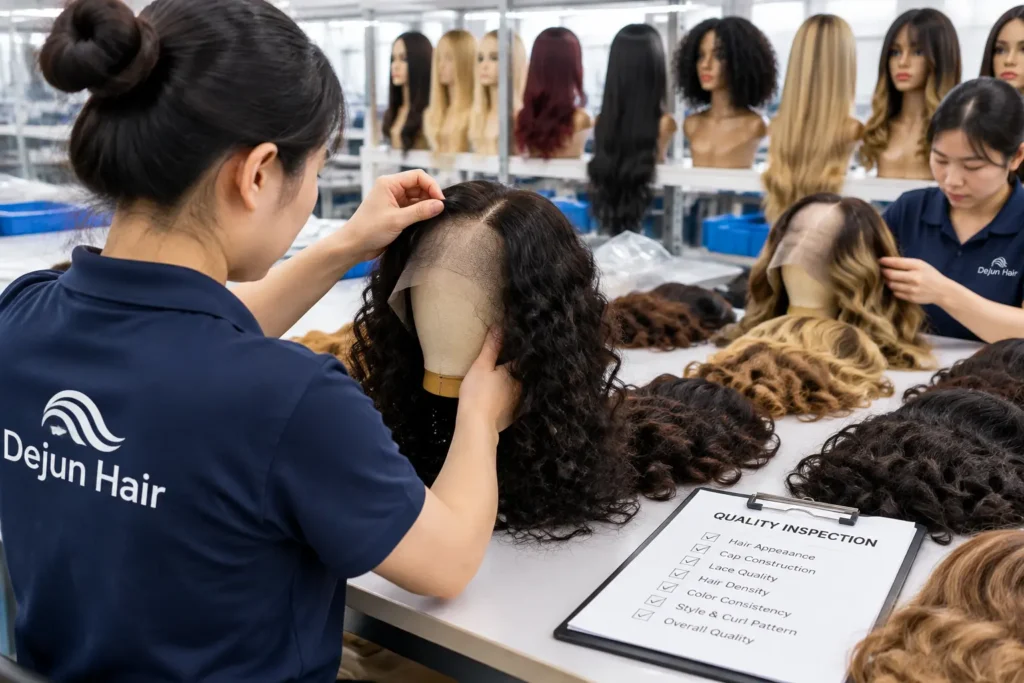
Important areas include hair authenticity, shedding, tangling, density consistency, lace construction, cap sizing, color stability, stitching, hairline workmanship, and overall finishing.
This is where working with a manufacturer that controls its production process becomes important.
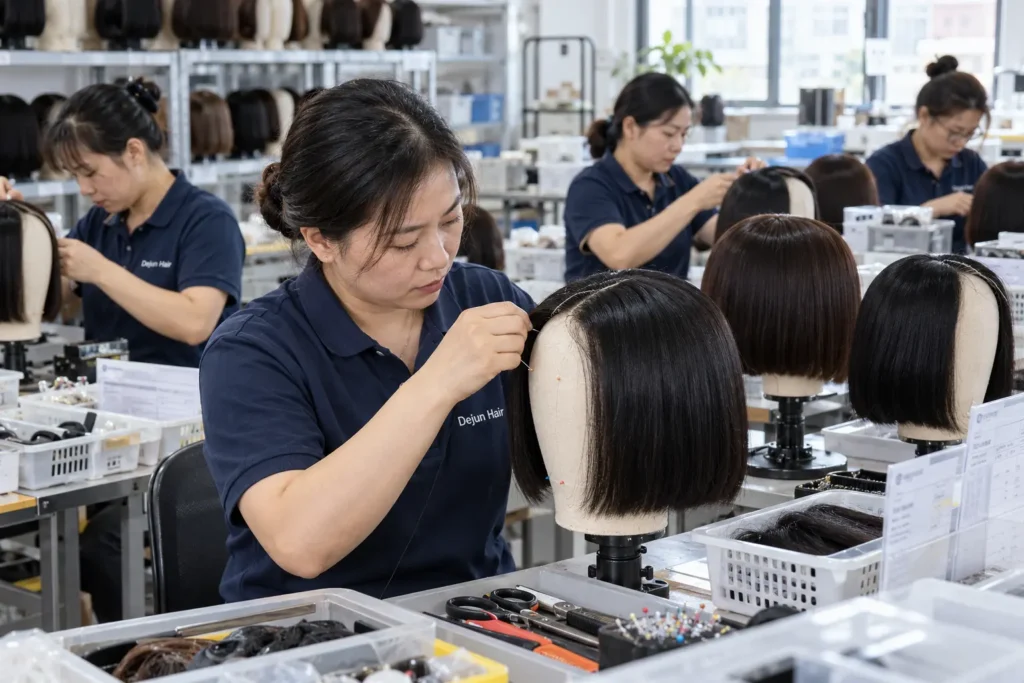
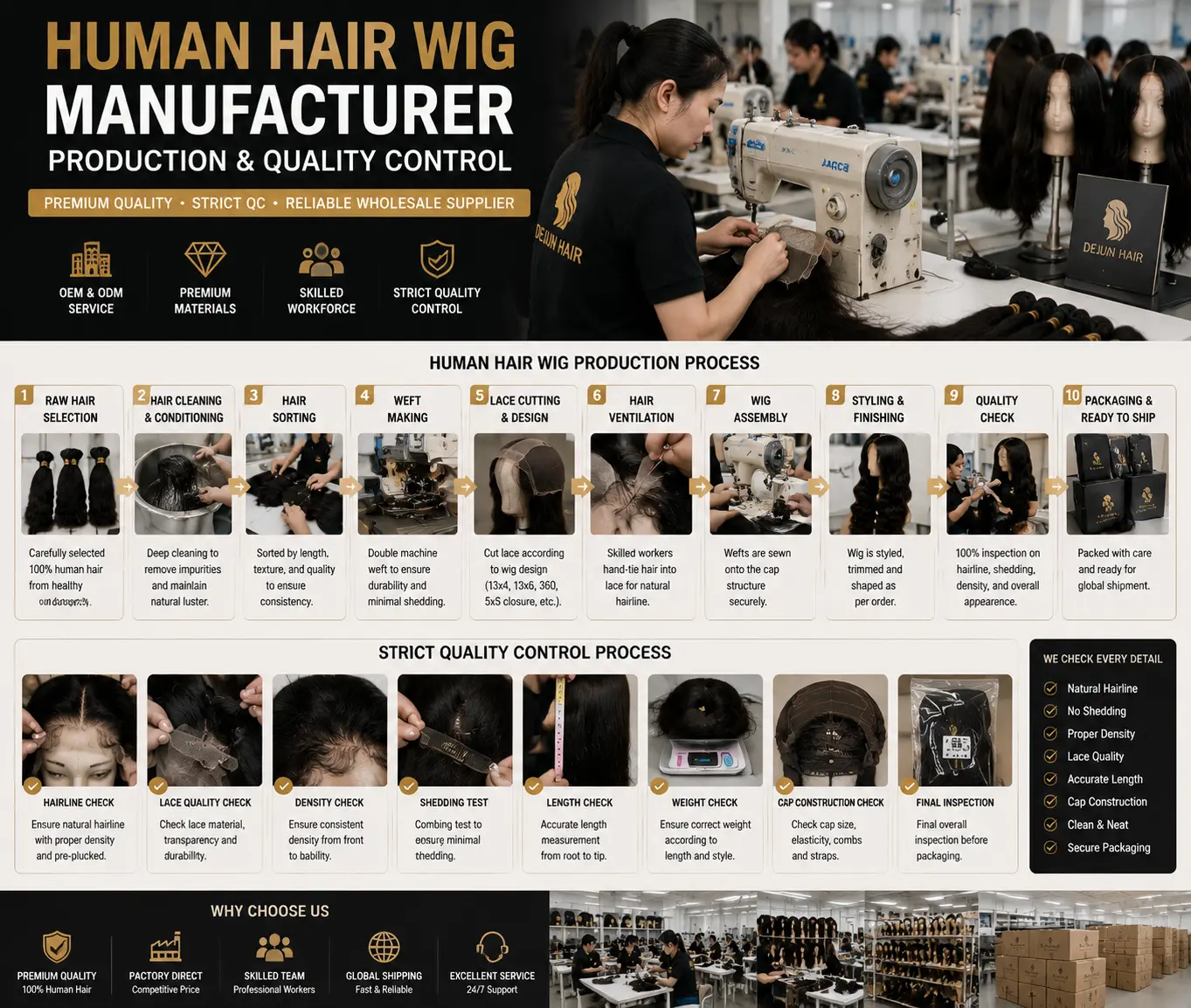
At Dejun Hair, for example, production covers multiple stages from hair processing and cap construction to lace sewing, styling, inspection, and warehousing. Finished products are checked for factors such as smoothness, construction stability, color performance, and sizing before shipment.
For B2B buyers, quality control should not be viewed only as a technical requirement.
Quality control is also profit control.
If improving consistency reduces returns and increases repeat purchases, the financial value can be much greater than a small reduction in the initial purchase price.
6. Increase Perceived Value with Private Label Wigs
Competing only on price can make it difficult to build sustainable margins.
If multiple sellers offer similar unbranded products with similar photos and descriptions, customers can easily compare prices and choose the cheapest option.
This is where private label wigs can become valuable.
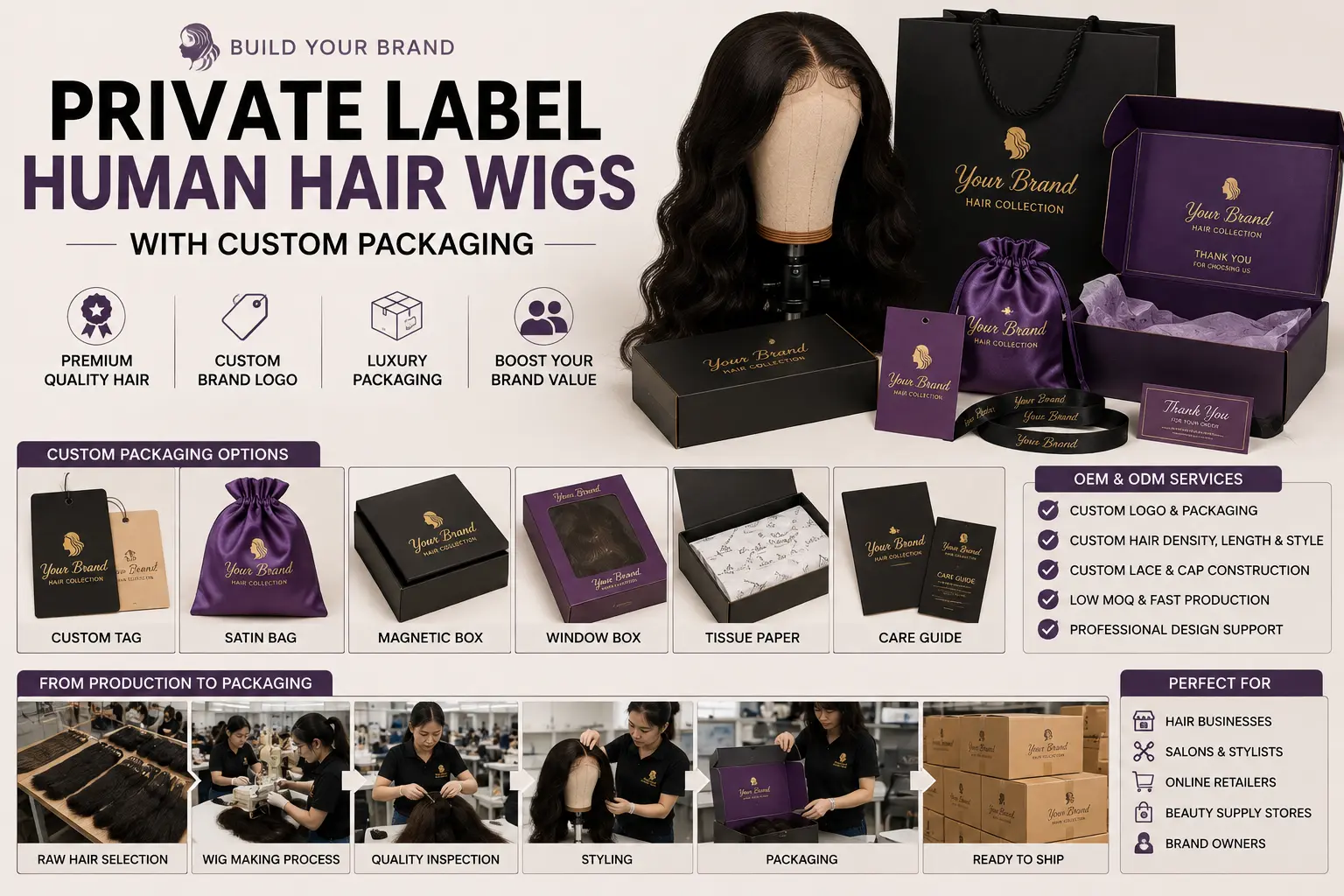
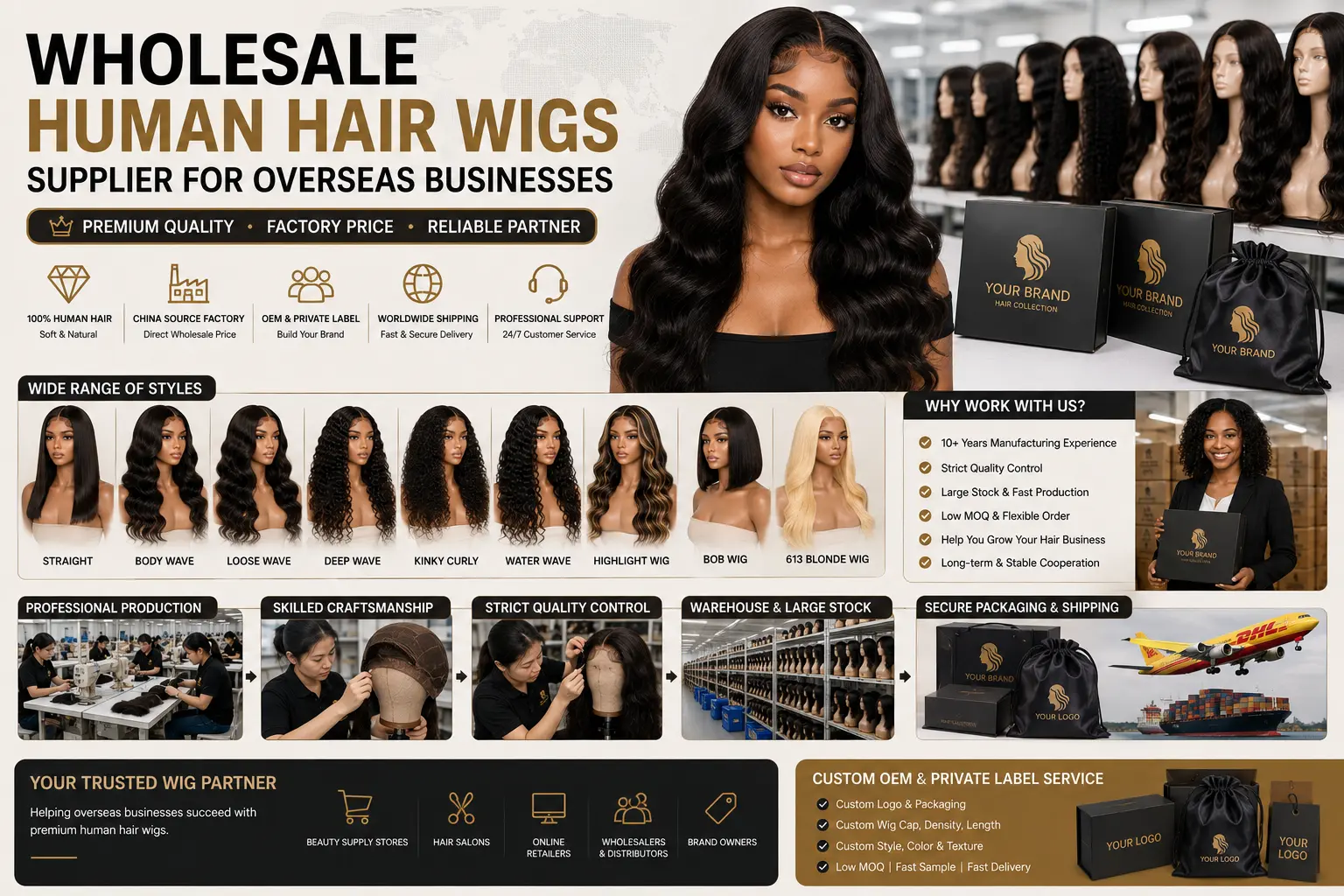
Depending on order requirements and manufacturer capabilities, private-label customization may include:
- Brand logos
- Packaging boxes or bags
- Hang tags
- Wig labels
- Custom cap sizes
- Different densities
- Specific lengths
- Lace specifications
- Custom colors
- Product care materials
Private labeling does not automatically justify a higher price. The underlying product still needs to deliver good value.
However, consistent products combined with professional presentation can help transform a generic wig into a recognizable retail offering.
Customers are buying more than hair. They are also buying convenience, confidence, presentation, service, and the overall brand experience.
For salons, packaging can also strengthen the customer experience after an appointment. For online resellers, recognizable packaging can improve social-media content, unboxing experiences, and customer recall.
As your business grows, OEM development can go further by adapting products to your specific market rather than simply adding a logo to existing stock.
7. Calculate Landed Cost, Not Just Factory Price
Another common mistake is evaluating a wholesale order only by the product quotation.
Suppose Supplier A offers a lower unit price, but the packaging is bulky, and the shipping method is inefficient. Supplier B charges slightly more for the product but helps optimize packing and shipment consolidation.
Supplier B could potentially produce a lower landed cost.
When you buy human hair wigs in bulk, consider:
Factory price + packaging + freight + customs-related expenses + local delivery = landed cost
Then divide the total cost by the number of saleable units.
This gives you a more realistic cost per wig.
Shipping strategy can also change as your business grows. Small test orders may prioritize speed, while larger planned orders may justify different logistics arrangements.
For African, European, and North American buyers, working with suppliers familiar with international shipments can also simplify documentation and reduce avoidable delays.
Good logistics planning does not make an exciting Instagram post, but it can make a meaningful difference to profit.
8. Build a Product Mix for Different Customer Budgets
A profitable wig salon business or retail store does not necessarily need every customer to buy the most expensive wig.
Instead, consider creating different product tiers.
Entry-Level Range
Products at accessible price points can attract new customers and price-sensitive shoppers.
Core Best-Seller Range
These should be the reliable products that generate regular sales and make up a large part of your repeat inventory.
Depending on the market, this could include popular straight wigs, glueless styles, lace front wigs, or bob wigs.
Premium Range
Higher-grade hair, premium lace, greater density, specialized colors, or customized construction can serve customers willing to spend more for specific features.
This structure gives customers a choice without forcing your business to compete exclusively at the lowest price.
It can also increase average order value. A customer who enters your store looking at an entry-level product may decide that the additional features of a mid-range or premium wig justify the higher price.
9. Use Pricing Strategies That Protect Margin
Retail pricing should not be based simply on copying competitors.
Your price needs to reflect your actual cost structure, market positioning, and customer value.
When setting prices, consider:
- Landed product cost
- Expected return or defect allowance
- Advertising costs
- Payment fees
- Packaging
- Salon services
- Competitor pricing
- Target margin
- Customer purchasing power
Discounting should also be used carefully.
Constant promotions can train customers to wait for the next discount instead of buying at normal prices.
Instead, salons and resellers can experiment with value-based offers such as:
- Wig + care kit packages
- Wig + installation services
- Multiple-unit offers
- Returning-customer incentives
- Limited seasonal collections
- Premium packaging bundles
The objective is to create more value without unnecessarily reducing the base price of your wigs.
10. Turn First-Time Buyers into Repeat Customers
Acquiring a new customer usually requires marketing effort. Once you have earned that customer’s trust, encouraging another purchase can be more efficient than repeatedly starting from zero.
This is why repeat customers are important to long-term profitability.
For salons, customer retention can be supported through personalized recommendations, maintenance guidance, styling services, and reminders about new arrivals.
For online sellers, strategies can include:
- Post-purchase care instructions
- Email or messaging follow-ups
- New-product announcements
- Loyalty incentives
- Restock notifications
- Personalized product recommendations
- Customer-only offers
After-sales support also matters.
Providing practical information about washing, conditioning, storage, heat styling, and general wig maintenance can help customers protect their purchase.
A customer who understands how to care for a human hair wig is less likely to confuse maintenance problems with manufacturing defects.
That reduces unnecessary disputes while strengthening your position as a professional seller rather than simply another online wig store.
11. Improve Wig Marketing Strategies Without Depending Only on Discounts
Marketing can either improve margins or destroy them.
If your only marketing message is “cheap wigs,” price becomes the main reason customers choose you—and another seller can always offer a lower price.
More sustainable wig marketing strategies focus on demonstrating value.
For example, salons and online sellers can create content showing:
- Before-and-after transformations
- Different ways to style one wig
- Lace and hairline details
- Glueless installation demonstrations
- Length comparisons
- Wig care tutorials
- Customer transformations
- New color collections
- Product comparisons
For social-media resellers, video can be particularly useful because customers can see movement, density, texture, color, and styling potential more clearly than in a static product image.
Educational content can also build trust.
Instead of only posting “Buy Now,” explain how customers should choose density, length, lace type, or texture.
When buyers understand why one wig costs more than another, it becomes easier to sell on value rather than price alone.
12. Use Sales Data to Improve Wig Inventory Management
As your business grows, purchasing decisions should become increasingly data-driven.
Track information such as:
- Sales by style
- Sales by length
- Sales by color
- Sales by price range
- Gross profit per SKU
- Inventory turnover
- Return rate
- Repeat purchase rate
- Slow-moving inventory
This can reveal useful patterns.
You may find that a premium wig has the highest margin percentage but sells only occasionally. Meanwhile, a mid-priced glueless wig may have a slightly lower margin but sell several times faster.
The second product may contribute more total profit over the year.
Sales data can also help when negotiating with your supplier. Instead of ordering randomly, you can provide a more accurate purchasing forecast and concentrate larger quantities on proven products.
This creates a healthier cycle:
Test → Sell → Measure → Reorder → Scale
That is generally safer than:
Guess → Buy Large Quantities → Discount Unsold Inventory
13. Build a Long-Term Relationship with Your Human Hair Wig Supplier
A reliable wholesale human hair wig supplier can become part of your growth strategy rather than simply a company that ships products.
As order volume increases, a strong supplier relationship may help with:
- More efficient production planning
- Repeat-order consistency
- New product development
- Custom specifications
- Packaging development
- Market-specific products
- Mixed-order planning
- Bulk order scheduling
Long-term cooperation can also make purchasing communication more efficient because the factory becomes familiar with your specifications and quality expectations.
For example, a salon may consistently need particular cap sizes and densities, while an African distributor may require a broader combination of styles and price levels. An online seller may prioritize glueless constructions, trending colors, and branded packaging.
These businesses should not necessarily use the same purchasing strategy.
An experienced manufacturer should understand that different markets require different product mixes.
With around 20 years of wig manufacturing experience in Shaoyang, Dejun Hair works across human hair and synthetic wig categories and supports stock wholesale as well as OEM/ODM customization. Our production process includes hair processing, cap construction, lace sewing, styling, quality inspection, and warehousing, allowing overseas buyers to source multiple product categories through one manufacturing partner.
For buyers, however, the most important principle remains the same: choose a supplier according to the long-term economics of your business, not only today’s quotation.
Frequently Asked Questions About the Wholesale Human Hair Wig Business
Is selling human hair wigs profitable?
It can be profitable when product selection, sourcing costs, inventory turnover, retail pricing, marketing expenses, and returns are managed carefully. A high markup alone does not guarantee a profitable business if inventory sells slowly or product problems create frequent refunds.
How do I start a wholesale human hair wigs business?
Start by defining your target customers and sales channel. Research the styles, lengths, textures, and price levels your customers prefer, then find a reliable manufacturer and test products before committing to large quantities. Begin with a controlled inventory, track sales performance, and increase purchasing quantities for proven best sellers.
What are the best wholesale wigs for a resale business?
There is no universal bestseller for every market. Glueless wigs, lace front wigs, bob wigs, straight wigs, and popular colored styles can all perform well. The best products are those that match your local customers while delivering a healthy balance of margin and inventory turnover.
How can salons increase profit with human hair wigs?
Salons can increase profit by combining product sales with services such as installation, customization, styling, and maintenance. Private-label products, care kits, repeat-customer programs, and carefully selected inventory can also increase customer value without relying entirely on price increases.
Should new wig resellers buy large quantities?
Usually, testing the market first is safer. A mixed order across several styles, lengths, or colors can reveal actual customer preferences. Once sales data identifies strong products, larger repeat orders can be concentrated on proven SKUs.
What should I look for in a wholesale human hair wig supplier?
Evaluate hair quality, manufacturing capability, quality control, MOQ flexibility, sample availability, customization, production lead times, stock availability, shipping experience, communication, and after-sales support. Consistency across repeat orders is especially important for long-term business growth.
Increase Profit by Improving the Entire Wig Business
Increasing profit from wholesale human hair wigs is not about finding one secret product or negotiating the lowest possible factory price.
The strongest businesses improve the entire chain:
Product Selection → Sourcing → Quality → Inventory → Pricing → Branding → Marketing → Customer Retention → Repeat Purchasing
For beginners, that may mean starting with a smaller mixed order and using real customer feedback to identify best sellers.
For established salons and resellers, it may mean improving inventory planning, developing private-label products, reducing returns, or negotiating a more efficient long-term supply arrangement.
And for growing wholesalers, it may mean moving away from opportunistic purchasing and building a stable relationship with a manufacturer capable of supporting larger volumes and customized product development.
If you are planning to expand your human hair wig inventory, consider testing several products before scaling. Dejun Hair supports overseas salons, distributors, retailers, and e-commerce sellers with factory-direct human hair wigs, flexible mixed orders, OEM/ODM customization, private-label packaging, and bulk production.
Contact Dejun Hair to discuss your target market, preferred wig styles, order quantity, and customization requirements, and build a wholesale product plan around your actual business needs.

Dejun Hair
Direct from Chinese Wig Factories | One-Stop Wholesale Supplier of Wigs for International Trade.